For many high school football recruits, there is one aspect of the recruiting process that flies under the radar. There is a certain pride in being able to represent a community that helped make you into the person you are today. Many don’t need many words to express that feeling. For example, Asa Burch, a highly touted class of 2028 edge rusher, spoke to The Observer this week about his recruiting process.
“I can’t wait to represent where I’m from,” Burch said.
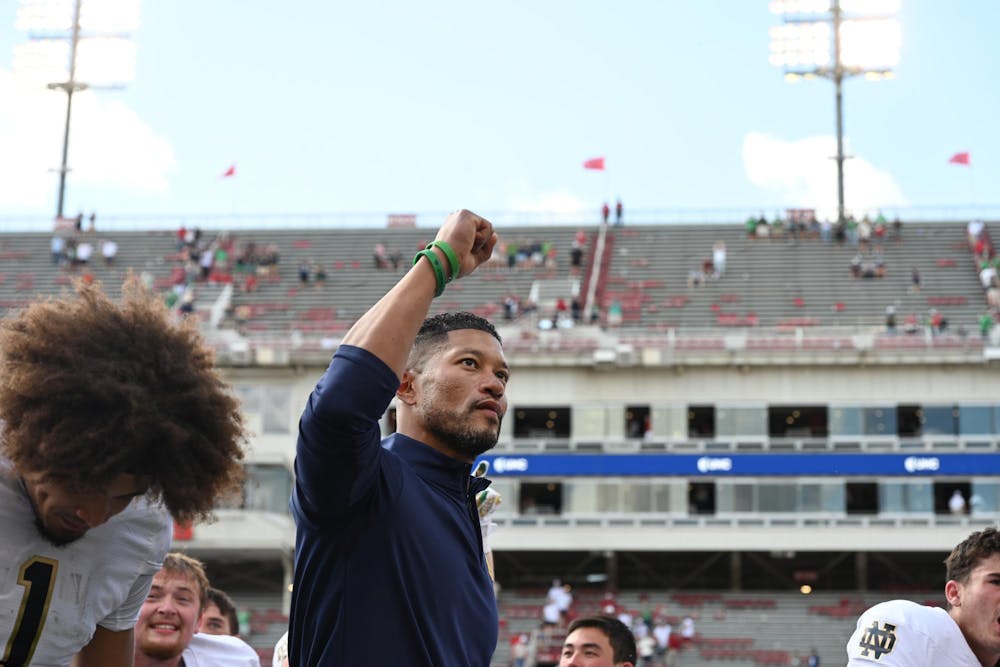
Burch, a product of Warren, Ohio, received an offer from Fighting Irish head coach Marcus Freeman and the Irish on April 12. In addition to Notre Dame, the 4-star holds offers from schools in each Power Four conference and many more beyond. In the Big Ten, he holds offers from Ohio State, Michigan, Oregon, Penn State and Michigan State. He also holds at least one offer each from the other three major FBS conferences: Missouri and Tennessee in the SEC, West Virginia in the Big 12 and Pittsburgh in the ACC. He’s as widely recruited as any other in his class.
In the world of college football, there is no facet of building a team as important as recruiting. However, it has taken a sharp turn in recent years with the introduction of NIL into the landscape of recruiting. But, much of that NIL money goes toward luring recruits out of the transfer portal. Another hallmark of modern college football, the transfer portal has given players the liberty to leave their former teams and join another in hopes of better prospects there. Reports over the past portal period suggested that quarterbacks could lure in between $1 million and $4 million in NIL, while freshman quarterbacks typically draw between $100,000 and $300,000.
The same, however, cannot necessarily be said of high school recruits like Burch, who will have to make a choice about their first school, one that could make or break their college football career.
This weekend, some of the most valuable high school recruits in the eyes of the Notre Dame coaching staff will likely be present at Notre Dame Stadium for the annual Blue-Gold Game. It may not be their only visit with the Irish, but it will be one of the most valuable in terms of the impact that it creates. The difference between these recruits and those out of the transfer portal, however, is what they may be looking for.
Every recruit, no matter what level, wants to be successful. Nowadays, they also likely want to pull a profit from both NIL and the newly introduced revenue-sharing measures. The primary difference for high school recruits is they have no experience at the collegiate level and, like Burch, may focus more on finding their new football home.
Burch made it a point to explain not everything in the college football recruiting process is purely about football. Instead, he emphasized the importance of finding a balance between education and athletics while keeping a good relationship with his coaches, all hallmarks of finding a new home rather than just a new football team.
“I’m looking for a school with good education and to be great at football,” he said. “I value the connection between the coaches and the players.”
Unfortunately for Burch, things weren’t always easy in the recruiting process. When asked about how he has navigated the recruiting process, he admitted, “It was pretty rough in the beginning, but now I have some good things going for me so I would say amazing.”
During his visit to Notre Dame, Burch had the chance to meet with several members of the coaching staff, including Freeman. He also had the opportunity to tour the football facilities, noting that he thoroughly enjoyed the entire experience.
Overall, Burch felt “great” after his tour and said he “can’t wait to go back.”
“I love how they do things with their athletes and their education,” Burch said, referring back to his previously mentioned preferences for finding his best recruitment match.
It seems NIL dominates the landscape of recruiting in 2026, however, other factors can play just as big of a role, particularly for those at the high school level. For Burch and countless others, there is one part of athletic success that cannot quite be quantified: pride. Whether an athlete comes from a football-rich area such as Northeast Ohio, like Burch does, or a less tradition-rich area, there is still immense pride to be taken in representing a community on some of the biggest stages in college athletics.
Pride may be an older aspect of recruiting; it is certainly harder to measure. But for high school athletes moving to the next stage of their careers, it may matter more than anything else.