Senior defender Mitch Ferguson let himself fall to the turf at Alumni Stadium. With the cold November night enveloping him, the four-year starter wondered whether this was the end. Eighth-year head coach Chad Riley’s Irish had just fallen 3-1 to North Carolina in the opening round of the ACC Tournament. As a result, which was representative of its 2025 season, Notre Dame couldn’t string together a consistent 90 minutes of soccer when it mattered most.
Firmly on the bubble with just seven wins over Division I competition and an RPI of 44 that sat just below the cutline, the Irish were at risk of being omitted from consecutive NCAA Tournaments. With an agonizing 11 days before the bracket was to be announced, the ever-placid Riley conscripted his team to continue training with the hopes that its name would be announced in the field.
“We felt good about it because we had some good wins and a strong schedule, but at the same time, it certainly wasn’t a lock,” Riley recalled.
Eventually, the day of the selection show arrived, and Notre Dame was given a lifeline to continue its season where it began, in Ann Arbor against rival Michigan. “You have these ebbs and flows, and the idea is that you want to position yourself for the tournament. And I think we did that,” Riley said.
Coming off 2024, a year in which the Irish started the season ranked No. 2 but ended without a tournament berth, the Irish entered 2025 with a retooled lineup and expectations. With college soccer rapidly evolving amid the influx of international talent and the advent of the name, image and likeness era, Riley’s program had to navigate unique difficulties while strategically filling some voids in the roster.
Notre Dame’s long-standing reluctance to admit undergraduate transfers and international athletes has left Riley’s program among a select few in the sport still conducting recruiting in the traditional, relational approach. Despite this, Riley found solace in how the 2025 national champion Washington built its roster.
“We’re trying to not put our heads in the sand, but at the same time Washington would be a good example of how we hope to adapt. A grad transfer here and there is gonna help strengthen our team and culture, and at the same time, the school is making a push to broaden our international appeal,” he said.
Reflecting this mindset, Riley added graduate defenders Martin Von Thun from Holy Cross College and Diego Ochoa from Boston College to solidify the center back position. Ochoa made an immediate impact in the Blue and Gold, finding the back of the net in that season-opening 1-1 draw at Michigan.
The Irish then made their Alumni Stadium debut with a disappointing scoreless stalemate against IU Indy. In what would become a staple for the 2025 squad, Notre Dame responded by picking off No. 15 Oregon State just four days later. “The team stood up to some challenges really well, bounced back from disappointment really well, and was really fun to be with through ups and downs,” Riley assessed.
Shutout wins over Pitt and Louisville punctuated a strong 5-1-2 start to the season and propelled the Irish into the national polls heading into October. Then, adversity struck again. Reflecting on the trials that month brought his team, Riley said, “October is always gonna be a slog, because of mostly league games, and classes will start to ramp up. So it was a little bit more up and down, but it’s something we want to always handle better.”
Despite defeats to SMU and Virginia, the Irish headed to DeKalb, Illinois, on Oct. 21 for a midweek showdown with lowly Northern Illinois, still in prime position for a postseason run. Despite an early goal and a man advantage for the second half, the Irish conceded on a late counterattack to fall 2-1. The setback tanked their metrics and made a trip to Chestnut Hill, Massachusetts, just three days later vital.
Looking back at how his team handled those critical three days, Riley credited his senior class for its resilience, saying, “A lot of the credit to keeping a steady ship is owed to the seniors.” He continued, “Sometimes you can play well and it won’t go your way, but you still got to get up and get back to work. It showed a level of maturity of the group that maybe didn’t exist before, but I think they grew up a lot during the year.”
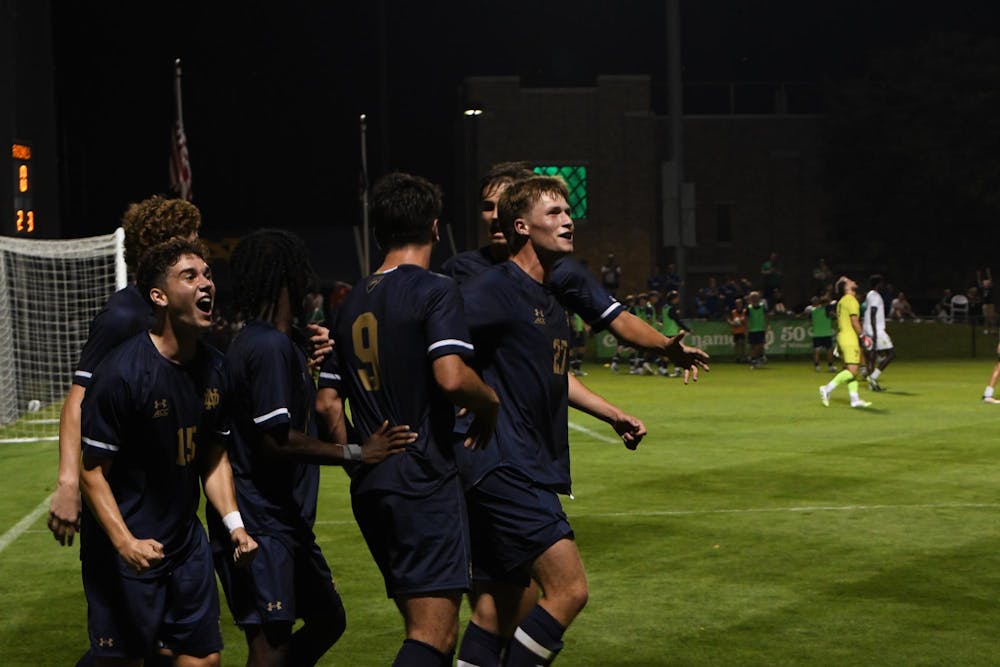
Led by Ferguson and fellow seniors Wyatt Borso and KK Baffour, Notre Dame secured a late goal to seal the 1-0 win. That result proved to be enough to lock up its spot in the postseason, where stellar defense and a fortunate bounce propelled the Irish over Michigan 1-0 in their first-round rematch. That stringent defense, anchored by superstar sophomore goalkeeper Blake Kelly, nearly kept No. 14 Akron at bay in round two before the Zips countered after the Irish hit the bar late to conclude their season.
Riley believes the end of the season was representative of the impact this senior class had, as well as why the Notre Dame model can continue to succeed in this modern era. “Generally speaking, we want it to be a place where you come from high school, and we put you in a challenging environment, you grow over time, and I think then you can win. The [senior class] won an ACC Championship and got to the national championship game. I think they’ve got a lot to be proud of. As a group, I really enjoyed working with them, and I think they were very steady leaders,” he said.
Heading into 2026 with yet another grueling schedule on tap, Riley hopes that both the setbacks and the successes of 2025 have prepared his team for new heights. “You have to sustain concentration from the first whistle, and not have those little dips. The main goal in the spring was how consistent we could be, and I think we’ve done a good job at that,” he commented.
In an age of uncertainty and instability, Riley, a Notre Dame man through and through, remains confident that his program can sustain its standing near the top of college soccer. “We want to grow with the times, but at the same time not lose the core values and principles that make this a transformation time in people’s lives,” he concluded.