Growing up in a proud Notre Dame family, my acceptance in March 2020 felt like a dream come true. Now, as my time here draws to a close, I find myself reflecting on that dream — and the reality of my experience at Notre Dame.
The reality is that I’ve experienced some of the most difficult moments of my life while at Notre Dame. Over these six years, I’ve navigated two years of health leave, two mid-semester hospitalizations, a spinal cord surgery, numerous emergency room visits and countless medical appointments. My experience has been more complicated than I could have ever envisioned.
Throughout these challenges, one of the most painful realizations was how Notre Dame failed to support me. During my first year, I nearly died due to episodes of anaphylaxis caused by a denied housing accommodation — an issue the University already knew about, as it had approved the same accommodation for subsequent years. During my second year, after a late-semester hospitalization, I struggled to finish coursework while facing resistance from unaccommodating professors. Throughout my time here, I’ve navigated countless access issues — on campus, in class and in the community. These obstacles have cost me thousands of dollars in preventable medical bills and weeks of lost academic and social time.
I don’t share these stories to suggest that Notre Dame is irredeemable. I wouldn't have spent my undergraduate years fighting to make this campus more accessible if I didn't believe it was worth the effort. I share this because I know that Notre Dame can do better. Becoming the beacon of belonging we claim to be is within our reach. Through my work with Access-ABLE and Accessibility Leadership Fellows, I’ve fought to dismantle the systemic barriers that leave disabled students isolated and excluded. However, the responsibility of this work cannot fall on students alone. Notre Dame must take institutional action to ensure that disabled students aren’t left behind.
Notre Dame has clear legal obligations under the Americans with Disabilities Act and Section 504 to ensure equal access for students with disabilities, including physical access to campus facilities. Beyond the law, we have a moral imperative. Our Catholic tradition calls for the full inclusion of disabled people in Church and everyday life, necessitating the removal of barriers that prevent their participation.
It hurts to see the University fall short of its Catholic mission.
The disconnect is most visible during our winters. The University advises students with mobility needs to utilize “Accessible Entrances.” Sara Bea provides band-aid accommodations like peer notetakers and false promises of “priority snow removal.” Yet, this “support” is woefully insufficient. At the start of this semester, I was forced to forgo my mobility scooter on numerous days because of impassable snowy sidewalks. One day, I slipped on ice and dislocated my hip at the “Accessible Entrance” of a classroom building — only to be forced to navigate 5 miles of treacherous, unplowed paths to attend class and meet my basic needs. When a spokesperson argues that clearing 71 miles of sidewalks is “challenging,” it rings hollow to those of us living the reality of it. That “challenge” cannot compare to the physical danger disabled students face every time we leave our dorms and the isolation we face when we can’t.
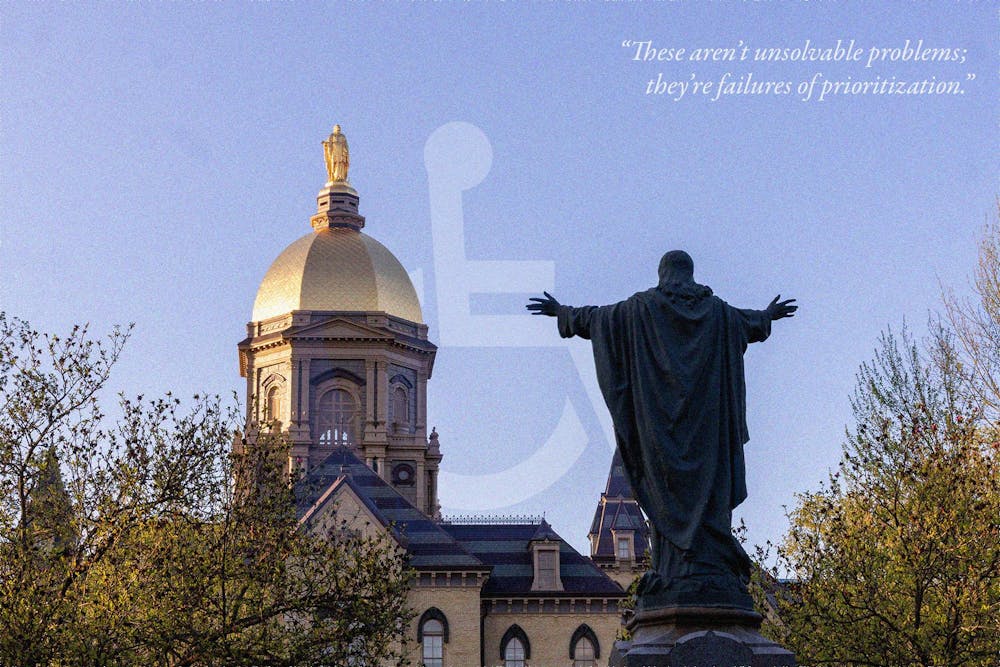
These aren’t unsolvable problems; they’re failures of prioritization. For years, disability student leaders have proposed feasible solutions that remain unimplemented. There are amazing students and staff working on these issues, if only the University would listen.
The University must implement a dedicated, on-demand campus paratransit service. This isn’t a revolutionary request; it’s standard practice at many peer institutions that value student safety and inclusion. By providing reliable, accessible transportation for students with mobility needs, Notre Dame can bridge the gap between its professed values and the lived reality of its disabled students. We are a University that prides itself on being a tight-knit community, yet we routinely fail to provide the basic infrastructure required for disabled community members to thrive.
I write this reflection because I’m a devoted Domer who believes Notre Dame is capable of better. I leave with a deep love for this community, but I also leave with a call to action: Notre Dame must match its rhetoric with tangible action. We deserve a campus that doesn’t just claim to be inclusive but proves it.
I’ve loved my time at Notre Dame — challenges and all. I hope to leave this place more accessible and inclusive than it was when I arrived. Our disabled students and our Notre Dame community deserve nothing less.
Meghan Ellis
Class of 2026
mellis7@nd.edu