Skip to Content, Navigation, or Footer.
Tuesday, Dec. 16, 2025
The Observer

Opinion


The Observer

The State Road 933 divide

·

State Road 933 is just a stretch of concrete, just two lanes of local traffic in each direction, just a road. But State Road 933 also acts as a physical divide between Notre Dame and Saint Mary's, and the divide is much wider than four lanes of asphalt. This week, The Observer has published a series titled "Her Loyal Daughters," a five-day stretch of stories to mark the 40th anniversary of coeducation at Notre Dame. We have written about a possible merger between Notre Dame and Saint Mary's in the early 1970s, when both were single-sex universities. We have written about the memories of the first women on this campus and their male classmates. We have written about the men and women who walk down Notre Dame Avenue and the Avenue at Saint Mary's today. Notre Dame and Saint Mary's have been neighbors since the mid-1840s. Holy Cross sisters founded the College in 1844, just two years after Holy Cross priests began Notre Dame in 1842. A co-exchange program developed between the two schools in the mid-20th century so students at each college could capitalize on the resources of the other. A merger made sense. But we've heard it again and again this week: "I'm glad the merger fell through." Graduates of both schools have expressed thanks for their unique degrees. University President Emeritus Fr. Theodore Hesburgh wanted Notre Dame to become a top Catholic research university, a distinctive voice in higher education. It made sense to search for the brightest minds in the country to achieve that goal, and that search needed to include women. So Notre Dame went coed and today is a top-25 university. When Notre Dame and Saint Mary's discussed a possible merger, there were more than 300 women's colleges around the nation. It has been 40 years since those talks failed, and there are now fewer than 100 women's colleges in the United States. Fewer than 40 of those schools have a Catholic identity. Saint Mary's has built itself on the goal of providing strong liberal arts and a Catholic education for women, and it is both one of the top 100 liberal arts colleges and one of the premier women's colleges in America.   Notre Dame and Saint Mary's have different missions, but both excel. Notre Dame and Saint Mary's have different strengths, but both graduate top-tier students. Notre Dame and Saint Mary's are on different sides of State Road 933, but are neighbors. So why does that narrow strip of concrete often feel like a gulf between us? We all know the stereotypes. Notre Dame women aren't as pretty as Saint Mary's women, but they're smarter under the Dome. Saint Mary's women are easy. We throw the word "slut" around without a second thought. Notre Dame men who strike out with their female peers on this campus can easily find a "SmickChick." We ride the "Sluttle." These stereotypes are disgraceful, inaccurate and uninformed. And we - men and women, Saint Mary's and Notre Dame - are responsible for allowing them to continue. We perpetrate them without considering their consequences. We laugh at jokes on the annual Zahm House ticket for student body president and vice president about a monorail between Notre Dame and Saint Mary's, so women could more easily find their way to men's dorms. Debate about Saint Mary's students' chances in the BCS National Championship Game ticket lottery became really nasty, really quickly. It starts with freshman orientation. Frosh-O welcomes new students to school traditions, but it also sets the tone for dorm and gender relationships on campus. Women's dorms serenade men's dorms, and men escort female students on "dates" to various brother-sister dorm events. But freshmen generally don't collaborate with other dorms of their same gender, and the first time Saint Mary's women enter the mix is on the sweaty dance floor at Domerfest, taken aback by the misperceptions they often face. Freshman orientation does not foster positive relationships between Notre Dame students and their own gender outside the immediate dorm community, and it definitely doesn't introduce Saint Mary's and Notre Dame students in a setting that encourages them to form friendships. There is awkwardness to this structure, a sense of competition among one gender for members of the other. It starts with freshman orientation, but it continues beyond that first weekend. How many Notre Dame students have walked up the Avenue? How many Notre Dame students avail themselves of the classes we can take at Saint Mary's? How many Saint Mary's students eat after club meetings or band practice in the dining hall at Notre Dame, where obtaining a co-exchange meal is unnecessarily difficult? How many students have thought about the jokes we pass to younger students, the flippant comments we make and their consequences? Administrators and students at both schools should remember this era of coeducation and return to its original principles - Notre Dame and Saint Mary's are two schools, on two different sides of the road, striving to accomplish two different missions. We are different, not better. Let us drive the administration to reform the freshman orientation experience and set a more positive tone for gender relations. Let us build a sense of sisterhood not just in our individual dorms, but also between all female students. Let us demand more convenient options to share meals together and to travel from Notre Dame to Saint Mary's. Let us foster collaboration between clubs, between those studying abroad in the same cities from different schools and between individuals studying similar subjects. Let us rid our language of terms like "slut." Let us embrace coeducation in the best sense of the word - a community of men and women, studying together, learning with and from each other. Let us make this road we travel down together into a two-way street.


The Observer

Study abroad deadline hits too early

·

One day I sat down in an info session for a minor I was interested in at the time. The Professor used the session not just to talk about the minor, but also to give some general advice for any ND student. The most memorable item was: "Get the hell away from Notre Dame. You've got to study abroad." Following that advice, I scrambled this past November to finish a 500-word essay on why I would be a good fit for Notre Dame's Washington Program and why the Washington Program would be a good fit for me.


The Observer

Our introduction to 'philosophy'

·

Last semester, I helped a friend with her Introduction to Philosophy course. Like many Introduction to Philosophy courses at Notre Dame, it functioned primarily as an introduction to intellectual history and as an introduction to certain mind games. Such courses have instilled a general sense that philosophy is largely a waste of time. This sense is confirmed by students whose only exposure to philosophy is: "How do you really know that you exist?" For many, philosophy progresses in a series of pointless questions. If a tree falls in a forest and no one is around to hear it, does it really make a sound?

The Observer

Notice men's basketball

·

If the Notre Dame men's basketball team defeats Cincinnati at Purcell Pavilion on Sunday, it will mark the fourth straight season in which the Irish have earned 10 wins in the Big East - a remarkable feat considering the conference has consistently stood atop college basketball during the past decade. It's a shame so many students have failed to notice. Irish coach Mike Brey's squad - which recently clinched its seventh consecutive 20-win season, the first time that feat has been accomplished in program history - has consistently competed among the conference's elite during his 13 seasons at the helm. But with Brey set to accomplish a personal milestone - four consecutive NCAA tournament berths for the first time in his coaching career - the student body has been mostly apathetic. Unless a marquee program like Kentucky, Syracuse or Louisville is in town, the student section of Purcell Pavilion is mostly a ghost town. Even the enticement of ESPN's "College GameDay" coming to campus could not attract a large student crowd, and the network's strategic camera angles could not hide the fact that the vast majority of seats were empty. The electric atmosphere of that evening's five-overtime thriller against Louisville carried little weight four days later when DePaul and Notre Dame played another overtime. For a program that is consistently among the best in what is typically the nation's best conference, the lack of support makes little sense. College basketball games are only two hours (with the exception of five-overtime tilts), which is the perfect amount of time for a midweek study break or a weekend activity. Even the price is affordable. When members of the Class of 2013 were freshmen, a student ticket booklet cost $100. This season, one could be purchased for $65. If you just attended the seven Big East games and the November matchup against Kentucky and chose not to attend the other non-conference games, it only cost a sliver more than $8 per game - affordable for even a college student. Sure, Notre Dame might not offer the best ticket policy and could offer some flexibility to students akin to other universities. Many students want to see Kentucky, Syracuse or Louisville, but they don't want to pay for games against Evansville and Monmouth in the process. It's not only the early non-conference attendance that suffers (that's somewhat to be expected because of the lack of many marquee matchups), but also the student attendance against quality programs like Villanova, Georgetown and Cincinnati - matchups that students should want to see. Selection Sunday is three weeks from Sunday, and the Irish are on the brink of clinching yet another bid into the field of 68 teams. Only two home games remain (Cincinnati and March 5 against St. John's), and Brey would no doubt welcome a gaggle of newcomers on the Notre Dame bandwagon as Jack Cooley and Scott Martin, who's currently sidelined with an injury, close out their Irish careers. There's no doubt Notre Dame's a football school, but the quality teams Brey continues to develop are worthy of more of a showing from the student body. See if you can snag a last-minute ticket or find a friend with season tickets who might have lost interest. Use it as a midterm study break or as some time you set aside to enjoy yourself for the week. But take the time to notice before the end of another entertaining season has passed.


The Observer

Saturday night's alright

·

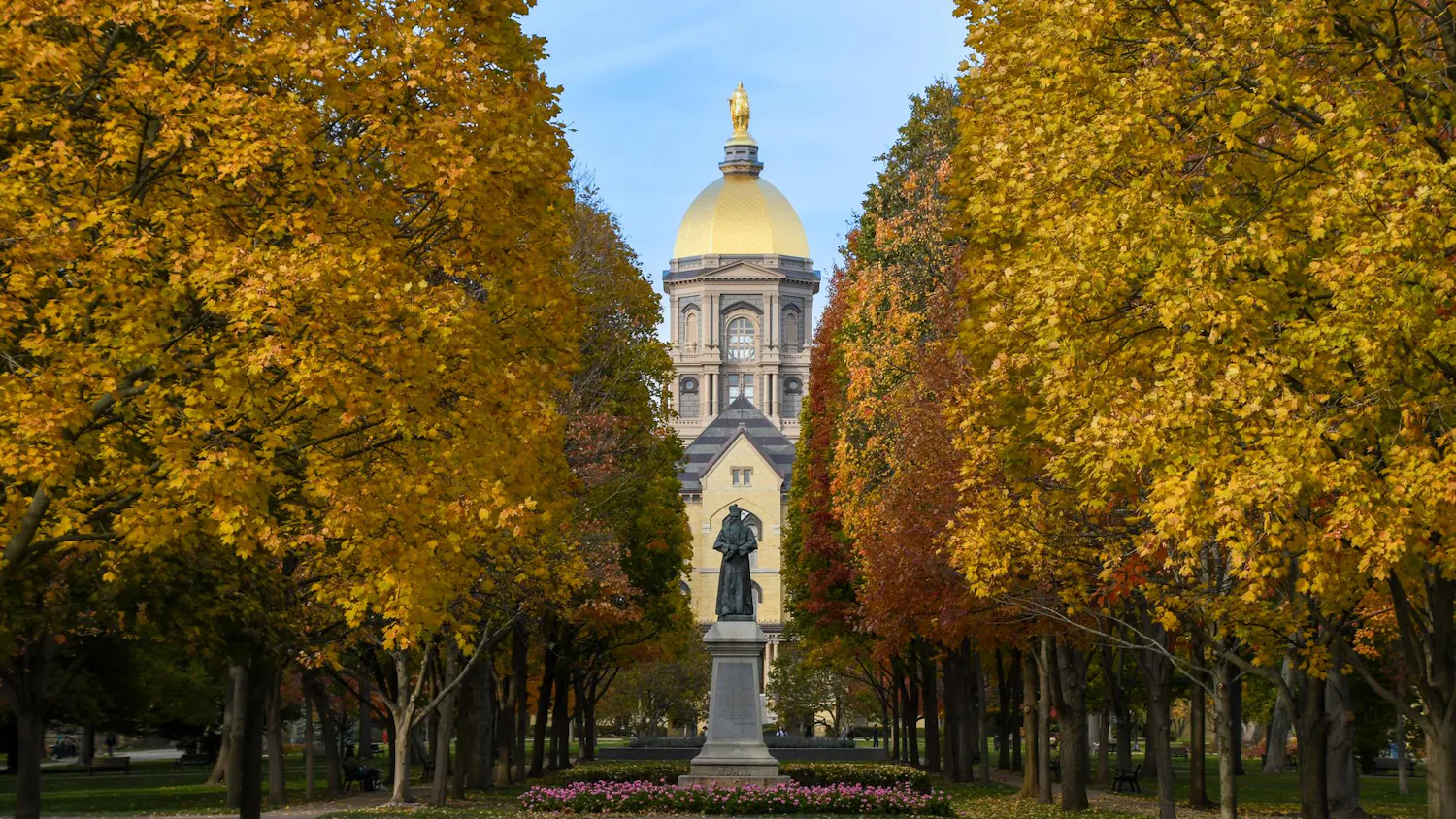
The date was Saturday, Feb. 16. Without a home game for men's basketball, the day in my mind was relegated to a mundane workday with little to look forward to - that is, of course, with the exception of burrito night at North Dining Hall. Besides complicating the debate about dining hall superiority, burrito night provides weary, winter-worn students with the motivation to work hard during the day. A fair amount of you know the punch line, as it were, to this story. It turned out, hopefully by some unthinkable oversight, but more likely because of Junior Parents Weekend, that there was no burrito night. The caveman in me wanted to rise up and rebel, but the French in me decided against that. Why exactly did I feel so upset about such an (admittedly) small thing? Barring a physical addiction to burritos, the feeling I experienced was entitlement.   In my mind, every Saturday night is virtually declared as, "Burrito Night in America" by Bob Costas himself. What I was perceived as mine was now taken from me.   Honestly, I would venture to say the majority of us at Notre Dame have little to no experience with entitlements. So as not to get too carried away, my sense of entitlement towards Saturday night burritos is small compared to conventional entitlements - be it public union benefits, unemployment compensation, food stamps etc. What I need to learn, even if it takes something small like a burrito, along with the rest of America, is the danger of entitlements.   Entitlements are, by definition, either something someone feels they have a right to, or something someone actually has a right to. Either definition suffices; however, the line between the two definitions is where entitlements become dangerous. "I have a right to do something" and "I feel I have a right to something" are different things. Once our feeling to have a right becomes an actual right, it is almost impossible to turn back. In a person's mind, there is now a permanent expectation and deserving feeling towards that object, i.e. payment, benefit etc. Simply put, once a person feels entitled to something, there is no turning back. I would now challenge most people to think of entitlement programs that have been reduced or cut by the federal or state government. There are some examples, but they are few and far between. As of just last year, it was estimated that 62 percent of the annual federal budget went to entitlement programs. Many of our country's fiscal and budgetary problems stem from this fact. A laundry list of problems results from paying entitlements with the majority of tax revenue. Daily operations of the government are sacrificed due to lack of funds. States in particular are faced with the challenge of balancing a budget while a critical amount of their revenue goes to funding entitlement programs.   Take Wisconsin, for example. About two years ago, newly elected Gov. Scott Walker was faced with a $3.6 billion budget deficit. In order to balance the budget, Walker proposed to make various cuts in different areas of the budget, but the main money-saving decision came in asking teachers to pay for a modest amount more of their health benefits. Walker simply asked public school teachers' unions to pay for 5.8 percent of their pension costs and 12.6 percent of their healthcare costs. Compared to the private sector, the teachers still had a top-tier health and retirement plan. However, because of nothing but a sheer sense of entitlement, the teachers made a preposterous amount of stink about these modest increases. The public teachers union was used to always receiving more and more from the state without thinking about where the money actually came from. When the Wisconsin legislature met to pass the legislation in Madison, protests broke out. Protests are not inherently bad things, but the protesters' presence in Madison had many implications. For one, some of the people were not even Wisconsinites - they had been bussed in from New York.  On top of that, teachers in the Madison and Milwaukee school districts took off time from teaching to join the protest in Madison. At one point, state senators received death threats while walking into the capitol building to do their job. Ask yourself, what was the cause of these months of mayhem and unrest in the Wisconsin state capitol? The cause was entitlement. The teachers felt it was their right to have these benefits. The power of entitlement caused people to be beside themselves. The power of entitlement resulted in the recall (however unsuccessful) of a governor who had done nothing remotely criminal. There are a lot of tough choices that need to be made in the near future. If a politician seems hesitant to make a tough change, it is because they are well versed in the power of entitlements. It is virtually political death to try to make major cuts to today's entitlements. The uproar in Wisconsin and political hesitation merely speak to the power of entitlement. With any luck, this Saturday night we'll all be treated to another burrito. If eaten in the perspective of this column, burrito night can provide not only food, but food for thought. Joel Kolb lives in St. Edward's Hall and is a sophomore studying mechanical engineering. He can be reached at jkolb1@nd.edu The views expressed in this column are those of the author and not necessarily those of The Observer.


The Observer

Two families

·

Like all high school seniors this time of year, my younger brother has a serious decision ahead of him. He's deciding where to go to college and he's split between accepting offers from Notre Dame and the University of Michigan. In my house, this is a legitimately difficult decision, even though the right choice is obvious to all of us here in South Bend. In the spirit of total honesty, I'll admit it - my family members are Michigan fans, cheering for the Michigan Wolverines even before the Irish. I like to think of myself as a success story in this regard, living proof that one can overcome such a dismal situation. I have been wheedling my sister and brothers to change their ways and join me, bombarding them with Notre Dame apparel for Christmas and talking ad nauseam about how generally awesome this place is. But when my brother opened that Welcome Home letter a few months ago, I began to look at our school in a whole new light. We hear a lot of talk about our "Notre Dame family" and the ways it fosters a sense of community and hospitality on campus, from Frosh-O weekend to the student section in the stadium. I had never thought, though, about what it would mean to share that adopted family with a biological family member. I love my family at home more than anything else. They provided me with love and support that formed me indelibly during my 18 years living with them, and I have been lucky enough to find a similarly positive "family" in my past two years at Notre Dame. And I really, really hope my brother comes here. I hope he reads this eventually, after accepting his offer and submitting the deposit, and a precious Hallmark-esque"awww" moment ensues. I haven't had the legacy student experience at Notre Dame, with grandparents who rubbed shoulders with KnuteRockne and parents who remember when Mod Quad was actually modern. I can't imagine how much fun it would be to have a brother here and, sappy as it sounds, I'm thinking about what it would be like to turn onto Notre Dame Avenue for the first time with him on move-in weekend and catch a glimpse of the dome (I'm blushing. But really). I love my home family, and I love my Notre Dame family, and for the first time, there exists the possibility that the two don't have to be separated. I belong to two families, one I chose and one I didn't. And here's hoping that the baby bro helps me bring the two together.


The Observer

Green Revolution

·

The role of the federal government's involvement with green technology has faced intense scrutiny in recent years due to the bankruptcy of Solyndra, a manufacturer of solar panels that received a federal loan for $500 million.


The Observer

Innocent until proven guilty?

·

Irony has a remarkable way of occurring regularly in everyday life. Most recently, an unfortunate Nike ad campaign starring the amputated Olympic hero, Oscar Pistorius, has showcased such irony with the tagline, "I am the bullet in the chamber."Pistorius is in the aftermath of a confusing tragedy, in which he shot his girlfriend. It is not yet clear whether the shooting was intentional or not. In the middle of this confusing tragedy, during what could possibly be an incredibly difficult grieving period, Pistorius, like so many stars before him, has been forced to suffer through consistent criticism.


The Observer

The gift of education

·

Stop. Look around you. Where are you? Maybe you're somewhere on the Notre Dame or Saint Mary's campuses. You might be sitting at your desk in the offices of a major financial firm in New York or Chicago. Or you could be using medical expertise to provide health care to people in need in another country. How did you get there? Not in the literal sense of modes of transportation, but in terms of the experiential journey you took to arrive at this particular physical location and moment in your life. Now ask yourself - could you have gotten to that place without an excellent education? Chances are the answer is a resounding "no." From the time most of us began preschool, higher education and career aspirations were probably a topic of occasional dinnertime discussion or at least casual thought. Whether you dreamed of being a doctor or lawyer, a teacher or CEO, those dreams were predicated on progressing through at least 18 years of education before attaining your respective goal. We understood such long-term goals couldn't be achieved overnight, and hard work and perseverance in school were necessary means to the end of realizing our personal ambitions. No matter where we grew up, we were lucky to have access to the kind of educational experiences that paved the path to where we find ourselves right now. But for too many young people in the United States today, those educational opportunities are declining in number and quality every day. Too many students graduate high school unable to read at an 8th grade level. Schools all over the country fail to meet expectations set by standardized testing. This is a serious problem in need of equally serious attention. For those schools unable to fully meet the needs of their students, the impact of such a lack of resources and opportunities is felt years and decades after children leave school and become adults. These limitations hinder students' ability to succeed in every field of the workforce, from engineering and medicine to business and journalism. Our nation, exceptional in many measurable areas, ranks only 17th in education among its developed peers, according to a 2012 global report by the education firm Pearson. We are losing educational ground quickly, and this trend bears negative implications for American innovation, technological advancement and global participation. President Barack Obama acknowledged the unsettling decline of American education in recent years and pledged to take action to improve educational shortcomings during his State of the Union address Tuesday. But he alone can't bring the entire nation to a higher standard of academic excellence. That's where we, as Notre Dame and Saint Mary's students, come in. Sound like a lofty goal? It is. But we're not telling everyone that we have to commit our lives to teaching or serving as school principals. We can have a tangible impact on children's futures even during our undergraduate years. Since the earliest years of education are arguably the most formative, we can take it upon ourselves to start tutoring at the Robinson Center or La Casa de Amistad. We can work as camp counselors during the summer. Notre Dame and Saint Mary's partner with local schools and organizations to run mentoring programs for young people in the South Bend community. Even the simple act of a friendly hug can mean more than you know. If teaching seems like a feasible career path for you, apply for Teach for America or the Alliance for Catholic Education to make a difference in both public and private underserved schools across the country. Even if we don't see teaching or school administration in our career paths, we have countless opportunities to contribute our own voices to the education debate. Whether we realize it or not, education will continue to affect us even after our own formal educational experiences end. And whether we pledge to volunteer in local schools, dedicate our lives to shaping education policy or even just serve on the local PTA, we can make a difference. It's not enough to sit on the sidelines while the education debate rages on before our eyes once we leave the education system. We have been educated at a world-class institution of higher learning, and we have the power to use the broad base of knowledge we've gained in college to change the future of American education. So how will you share the gift of education that has been given to you with the rest of the country?


The Observer

No labels

·

Last week, President Barack Obama signed a rather peculiar piece of legislation into law. This law is not odd in the sense that it provides pork barrel spending for projects that neither need nor deserve the money. Neither does this law establish an obscure holiday, such as National Grapefruit Month (which, by the way, is this month). Rather, this law, commonly known as "No Budget No Pay," is a rarity in Washington these days because it contains a genuine and innovative idea that ultimately aims to make Congress work better and more efficiently. At its most basic level, the law states that if Congress does not pass a budget, then representatives do not receive their salary until a budget is passed. The law, which won't take effect until 2014, is beautiful in its simplicity and fundamentally aims to force our elected officials to do their jobs. Let's face it; if I, as a student, were to stop doing my homework or assigned reading, I could not reasonably expect to receive the same grades as if I were doing all of my work. In the same way, this law requires representatives do perhaps the most important part of their job before they receive any payment. Now, of course this law does not change the political landscape completely. It is, however, a step toward progress, which is always the right direction. The law will not affect many representatives, who rely very little on their government paycheck (the median net worth for a member of Congress in 2011 was $913,000). Representatives will not lose any of their pay (which is $174,000 for rank and file members and $193,500 for leadership positions), either, but rather it will simply be withheld until they pass a budget. Furthermore, the law only applies to the April deadline for a budget resolution, and not the 12 appropriations bills that must follow to allocate the money. Despite these shortcomings of the bill, I nevertheless believe this law could be a watershed moment for Congress. It is an undeniable step in the right direction because it presents an innovative idea that solely aims to make Congress work. I truly feel this is a moment that needs to be seized, though, because of where the idea for No Budget No Pay began. The concept behind the law is the brainchild of a "non-partisan" group called No Labels, and it is only one point in a 12-point plan to "make Congress work." A statement on the group's website describes No Labels as "a growing citizens' movement of Democrats, Republicans and everything in between dedicated to promoting a new politics of problem solving." No Labels is not a lobbying group. Nor is it a special interest group. And it is certainly not a Super PAC. It is simply a group that wants for our country what all of us should demand from our leaders. No Labels is not confined to one party or ideology and neither does it care about political issues. Their only concern is stopping the political gridlock we have all become far too accustomed to and making the government focus on actual achievement and progress. The best part about No Labels, though, is that No Budget No Pay is only the tip of the iceberg. In Dec. of 2011, the group released its 12-point plan to "Make Congress Work!" and has not looked back since. Aside from No Budget No Pay, this plan includes other creative ideas designed to foster increased Congressional productivity such as banning all pledges (like pledging to never raise taxes) other than the oath of office and allowing a "sensible majority" to override a committee chair's refusal to put a bill before the whole House or Senate. Other proposals put forth by No Labels range from the simple (bipartisan seating) to the more controversial (requiring a straight up or down vote on all presidential appointments within 90 days) to the downright intriguing (a monthly question and answer session between Congress and the President, similar to the UK's Prime Minister's Questions). All of the proposals, no matter how feasible, put the issue of political efficiency and effectiveness in a more prominent position, which is something we desperately need. Somehow, we as Americans have grown complacent enough to accept Congress's inability to do actual work. We have come to accept the gridlock and division as business as usual. We have put ourselves in a dangerous place by accepting unacceptable work. The only way to reverse this culture of stalemate politics is to demand more of our leaders and more of ourselves. We need to shed our political labels in the pursuit of progress. In order to secure a better tomorrow, we need to work together today. Jack Rooney is a freshman studying political science.  He can be contacted at jrooney1@nd.edu The views expressed in this column are those of the author and not necessarily those of The Observer.


The Observer

Clueless in romance

·

Midnight's toll officially ended Valentine's Day - the most romantic day of the year - dividing us into two camps: those nursing a love-induced hangover versus those still starved for affection. For the famished on campus nibbling on half-priced chocolates today, coincidentally National Gum Drop Day, alarms begin blaring to step up your romantic game or face another failed flirtatious semester. This moment establishes your deadline for a short-term, semester-long game plan to catch someone for whom you currently have a crush. Otherwise, your chances precipitously dwindle each passing day beyond tomorrow, "Do a Grouch a Favor Day." Avoid procrastination when conceiving a plan to snag your crush. Until my last semester at Notre Dame, I mistakenly overthought my romance dance roadmap into a conundrum until each semester's waning weeks. I repeatedly failed to entangle potential love interests into noticing me. Seven long-gone, sub-par semesters passed before I hatched my plan early enough to succeed senior year. I began on the Ides of February (today), the semester's two-minute warning that pushes limits on yielding dates, romances or even an "MRS" degree. Romantic gameplans are like any in sports. They evolve with the times, but the premise remains constant - to score. A good generic model plays to your strengths, studies the opposition, exploits your opponent's weaknesses, employs accomplices and utilizes cutting-edge technologies. The perfect gameplan wins with enjoyably convincing scores like last month's BCS National Championship Game won by a team whose name shall not be mentioned here. After completing your opposition research homework, pick your home field. The hardwood becomes a great basketball player's romantic domain, especially if she beats him one-on-one playing a game of "R-E-S-P-E-C-T." Most every subtler environment can equally conquer your crush. A classroom is the most conducive milieu to draw your battlefield lines, followed by the dining halls, campus activities (where your interests already intersect) and with social opportunities rounding out the field. Regardless of your chosen turf, arrive ready to impress your potential companions with humor or knowledge while sprinkling a few mild-mannered academic, religious and sports challenges to pique their interests. Employ the military's two-pronged pincer strategy along your front line in the classroom. First, find a signature item other than your smartphone's annoying ring tones or your neon paisley patterned rain boots worn on drizzly days. Carry a conversational piece to class to tempt your targeted crush, but avoid acting like Cher Horowitz (Alicia Silverstone), the good-natured, but superficial girl in the movie "Clueless" who sent herself chocolates. Rather, utilize something that doubles to divert your eyes from your professor's searching glare. You could defensively control eye contact from either your crush or professor through sips from a boring Starbucks thermos. It would be better to fully utilize your offensive and defensive arsenals simultaneously with a star-powered prop like a premium organic Kombucha mug displaying icons of its live bacteria and yeast components - mushroom cultures, acids, scoby and mother ingredients - summoning images of a wonder drink that detoxifies and energizes bodies. That uniqueness can conjure conversations but possibly limit your pool of potential interests to the health-seeking crowd. So anticipate potential pitfalls in your tricky trek that tries to rely on a fad featuring a concoction of effervescent fermentation in a sweetened tea. Your remaining double envelopment tactic requires studying your crush's schedule without becoming a stalker to find optimal opportunities to interact. Entice your crush to interact on topics of mutual interest, most notably homework, that may eventually lead to hanging out together. Interaction before class assures less awkward moments when you can complain about your agonizing homework. After-class encounters, however, heavily rely on pacing yourself to your crush's tempo, which can wildly vary from chill to frenetic. Ideally, when your crush is less rushed or lingers to speak with the professor, you may slowly gather your Kombucha mug or loudly text or adjust your ducky boots while awaiting a conversational opportunity. Finally, masterminding a comprehensive game plan must also incorporate human allies and technologies. Find a sidekick - not fatalistic Thelma and Louise, perhaps Sonny and Cher (not Silverstone's "Clueless" character), or simply like Kelly Rowland and her BFFBeyoncé - any relationship complements your ability to triangulate against your targeted crush. Moreover, making friends in class further lessens your social awkwardness to ask a crush to hang out. Friends also advance your three-degrees of separation through the dormitories and on Facebook where obtaining a coveted Facebook friend request with your crush is like making a first down a foot from the goal line. Classmates become great allies in facilitating your social networking. On Facebook they stand as decoys to distract your crush depending on how desperate you are or how late it is in the semester. These new mutual friends create a common bond to help clarify homework assignments, initiate party invitations and with that, provide a way for your crush to more easily friend-request you directly. Master your game plan now, and by semester's end you will speak a new Romance language, "Adios solitarios." Gary J. Caruso, Notre Dame '73, serves in the Department of Homeland Security and was a legislative and public affairs director at the U.S. House of Representatives and in President Clinton's administration. His column appears every other Friday. Contact him at GaryJCaruso@alumni.nd.edu.du The views expressed in this column are those of the author and not necessarily those of The Observer.


The Observer

Immigration and American values

·

I strongly disagree with Mr. Ellis' points ("An Argument Against Amnesty," Feb. 5) regarding amnesty contradicting American principles. Immigration embodies American values: Respecting equality, hard work and innovation. Seeing immigrants as no more than "enemies, foreign and domestic" will only make America more exclusive, denigrating and stagnant


The Observer

Man's best friend

·

"A dog has no use for fancy cars, big homes or designer clothes. A waterlogged stick will do just fine. A dog doesn't care if you're rich or poor, clever or dull, smart or dumb. Give him your heart and he will give you his."


The Observer

A culture in need of relations

·

"The trouble with many of us, and with our culture as a whole is that we don't take time to 'relate,' to connect publicly and formally but meaningfully with others. We sit in meetings and conferences and dinner sessions with scores and hundreds of others . . . But we don't take the time to meet one to one with others, to hear their interests and dreams and fears, to understand why people do what they do or don't do what they don't do," community organizer Michael Gecan wrote.


The Observer

In defense of Catholics and Catholicism at Notre Dame

·

In its recent student government endorsement, Scholastic Magazine criticized one ticket for its proposal "to instate a prayer before home football games." Scholastic insisted that such a proposal "contradicts their platform of inclusion." No doubt, furthering the inclusivity of the campus environment at Notre Dame has been a very important focus in recent years. After publishing an offensive comic strip by The Mobile Party in January 2010, The Observer issued a statement condemning the "cruel and hateful" comic printed in its pages. The comic made an offensive joke about gay men being assaulted.


The Observer

Fostering discussion and debate

·

As we are students at one of the most prominent universities in the world, I believe it is our duty to engage ourselves in the realm of public policy. For years, we've heard our parents and grandparents say, "You kids are going to be the leaders of the future," and if that is true, should we not start talking about controversial issues now? One of my professors jokingly mentions "Notre Dame students are too nice," and I believe part of that is true because no one wants to say anything controversial in fear of backlash. But here is the sad truth: If we are scared to voice our opinions at a university - the literal institute for academic discovery and debate - where else is there for us to discuss such divisive issues? I decided to apply to write for The Observer because I wanted to discuss some of my libertarian-leaning ideas, hoping to probe some response from the student body. It feels like there is a grey cloud shadowing the younger generation all across America with apathy, and if we, the "young leaders," want to make the future better than today, it is crucial to start discussing things sooner rather than later. For these reasons, I would like to thank the readers of my last column on gun control who contacted me in agreement with my position - it's great to hear people care enough to show their support - but I would more importantly like to applaud those who contacted me in disagreement, particularly Ms. Conron, who ran an article, "If gun control is futile, what isn't?" on Feb. 6. I know I wouldn't be providing provocative or stimulating articles if I didn't rustle any jimmies in the process. Criticism forces you to discuss in further detail where you stand on particular issues and also develops your argument, just as practicing free throws will make you a better basketball player. But, it is this area of dissent I would like to discuss in further detail. I'd much rather discuss something like gun control with someone who completely disagrees with me on the topic than with someone who is indifferent to the issue. Debate is the way we as Americans can change culture and you can't debate someone who is ignorant to the world surrounding them. One of my favorite quotes reads, "An idea whose time has come cannot be stopped," and to be quite honest, I was expecting completely different oppositions to aspects of my last article. With my anti-gun-centralization position, I was expecting some people to send me emails asking questions, "Are you suggesting American citizens should be able to buy sniper rifles or AK-47s?" or "Do you believe there should be armed guards in public schools?" Those are relevant issues and are obviously not held uniformly in the pro-gun arena, but instead of those topics arising, the primary criticism I received was for apparently being anti-speed limit, anti-driver's license and anti-safety. In order to create a community that will foster debate, discussion and a free-flow of ideas, we need to do our best to hold back emotion and approach things analytically. In my last article, I was attempting to weave a political philosophy of anti-force and anti-coercion, stating government guns will be necessary to collect guns of private citizens; I then continued to offer statistics that suggest cities or countries with more "anti-gun" laws actually have more crime and violence. I was then incredulously surprised to see a response stating I must be against "basic regard for other people's safety," when in actuality, I was offering a platform that would help make our country better off (by being more safe). Ms. Conron argued in her article, "if expanding gun control is futile ... basically ever other government activity imaginable [will be too]," which is another argument in itself, but has absolutely nothing to do with the issue at hand. We are discussing how guns affect the safety of the public, not whether or not I disagree with being taxed for driving 67 in a 60 mile-per-hour zone. So to answer the question, "Does that mean our society should abandon all legal attempts to ensure public safety?" the obvious, simple answer is "No." If we want to further this discussion of what is the most efficient at stopping violence in America, it won't help to attack a misrepresentation of one side's argument (see "straw man"). In order to delve into debate and actually mitigate the country's problems, we need to be concise and stick to the issues at hand. So please, let's have a discussion. Let's talk about divisive policies that will stir up emotion, but let's also attempt to hold back our passions and keep the issues in clear sight. Without doing so, the one percent will just be known as "those who don't care about the poor" and the pro-choice proponents will just be labeled as "baby killers." As soon as one side just starts throwing around demeaning accusations and fails to provide any concrete, relevant point or counterargument, any hope of positive change will fade into oblivion and the "debate" will simply turn into name-calling. I would also like to clarify for those students confused by Ms. Conron's statement: "I must have missed the day in class where we learned about our right to defend ourselves ... not given by Congress, but by God." Don't worry, none of you were daydreaming in Foundations of Theology the day natural law was mentioned. That idea is explained in the Declaration of Independence - check the first sentence. Connor Roth is a sophomore economics major and constitutional studies minor. He can be reached at croth1@nd.edu The views expressed in this column are those of the author and not necessarily those of The Observer.


The Observer

More government transparency

·

In the days leading up to Wednesday's student government election, students became acquainted with the diverse platforms of each of the six tickets running for student body president and vice president. Each platform contained promises and pledges, and their ideas ranged from town hall forums to balloting students on their priorities, working more closely with the South Bend mayor to an intercollegiate social justice forum, making sure the proposed gay, lesbian, bisexual, transgendered and questioning (GLBTQ) student organization comes to fruition to more concerts in the JACC. And yet these different platforms all included a uniting thread - more transparency in student government. Juniors Alex Coccia and Nancy Joyce proposed regular "State of Student Government" reports. Juniors Dominic Romeo and Philip Hootsmans pledged to keep an accessible list for all students of their checkpoints in major projects and to update it throughout their administration. Sophomores Billy Christy and Pat Roemer would post monthly YouTube videos to update the student body on their work. Junior Michael Masi and sophomore Tim Scanlan would build the student government presence on Facebook and Twitter. Freshmen Austin O'Brien and Nick Boggess wanted to release Student Senate meeting minutes every week. Even freshmen Kevin Salat and Paul Mascarenhas, the traditional Zahm House ticket, pledged to use social media in their administration, even if they pledged to do so in order to help students avoid friends during their most stressful or insufferable moments (i.e. before an organic chemistry exam). We can be guaranteed that whatever ticket wins the election will take steps toward a more accessible, more transparent student government. The names of the victorious candidates or of the tickets to compete in a runoff election, however, have been withheld from students twice now in the wake of allegations of campaign misconduct. Information on what those allegations are, what tickets have been challenged and the possible response from the Judicial Council has also been withheld from students. We're waiting with more questions than answers, and the need for more transparency is especially apparent as we continue to wonder the names of the students who will lead student government next year. Honestly, The Observer staff has editorialized about this more than once, and that in itself should be telling. In 2009, the Editorial Board requested the Judicial Council publicize the reasons it found a class council ticket guilty of two charges of campaign misconduct, which meant they could not spend any additional money on their campaign during the runoff election. "This policy should change and student government should amend the Constitution to allow the Judicial Council to disclose election violations," the 2008-2009 Board members wrote. In 2011, the Board called for a more transparent election process when a campaign "ethics clause" violation delayed the results of the student body elections, just as this year's allegations have caused the Council to withhold results again. The ticket found guilty of an election violation was required to submit an apology email to the Council before election results could be published. The Observer editorial proposed a number of alternate solutions, including a repeat election or eliminating the offending ticket. "Regardless of the challenges and imperfections of these alternatives, each proposal would have made at least some impact on the results of Monday's election - something the Election Committee's final decision completely and utterly failed to do," the editorial stated. This year, we know even less about these vague allegations. When the Council delayed results Wednesday evening, vice president of elections Katie Hennessy explained she reviewed two allegations against two tickets and found them considerable enough to be brought before the Election Committee. The Committee dismissed the allegations, yet another accusation was made before the window for complaints closed at 11:59 p.m. Wednesday. Hennessy said the names of the tickets in question would not be released so as not to sway any votes in a potential runoff election. We understand the challenges faced by the Judicial Council are difficult ones, and we applaud the way the Council challenges student government leaders to meet the standards of their Constitution. We also appreciate how seriously the Council takes its responsibility to run fair elections. But without informing students about these allegations, the Judicial Council continues to close the doors to the second floor offices in LaFortune and student government as a whole. When students know what these allegations were, we can contribute to the debate about the best response to broken rules. We can be a part of a larger conversation about the Constitution of the Student Government. We can learn more about the candidates who campaign with their best selves and make informed decisions about who we want in office. The candidates vying for the role of student body president and vice president are all ready to make their administrations more transparent and more open. It's time the Judicial Council worked for that same goal.


The Observer

Fall and laugh

·

I fall a lot. Anyone who studied abroad with me could verify that it's one of my defining characteristics. First I wiped out in the cafeteria of my international school in Toledo, Spain. Luckily, I managed to keep all my food on the plate. Talk about the luck of the Irish (or Spanish?). Then I faceplanted outside a cathedral in Granada. A mildly amused man selling trinkets on the sidewalk asked if I was okay. When I returned to Notre Dame, I made it through approximately one week of the semester before tripping up the stairs in Ryan Hall. If there's anything my tendency to fall has taught me, it's that I should permanently be clothed in bubble wrap. But if there's a second thing it has taught me, it's not to take myself too seriously. When I took my tumble outside the cathedral, I was incredibly frustrated. I grumbled to my friend about why I couldn't just stay on my feet like a normal person. Then something surprising happened - she laughed. After an initial moment of shock, I laughed, too. Within moments, we were both laughing so hard we could barely breathe, latching onto each other's arms as we strolled away from the building. Instead of sympathizing and stoking my largely undeserved self-pity, my friend demonstrated to me that my fall wasn't actually such a big deal. Where was complaining about my bad luck and lack of coordination going to get me? It would just leave me on the ground - angry, disillusioned and going nowhere. Getting up and laughing though would enable me to keep moving forward, focusing on the road ahead and not the path (or ground) behind me. And if I didn't think about them too much, I would barely notice the battle scars. I'm going to fall sometimes. Maybe a tray-on-tray collision will leave me more acquainted with the floor of North Dining Hall than I'd like to be (very probable). Or maybe I'll bomb a test, struggle in a relationship or just get a little under the South Bend weather. I'm not going to say that when we fall, we just need a good friend to pick us up. I'm going to say that when we fall, we need a good friend to laugh at us, remind us the world isn't ending and make us get up, dust the dirt off our knees and keep walking. As a wise friend once said, there's no use crying over spilled dining hall trays.