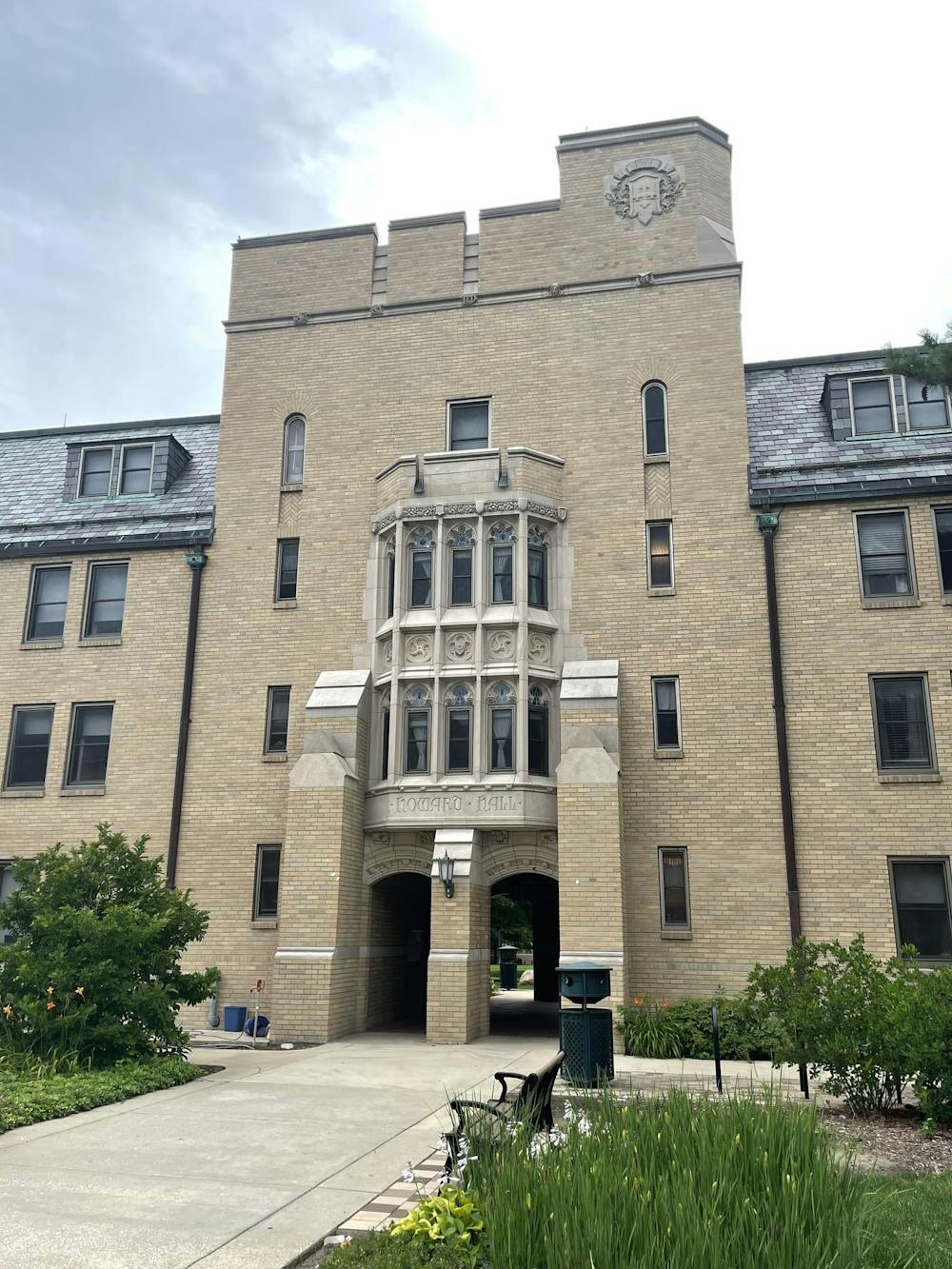
Howard Hall will be retired as a permanent residence hall after the 2025-2026 academic year, ending over 100 years of service as an undergraduate community at Notre Dame. Current residents will become part of the inaugural cohort at Therese Mary Grojean Hall.
The University has not officially determined how Howard Hall will be used in the future. In the past, residence halls that have not been demolished have been converted into temporary residences like Pangborn and Zahm Halls, or faculty offices such as Flanner and Grace Halls.
Residents were notified of the development in a meeting with hall rector Anna Kenny, director of Residential Life Nathan Elliot and associate vice president of Residential Life Karen Kennedy. The announcement comes just one day after Kennedy informed the Lyons Hall community of their move to Zahm Hall to accommodate a major renovation.
Howard Hall’s president, Athena Westland, said residents cheered and cried after the announcement was made.
The building was established in 1925 as a residence hall for freshmen. In 1987, it was added to the National Register of Historic Places as a contributing building to Notre Dame’s 116-acre historic district. One year later, the dorm was converted from a men’s to a women’s residence hall in accordance with a University plan to admit more undergraduate women.
After the meeting, Kennedy sent an email to hall residents to confirm the news. In it, she credited the Residential Master Plan for guiding the University’s decision. She also revealed that the number of residents a building can support plays a role in decisions regarding its future.
“Importantly, it aligns with our ongoing commitment to increase hall capacity to accommodate all current, new, and transfer undergraduate students while also improving equity across residence halls related to student experiences,” she wrote. “At times, this requires making very difficult decisions about the life span of a particular building, while prioritizing the residential communities that are at the heart of a Notre Dame undergraduate education.”
Kennedy specified that the manner in which the building was constructed ruled out the kind of restoration other residence halls had received through the Residential Master Plan.
Howard Hall is the oldest undergraduate residence hall to not receive renovations as part of the plan, which over the past decade has redone Alumni, Badin, Breen-Phillips, Dillon, Sorin and Walsh Halls, and demolished Fisher and Pangborn Halls. The plan was also evoked for Pangborn and Zahm’s transition to “swing dorms” that temporarily housed residents from halls that were undergoing renovations.
The approximately 150 Howard Hall residents will comprise only part of Grojean Hall, which supports a capacity of 275. The building will also be open for “floaters” — students who request to change their residence hall.
“This transition to an entirely new hall is necessary to both meet the housing needs of students and provide sufficient common spaces for community building,” Kennedy wrote.
According to Westland, the new community will support eight residential assistants, more than the four currently employed in Howard Hall.
Kennedy assured residents that the community’s mark on campus would be considered after the move.
“As we prepare for this transition, please rest assured that hall staff, in collaboration with the current Howard community, will decide how to best honor the hall’s legacy,” she wrote.