On Wednesday evening, Saint Mary’s College hosted poet and essayist Camille Dungy as part of their Visiting Writers Series. A distinguished professor at Colorado State University, Dungy read from her newest book “Soil: The Story of a Black Mother’s Garden” and spoke about her work on the book and overall on her experience as a writer.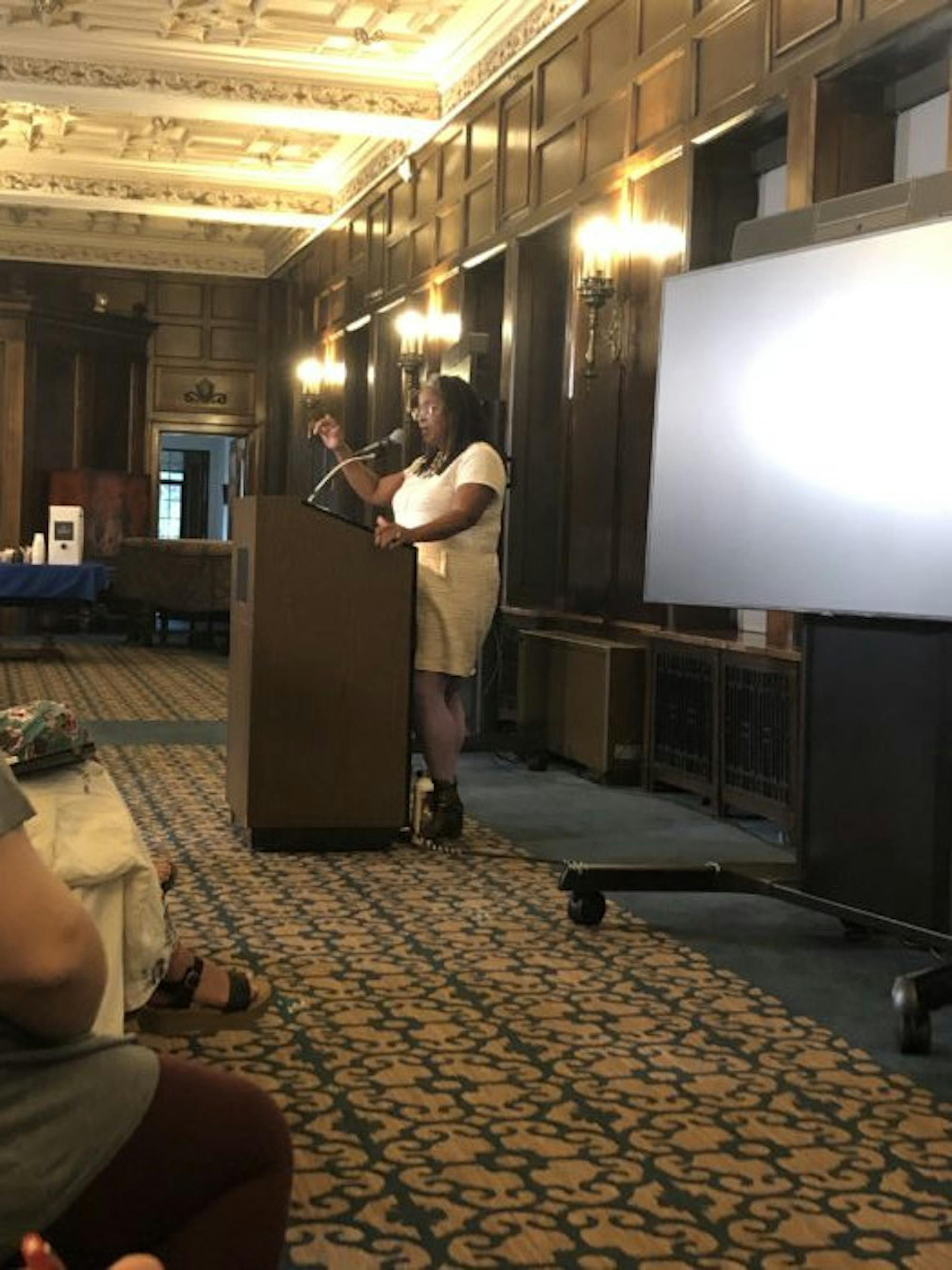
Director of the Visiting Writers Series and associate professor Rebecca Lehmann said, “I think that her book is really important, it speaks to the moment, touching on issues like environmentalism and the post-pandemic American landscape in ways that are really important.”
Dungy describes Soil as “a book length nonfiction narrative with some poetry and visual images, about seven years of my family’s efforts to diversify the landscape around us.”
In addition to embracing native flora and fauna to diversify the land, Dungy also notes “working in a predominantly white community.” She began to “think about sustainability and diversity and the ways that really paying attention to varieties and multiple ways of living and being in the world can make for a stronger, more sustainable community.”
Upon moving with her family from the Bay Area to Fort Collins, CO, Dungy said her new residence was only “1.2% black” and her yard was “super homogenous” and “cookie cutter.” Dungy said she knew she had to make a change.
Throughout her book, Dungy elaborates on the process of transforming her garden into a more diverse, vibrant land that embraces the ”chaotic” beauty of the natural world, explaining in detail the physical labor of this metamorphosis.
She said, “I worked and worked to try and create something different … but, it probably begs the question … Why bother?”
Dungy said the reason she endeavored in this transformation is “the choice”, explaining that her capacity to engage in a positive change for the environment motivated entirely by her own will excited her.
She said, “There’s something deeply liberating to me about digging in the soil and getting my hands dirty … because I get to”.
Describing the creation of ”Soil: The Story of a Black Mother’s Garden,” Dungy explains how the process was informed by her nine year old daughter, Callie.
Awarded the Guggenheim fellowship in 2019, Dungy was set to begin the creation of her book in 2020, but the pandemic intervened.
Dungy and her daughter spent most of their time at home “learning a lot about Colorado history, because was the unit in social studies, and learning really interesting things about prime numbers and square roots, because that was the unit in math,” she said.
In her book, Dungy concedes that the fear of not being able to balance motherhood and a career as a writer is legitimate.
“We can, in fact, not do it all. But the fear is also there, I think, because of the cannon, because so much literature does not include the stories of mothers who are also actively doing x, y and z,” she said.
She advocates for representation of all kinds in her book and advises those who wish to pursue motherhood and writing to “write into those gaps” and be the model of someone who can do both.
Dungy also said she found that what had originated as an idea for a poetry book had now changed its shape to read more like a memoir. She said that prose has more of an ability to hold information than poerty does. The book is chock full of information and Dungy’s use of prose allows her to inform the reader on complex issues relating to environmental justice, diversity, history and more.
Additioanlly, in giving advice to college students, Dungy reflected on her own experience, saying that despite growing up in a home that valued literature, she made her college decision partially because it allowed her to double major in English and the pre-med track.
Dungy said she held the belief that “you can’t just be a writer, you have to be something and then write on the side.”
At Stanford University, Dungy realized that sitting through classes such as molecular biology and organic chemistry made her miserable, and eventually made the decision to focus solely on an English Creative Writing major.
Dungy said her college experiences taught her to “find the thing that you care about so much that you’re spending hours in the library and … go down these rabbit holes and find excitement”.
In her closing, Dungy remarked on the value of Saint Mary’s College as an institution devoted to women.
She said, “I once taught at a women's college, and there’s a whole section in 'Soil' about how much I loved teaching at a women’s college and why.
“I thought that it was a really great community and a space for education, so I don’t know how often it is that you get shoutouts to women’s colleges in contemporary literature, but my book has some.”
SMC hosts author to discuss diversity and motherhood
Visiting writer Camille Dungy gave a reading Wednesday night in Stapleton Lounge from her latest book "Soil: The Story of a Black Mother's Garden."