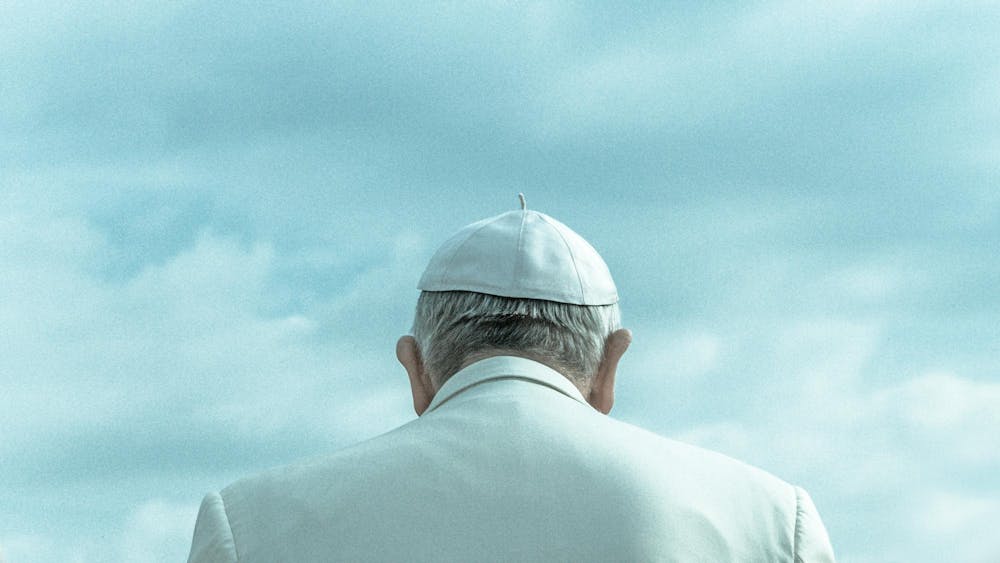
This past week, Pope Francis died, and with his passing, so too did our last line of defense against the growing politicization of Catholicism. When a family member spoke at town halls against Cleveland’s sanctuary status, I could always turn to Pope Francis’ letter to the Catholic bishops, reminding them that all of Jesus exists in everyone, including “the migrant and the refugee.” JD Vance’s increasingly cozy relationship with Catholic conservatism, where the gospel is rebranded as racist propaganda, has already begun to convince over one billion Catholics worldwide that violence and division define Jesus’ teachings, rather than his radical, sacrificial love. While I won’t explain why that manipulation is wrong, I will explain what realities I pray the new pope will contend with.
People today live in an atomized world where religion, the Church included, is just one more thing to juggle in a busy, productivity-driven life. Going to Church gives you the same satisfaction as crossing off “grocery store” on your to-do list. Of course, the Church has always struggled with getting people to act, not just believe, but now it feels especially palpable. Mass attendance among American Catholics has dropped 12 points in two decades, and less than a quarter of 18 to 26-year-olds attend weekly mass. They just don’t go. And, for those that do, there is a growing sense of disconnect. McKenna Kreton, a first-year student, describes homilies and liturgies as “repetitive” or “boring.” Even traditional Catholics like Sean Donahue, a junior who values the tradition in the liturgy, admit that “the Church doesn’t do enough to combat the perception that it is outdated.”
This perception persists because the Church has done little to meet people where they are. Just as Catholics once hoped the pope would reach out to former communist communities or newly emerging nations, today the pope must become a missionary to the people, frankly, on the internet, in their everyday lives. I’m not asking for a pope who is making TikToks or up to date on every passing trend. What I’m praying for is a pope and a Church bold enough to break free from the “habits which make us feel safe," as Pope Francis urged. Maybe make a TikTok, but more than that, see the internet for what it is: a new mission field, filled with people hungry for meaning. Reining in attempts to modernize evangelization is a hallmark of Catholic conservatism, but that prevents us from connecting with the communities who are in most desperate need.
Connecting with communities that are in desperate need of Christ’s love requires a critical look at who the Church has consistently left out. Sharon Hickey, a theology student, rightly pointed out that the Church has a “pattern of silencing women,” from the cloistered convents of the past to the current lack of women in parish leadership today. While Pope Francis has made strides — appointing the first female secretary-general of Vatican City — true inclusion remains elusive.
80% of Catholic women are dissatisfied with the ministry opportunities available to them, with 82% stating that women’s ministries aren’t equally valued as men’s. Of course, we don’t live in the world I pray for — where a woman could be a priest. But a pope who’s not just working with women but actively elevating them, relying on them for leadership, would be one step forward. We need someone who is ready to learn from women, not just tolerate their existence.
Beyond the Church’s own walls, gender-based violence continues to define worldwide realities. In 2023 alone, 51,000 women died due to gender-based violence, according to the United Nations. That’s the number we know. As Pennington points out, an estimated 126 million women are “missing” worldwide, so that number is likely much, much more. A Church that perpetuates this pattern of exclusion cannot be expected to fully comprehend or engage with this violence. More importantly, this violence is often stratified along sexual and racial lines. In the United States, for example, transgender women of color are substantially more likely to be murdered than their cisgender peers, while Indigenous women are disproportionately likely to go missing. I don’t expect the pope to show up at gay bars in the West Village or to spend more time on a reservation than in a Church (though that would give very much Jesus). But I do expect him to confront these issues head-on. The Cardinals, tucked away in their Churches and parishes, might not even know this reality.
But, I see it every day: when my friend tells me she’s been assaulted, or when my trans friend calls me in tears. Do any of the candidates for pope truly understand the gravity of this violence, the depth of this pain? I hope so — but if they remain committed to their own comfortable Catholic habits or traditions, blind to the suffering beyond them, they never will.
Perhaps even more pressing than these immediate concerns is the growing threat of fascism and xenophobia that has already chipped away at human dignity. JD Vance’s version of Catholic conservatism is not just about promoting antiquated religious dogma – it is a weapon in a broader war to align all faiths with nationalist movements seeking to strip away the rights of the ‘other,’ turning the Church into a tool for exclusion.
The rise of populist leaders and authoritarian regimes, driven by fear and division, is pushing societies to harden their borders and dehumanize migrants and refugees. Kilmar Abrego Garcia’s case exhibits this — criminalizing asylum-seekers has justified the erosion of not only constitutional guarantees but also the dignity inherent in life. The Church cannot afford to perpetuate this fascism by staying silent or being complicit; it must courageously stand against them. A pope who remains passive in the face of these growing threats will only further entrench the divisions and hate that already plague the world. We need a leader who will confront the growing tide of fascism and reject any attempt to politicize the Gospel for the benefit of those in power, no matter how many walls they build.
At this critical moment, the Church must once again be a force of radical love, one that stands in defiance of division, exclusion and hatred. It is not enough to hold onto tradition for the sake of comfort; we need a pope who will take bold steps, challenge the systems of oppression and reach out to those on the margins. The stakes have never been higher. The world needs a Church that is as radical as Christ’s love — a Church that fights for justice, dignity and the liberation of all people, no matter their background, identity or status. We need a pope that fights against facism.
Connor Marrott is a senior from Cleveland, Ohio His writing has appeared in the Cleveland Plain Dealer and the Cincinnati Enquirer. He serves on the board of SoildarityND and is always eager to discuss any and all ideas. You can contact Connor at cmarrott@nd.edu.