
This past week, I was invited to speak on a panel of alumni for the incoming class of Social Concerns Summer Fellowship students.
The summer fellowship, an eight-week immersive experience, prompts students to research a question of justice while partnering with one of 60 organizations around the world, with focuses spanning from climate justice to addressing healthcare access. Alongside the eight-week immersion, the Institute requires a one-credit course in the spring semester to help students prepare — both academically and spiritually — for their experiences. Although each placement is unique, the class is designed to give students the tools they need to cope with the many unknowns that emerge within the experience.
The professor, the incredible Samantha Deane, first taught the fellowship’s accompanying course last spring, and this year was her first chance to recruit former students to share some words of wisdom. Luckily, I was one of the students she reached out to.
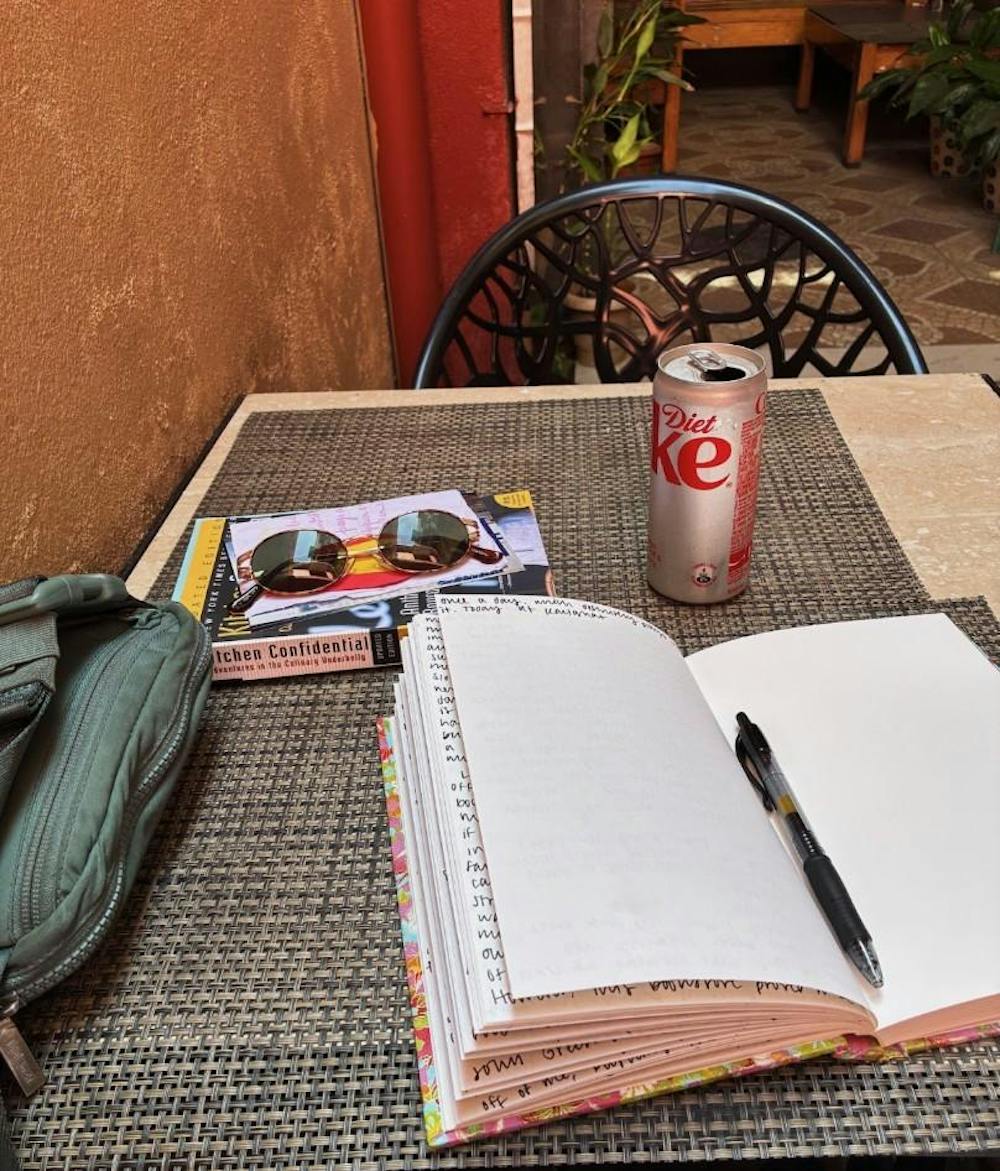
Deane shared a few questions she wanted us to reflect on before speaking to her class, such as how we formulated our research questions and what advice we wish we had been given before embarking on our immersion experiences. In preparation, I pulled out my first journal (one of three) from the summer and began rereading my entries from my first several weeks in Kolkata, India.
The first entry read, “Today was honestly a lot to process and I don’t think I’ll be able to get it accurately right now. I am genuinely so tired and all I want to do is fall asleep and wake up back in Saint Louis. 52 days until I leave and 54 days until I am home…” Not incredibly inspiring words to share with a class of over 100 students itching for their big adventure that summer. So, I kept reading.
Roughly a week later, I wrote, “The heat is very humid and heavy, my hair has never been curlier, and I have never been more physically or emotionally exhausted in my life. I don’t know how to balance the overstimulation of culture shock and the overstimulation of the work. I feel wholly lost.” Again, not the reassuring words of wisdom I was hoping to impart.
As I continued reading, however, the tone of the entries began to change. While the early entries were largely self-focused — chronicling my difficulty adjusting to a new culture and missing the comforts of home — they gradually evolved to reflect my learning process. Within a few pages, my writing began to include facts I didn’t want to forget and small moments of pride in personal achievements.
For example: “The bus fee is 12 rupees per ride, and I can either take the 21/1 bus or the 45 bus, but I need to make sure I don’t take the 47 bus, as that accidentally took me to a completely new part of Kalighat.” As I read this entry, I smiled, remembering being over twenty minutes late to work during my second week because I mistakenly got on the wrong bus. The bus hawker had been yelling “Kalighat,” and I naively assumed I would know where to go once I arrived in the right neighborhood. I ended up wandering along back streets, glued to a GPS app that didn’t fully work and eventually asking a poor soul sitting on his stoop to point me in the right direction.
Another entry read: “I listened to a ‘How to Speak Bengali’ podcast on the way to work this morning so that I could make small talk with the women, and it actually (kinda) worked! I tried it out on Ghita this morning. She seemed neither impressed nor disappointed, but rather played along with me — asking my name several times and then repeating ‘Ivy’ back to me and laughing when I returned the question. Clearly, I amused her.” Ghita, one of the women I grew closest with during my fellowship, was incredibly helpful during my first few weeks. She showed me where the folded laundry went, helped me figure out the dishwashing routine and even acted as an intermediary between me and the other women in the home, despite the fact that we didn’t understand a single word of each other’s language at the beginning.
I ended up rereading the entirety of that first journal, which chronicled May 27 through June 28. Even though the pages covered only half of my fellowship, it felt as if two different people had written the first and last entries. At the beginning, I was scared and overwhelmed — unsure of myself and feeling helpless in a new city, country and continent. But somewhere between May 27 and June 28, the framework of my writing shifted. I began focusing less on everything I didn’t know and more on what I was learning. Although I still had questions (and still do), the entries increasingly highlighted how my fellowship was changing me, rather than the other way around.
When I spoke to the students who will be in my shoes this upcoming summer, I made sure to emphasize three things:
- Start your visa application as soon as humanly possible.
- Keep a journal — for the love of God — Keep. A. Journal.
- Reframe how you approach this fellowship from “How can I serve this community?” to “How will this community shape me?”
The first piece of advice stems from the truly nightmarish journey it took me to secure an Indian visa — no fewer than six attempts.
The second comes from the ability to reread my journals months later and continue discovering new things about myself. An immersive fellowship like the one the Institute offers is meant to push students to do hard things. Although I felt homesick and overwhelmed at the beginning, the summer evolved into one of the most meaningful and memorable experiences of my life. Looking back at these entries now allows me to see my own transformation — one of growing competence and humility, but also deepened self-reflection and purpose.
Finally, the third piece of advice is one I believe every student in that classroom needs to hear. As Notre Dame students, we are accustomed to being academically successful. We identify with a prestigious university and are used to excelling on exams, writing strong papers and achieving measurable success in the classroom. However, as one of my fellow panelists, David Yawman, aptly put it, we sometimes view asking questions as a weakness.
But in order to fully embrace this fellowship, it is crucial to retrain that success-driven mindset. I told the students that my most important advice was to enter the fellowship understanding that the experience should change them more than the magnitude of their impact on the immersion community.
Although meaningful work and research are accomplished through these placements, the purpose of the fellowship is to foster a reciprocal relationship between students, their organizations and the communities they serve. Notre Dame students should not approach this opportunity with the delusion that eight weeks will fix or transform the world — that expectation is unrealistic.
But eight weeks should transform the student.
I see that transformation clearly in myself, reflected in the stark contrast between my first journal entry and my last. I developed grit, humility and — most importantly — the willingness to be informed by the community I worked with. Growth, and the pursuit of justice, does not occur in isolation, and this fellowship should reflect that mutual learning. While I don’t believe I did everything perfectly, I hope my advice resonates with the upcoming fellowship group and helps make their experiences just as impactful as mine was.
Ivy Clark is a senior pre-med studying neuroscience and behavior with a minor in global health and the Glynn Program. Despite living in the midwest her entire life, she has visited 11 countries and is excited to share her most recent endeavors working with the Missionaries of Charity in Kolkata, India. If Ivy could get dinner with any historical figure, it would be Paul Farmer or Samantha Power, whose memoir inspired her column name. You can reach her at iclark@nd.edu.


