
There is a phrase often invoked to describe Notre Dame’s institutional identity: ex corde ecclesiae, from the heart of the church. For decades, this identity has been the foundation of the University of Notre Dame, providing a moral compass that distinguishes us from top, secular institutions. However, as the university navigates the complex nature of the 21st century’s academic landscape, a persistent tension has emerged. How does Notre Dame balance their Catholic identity with a fundamental necessity for intellectual diversity? To me, Notre Dame must resist social pressure towards uniformity and instead embrace the intellectual friction only a diverse faculty can provide. While this may seem like a bold statement, it is a commitment Notre Dame has upheld for decades.
A Heritage of Diverse Opinions
In 1967, under the direction of University President Fr. Theodore Hesburgh, Notre Dame led a group of Catholic educators to a retreat in Wisconsin, resulting in the Land O’Lakes Statement. This statement established that Catholic universities must have “true autonomy and academic freedom in the face of authority of whatever kind, lay or clerical.” The Land O’Lakes Statement is often regarded as a declaration of independence from the ecclesial hierarchy. In order to compete with secular universities in the modern era, Catholic institutions realized they must separate from the Church hierarchy to maintain an “effectively operative” Catholic identity.
Do not mistake this move as Fr. Hesburgh advocating for the secularization of Notre Dame. He sought to empower Notre Dame by realizing that in order for Catholic thought to be taken seriously, it had to be tested and shared with a diverse, open market of ideas. If Notre Dame seeks to curate its leadership and faculty to ensure they mirror every belief upheld by the Church, it is not protecting their faith; it is insulating it. A faith that cannot withstand scrutiny is a faith that lacks confidence in its own truth.
The Alienation of the Minority
About 50% of Notre Dame’s faculty identify as Catholic. This is indicative of Notre Dame’s mission statement to ensure “the continuing presence of a predominant number of Catholic intellectuals.” Some see this statistic as a “crisis of identity” as it is a noticeable drop from past statistics of Notre Dame professors’ religious background. However, it still upholds Notre Dame’s promise of maintaining a predominant number of Catholic intellectuals.
When we look at our peers in the US News & World Report, we see universities that recognize that breakthrough innovation rarely comes from echo chambers. Continual calls to make Notre Dame “more Catholic” or “more traditional” decrease her intellectual vitality. If Notre Dame is intent on instituting a litmus test of orthodoxy on all her students and faculty, she is risking alienating people who will bring fresh perspectives to our campus. The response to opposing views should never be to silence them, them but to understand them and the people who hold them.
I am not Catholic. Raised Greek-Orthodox, Greek Orthodox, my family believed spirituality came from personal experience, not long church services. While I’m not a traditional Orthodox Christian, I came to Notre Dame worried I’d have to conform or wouldn’t fit in. Nearly a year later, I see how misplaced these fears were. I’ve become more religious and learned more about my faith here than I expected. Notre Dame has exceeded my expectations; I can’t imagine being anywhere else.
That being said, I recognize I am a Christian; therefore, my acclimation to Notre Dame may have been easier compared to with my non-Christian peers. Students of a vast diversity of religious backgrounds come to Notre Dame because they believe in her commitment to the pursuit of truth. That being said, when the University appears to prioritize ideological alignment over academic merit in its hiring processes, it sends a chilling message to non-Catholic students: You are guests. Know your limits within this institution.
Ideological homogeneity is dangerous. When we create echo chambers, we stop questioning our assumptions. We stop seeking to diversify our views. I know that since being here, I have questioned my thoughts about religion, political systems and so much more. This is because I have been exposed to views different than my own, from both students and professors. Ultimately, it is “the outsider” who forces us to question our convictions. To deny these voices a place in our leadership is to rob Notre Dame’s students of intense, meaningful questioning. I know I don’t want to be taught by professors who refuse to share their opinions because they fear for the security of their jobs.
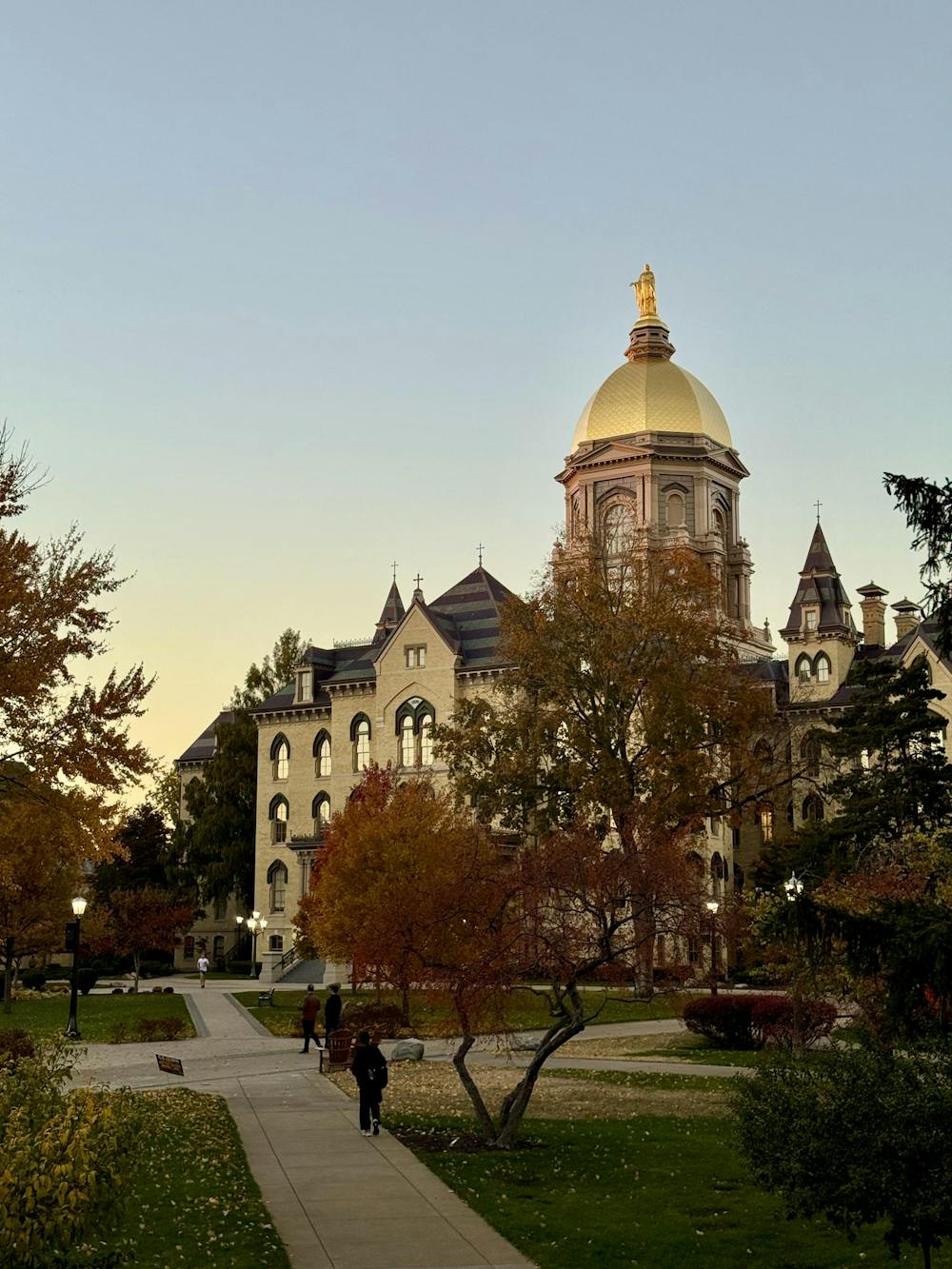
Notre Dame should not fear “the other.” Our Catholic university is robust enough to flourish alongside differing views. The Virgin Mary atop the Golden Dome will never become just a statue of a woman. Notre Dame’s Catholic mission is here to stay because it is an integral part of what makes Notre Dame Notre Dame. That being said, we should not fear inclusion because intellectual diversity is integral to cultivating a place where we can seek the truth. We are at our best when we are in a place where “the various lines of Catholic thought may intersect with all forms of knowledge.”
Thea Bendaly is a freshman from Carmel, Ind. living in McGlinn Hall. She studies political science and romance languages and is a member of the Glynn Family Honors Program. In her free time, you will find Thea crocheting in her dorm, singing with Halftime A Cappella or hanging around with friends. Please feel free to contact Thea at tbendaly@nd.edu as she looks forward to hearing your thoughts (good or bad) about the column.


