
In 1909, my great-great-granduncle Eugene was stabbed to death in a tavern over a girl. Some decades earlier, his ancestors sailed across the Atlantic from Alsace-Lorraine. Maybe when they first arrived on the shores of the New World — just two, young, French-German immigrants — they brushed shoulders with my best friend Katie’s ancestors, who were carting over from England. Maybe their descendants stood in the same line at the butcher’s as Katie’s paternal grandparents, who hailed from Cuba. Maybe, on the trolley, David and Marilyn Eppler sat a few rows down from my own maternal grandparents, fresh-off-the-boat from the Philippines.
At some point or another, our immigrant ancestors had to have crossed paths. Because the world is not as big as we think it is and because humanity can all be traced back, in some form or another, to the same cave in East Africa. The first Homo sapiens — evolving with their large brains and light skeletons — are every modern human’s great-great-(about 10,000 more greats)-grandparents. That makes us all family.
So where did we all go wrong? When did we start drawing borders, harboring prejudices and shouting at people to “go back to where they came from”? When did we start building walls and deporting children and forgetting that we’re all kin?
Some years ago, Caveman A probably tried to steal Caveman B’s prized rock. Or maybe Caveman C clubbed someone with his friend’s severed femur. Whatever the case, as soon as we started getting greedy, as soon as we started stabbing and punching and throwing accusations around, we started to take sides. We started to draw borders. We started noticing the differences between “us” and “them.”
Over these past four years, I have had the pleasure of volunteering with South Bend’s immigrant and Hispanic communities at La Casa de Amistad. If I’ve learned anything as a volunteer, it is that the differences we project onto “others” are purely exterior. Strip every last person down, and we’ll find the same skeleton and 99.9% of the same DNA. At La Casa, I laughed at silly jokes with people whose cultures I did not share and whose languages I did not understand. Because if I try hard enough, I can remember that cave in East Africa, when I snoozed around the same fire with my cavemen brethren. If I squeeze my eyes tight enough, I recall that we’re all a part of the same tribe.
I am saddened by the normalization of xenophobia in today’s society. Phrases like “go back to where you came from” are tossed around callously and casually. We forget not only that we are all immigrants, but also that our communities are built upon the backs of these migrants.
Despite calling South Bend our home for four years, most of us are ignorant of its storied past, and the key role that Hispanic Americans played in it. La Casa de Amistad is dedicated not just towards uplifting modern communities, but painting the stories of their past.
Literally.
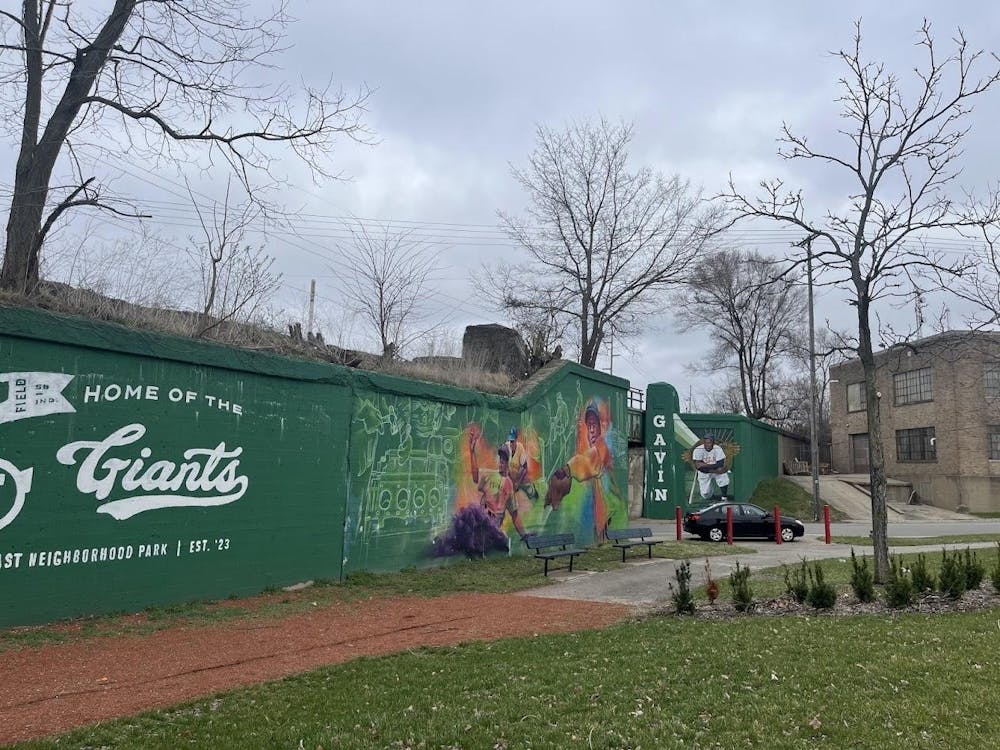
Next week, La Casa will unveil a new addition to the mural at Foundry Field. The art portrays the narrative of South Bend’s migrant populations. Just as our cavemen ancestors sketched stories across their walls, hundreds of thousands of years later, we still have the same desire to create art, to tell tales and to share them visually with one another.
South Bend’s own cave walls will be painted with the legend of the hardworking, underprivileged workers who made our city what it is today. Although we’ve escaped the shadowy depths of our prehistoric caverns, we still have many more walls to paint before we can learn to accept one another.
Foundry Field’s mural depicts marginalized 1920s laborers, many of whom were employed by the Studebaker Corporation. These men celebrated their heritage through community baseball games every Sunday. After toiling away all week — helping to produce the steel that would lay the groundwork for South Bend’s economy — the laborers made merry with America’s favorite pastime. Baseball brought them all together as new Americans.
The mural illustrates just one example of how immigrant communities shape and strengthen American cities. Cultural mixing makes our societies stronger. We waste too much time debating over made-up lines drawn in the sand rather than considering that we are all members of a collective home, all citizens of this one earth.
On the one hand, it is undeniably unrealistic to imagine a world with no borderlines. Eventually, boundaries must be drawn, governance must be centralized and taxes must be levied. But what really is the difference between a human born in Buffalo, New York and one born in Effingham, Canada? Does a 50-minute drive across the border really denote a person’s worth — born on one side of the drive, you’re American, and on the other, you’re less-than?
The baby born in Buffalo is just a baby, and so is the one born in Effingham. A person is just a person. Where they happen to be born is mostly luck.
What is America, if not a land of immigrants? What is America, if not a nation filled with people who come from another place? When xenophobes shout at others to “go back to where they came from,” do they not realize the irony in their own language — because they themselves “came from” somewhere else too?
Let’s suppose we really were to go back to where we came from. If we really wound the clock back far enough, every last one of us would wind up at the same joint in East Africa, painting the same cave walls, finding ourselves rather cramped.
Gracie Eppler is a senior business analytics and English major from St. Louis, MO. Her three top three things ever to exist are '70’s music, Nutella and Smith Studio 3, where she can be found dancing. You can reach her at geppler@nd.edu.


