There’s a new pope, I’m told. That’d be a good excuse to print a piece about “Conclave,” except I think we’ve all had our fill of invective and counter-invective about that movie. Hence, we’re left in search of other pope-themed content. (To be fair, Leo XIV is a Chicagoan, so maybe the most fitting way to celebrate his election is with a rewatch of “The Blues Brothers” or “Ferris Bueller’s Day Off” instead.)
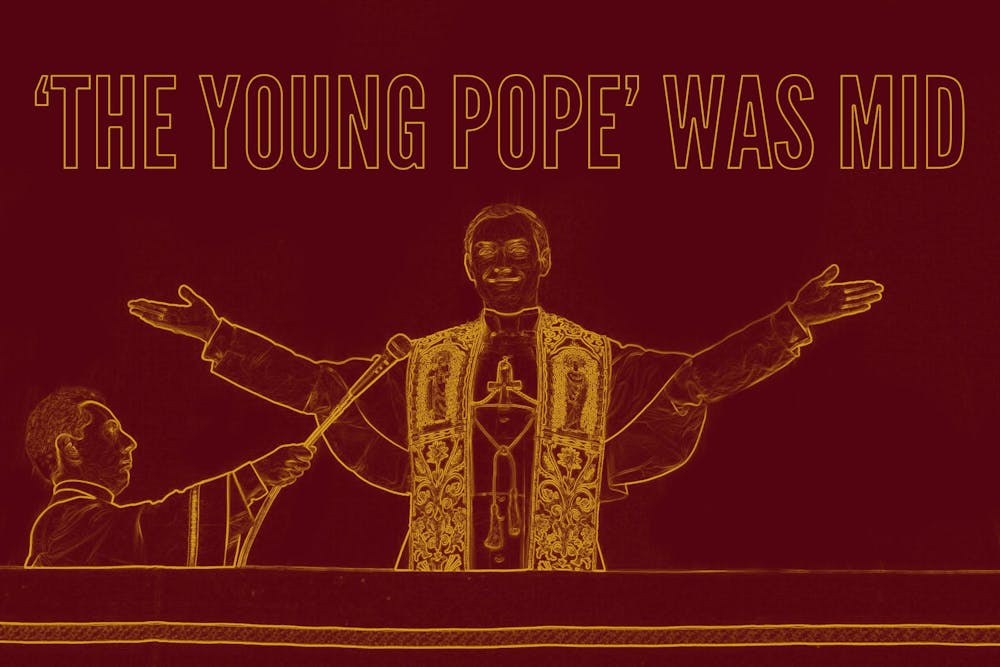
I think now is as good of a time as ever to revisit “The Young Pope,” a series about the Vatican released on HBO in 2016 which starred Jude Law and Diane Keaton. It spawned a minor media kerfuffle upon its debut — the National Catholic Register wrote, “Many Catholics are rightly upset about the scandalous anti-Catholic new HBO show called ‘The Young Pope’” — but people have mostly forgotten about the series, aside from Law’s “absolute love and total devotion” monologue, which you might’ve seen reposted on your short-form video outlet of choice.
On the one hand, “The Young Pope” was bizarre. A lot of the criticisms which “Conclave” received from Catholics but didn’t at all deserve can instead be applied quite rightly to “The Young Pope.” Whit Stillman (who — despite having directed “Metropolitan,” which the National Review ranked the third-best conservative film — now spends his days posting libbed-out Boomer memes about Donald Trump on X in an ironic twist of fate) used the term “late-model HBO porn” for “The White Lotus,” and while that’s an unfair assessment of “The White Lotus,” it totally fits “The Young Pope.”
“The Young Pope” is late-model HBO porn par excellence. To director Paolo Sorrentino, everything is an excuse for full-frontal nudity and dimly-lit fornication, but he doesn’t even have the guts to commit to smuttiness. He relegates a large chunk of the edgier footage to vague, meandering dream sequences which leave the viewer unsure about whether these scenes actually happened. That’s a cop-out, I think.
Late-model HBO porn isn’t just about sex, though — there are plenty of other ways to make middle-brow and self-indulgent television. For instance, “The Young Pope” revels in showing things like cardinals and nuns smoking cigarettes and the pope working out for shock value. A penchant for shock, a tendency to whack the viewer over the head with significance-laden imagery, plagues the show in general. Additionally, James Cromwell and Scott Shepherd (Law’s mentor and friend respectively) go big with their performances but fall completely flat.
Additionally, while “The Young Pope” likes to gesture at theology (i.e. recycling the same St. Augustine quote in several episodes), these scenes are written in a thin and sentimental way which didn’t work for me. A writer should never try to make a character smarter than he is, they say, because he won’t be able to sell it, and that’s precisely the trap which the “The Young Pope” falls into. Law’s character, Pope Pius XIII, is depicted as an ecclesiastical wunderkind, but his writing never really fulfills this expectation — platitudes and brooding, that’s all he has to offer.
On the other hand, I enjoyed “The Young Pope” regardless. Law is fun to watch, and while his lines aren’t insightful, they do fall nicely on the ear. Keaton’s performance is also unimpeachable; when Law’s character is at his most annoying, she keeps the show watchable. The cast of Italian cardinals, with their stereotypical behaviors and farcical scheming, play a big part in lightening up the show too. (Sometimes their accents were so thick I literally couldn’t make out what they were saying, but that’s the director’s intention, no doubt, so I didn’t turn the subtitles on — people are too precious about understanding every word these days.)
Although it’s sometimes glib and grating, I like that “The Young Pope” takes big swings. Sometimes that means striking out (e.g., the show’s corny attitude about cigarette-smoking and Pope Pius XIII’s white papal tracksuit), but there’s more dignity in that than in getting walked, and sometimes it means hitting homers like the gonzo needle drops, the unforgettable opening credits, the b-roll of nuns playing soccer, the absurd orphanage flashbacks, the New York side plot and the cardinal in love with the Venus of Willendorf.