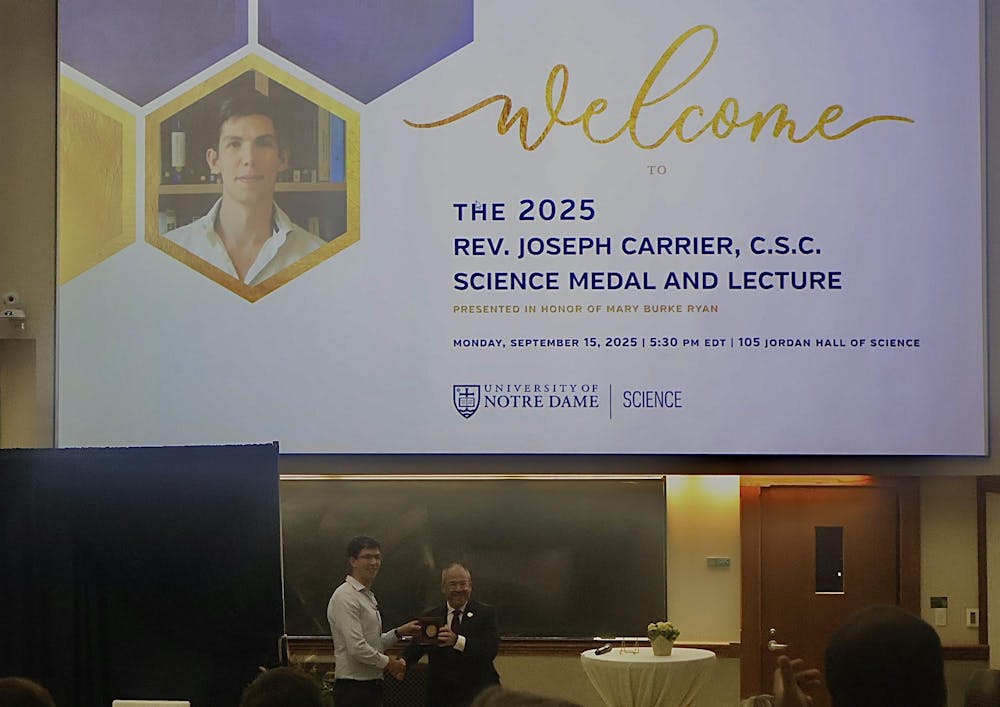
Oxford University’s James A. Maynard, a leading figure in number theory, was honored with the prestigious Carrier Medal at a ceremony held Monday in Jordan Hall of Science from at 5:30 p.m.
The Carrier Medal, established by the University of Notre Dame in 2022, recognizes scientists “whose work has transformed their disciplines and whose discoveries inspire future generations.” The Carrier Medal was named in honor of Rev. Joseph Celestine Basile Carrier, C.S.C., who became the first director of the science program at Notre Dame in 1865.
Maynard’s work spans some of the most puzzling unsolved problems in mathematics, including the famous Riemann Hypothesis, which offers a $1 million reward for proof. “I’m motivated by big, famous problems,” Maynard said. “Nobody says, ‘I am going to sit down and solve X Hypothesis.’ It’s a mixture of working alone and collaborating with colleagues, testing models and different ideas.”
In his lecture, Maynard highlighted how prime numbers, while deeply theoretical, have surprisingly practical applications.
For example, cryptography — the science of encrypting and decrypting information — relies on primes for secure online transactions. Without it, online banking, private communications and digital commerce would be vulnerable to cyberattacks. “While many applications to prime numbers are different, the least theoretical application of prime numbers is buying things online, which affects billions of people daily,” Maynard said.
Additionally, Maynard highlighted the importance of “internet security, maintaining that all transactions are kept secure” which in turn is completed through “the encryption of the number so that it is hard for a hacker to decrypt.”
Maynard told the audience about his favorite prime number — the number 2. “It’s simple, elegant, and foundational,” he said. He also referenced “sexy primes” and discussed the ongoing search for odd perfect numbers, saying he “does not believe one exists.”
A recurring theme in Maynard’s talk was the combination of talent and hard work. He described the process as “interactive,” often confronting false positives in his own work, but emphasized “the joy of small victories.”
“Pure joy comes in unexpected moments,” he said, recalling reading “The Music of the Primes” within the mathematics field as a transformative experience.
Maynard also touched on the more technical and collaborative side of number theory, exploring open problems such as the Riemann Hypothesis, and the interplay of theory with applied mathematics. His research bridges math with other sciences, showing the relevance of primes beyond theory, even in fields such as photography and secure digital commerce.
Maynard also referenced German mathematicians, Leopold Kronecker by stating “God made the whole numbers ... all else is the work of man.”