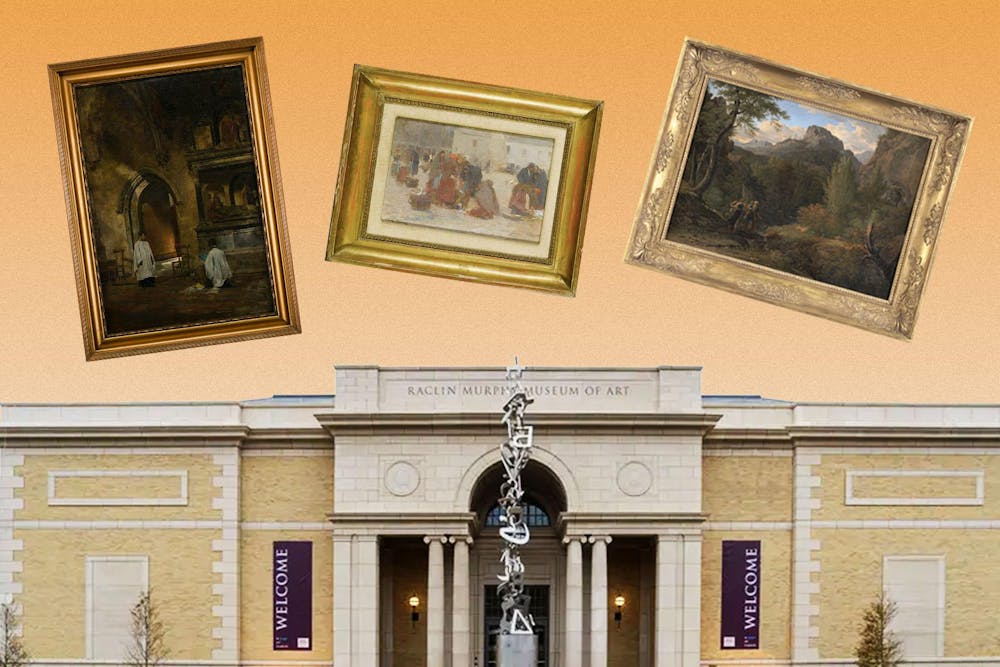
The greatest works of art take years to examine. But not everyone has the time nor the accessibility to explore these great works, so we must remember to appreciate the smaller pieces that are often overlooked. This is why Emily Normand, a Lilly Endowment museum fellow for religion and spirituality in the visual arts at the Raclin Murphy Museum of Art, started the Bite-Sized Art series.
Beginning in summer 2025, Normand started the program to allow all members of Notre Dame and the surrounding South Bend community to come explore the small works in shorter time frames. While the regular programs are usually 45 minutes or more, Normand realized that even that was too long for some people’s schedules.
“Not everyone has 45 minutes or an hour,” Normand said. She went on to say that the museum promotes “slow looking and encountering.” Normand wanted to take advantage of the museum’s free entry by creating programming made for lunch breaks: a 15 minute exploration of a singular art piece.
The Bite-Sized Art program has evolved since the summer, occasionally taking on themes related to other events happening at the museum or around campus. Last month, Bite-Sized Art partnered with the DeBartolo Performing Arts Center about their performance of “King Lear” by exploring a print related to the play that is displayed in the museum.
On Sept. 17 there was a different program that did not follow a theme; instead, it explored another small, overlooked piece in the gallery of European and American art. With the non-themed programs, Normand described how she goes through one gallery at a time, finding the perfect bite-sized piece from each one. This program explored “Psyche led to love” by Pierre-Henri de Valenciennes.
This work was painted in France in 1796 and was revolutionary in the French Academy of Fine Arts for its unique portrayal of landscapes. Valenciennes was trained in neo-classical painting, but found he was not a fan of the Greek and Roman tragedy-themed paintings and took a rare but niche interest in landscapes. At the time, landscape artists were looked down upon because their art was not as sophisticated as the classic paintings. Valenciennes compromised by combining small elements of Roman myth on his broader landscape of the French countryside. This work was the catalyst for the Historical Landscape Prize at the French Academy because it was the first of its kind and demanded the respect of the classicists.
Normand went on to describe the scene in the painting. The work itself is small, only 16 by 22 inches, so the scene of Psyche and the Hermit is almost imperceptible in the vast landscape that takes up much of the frame.
Normand spoke about the mythological background of the story of Psyche: how her beauty threatened Venus, who then sent Cupid to make her fall in love with the ugliest creature. After a series of failed events, Psyche ended up having to prove herself through trials. The trial in the painting depicts the scene where Psyche was going to drown herself, but a hermit was there to stop her.
What’s unique about this scene is that the hermit aspect doesn’t exist in the original text, “Metamorphoses” by Apuleius, at this point in the story. Additionally, hidden in the right-hand side of the painting is a vignette of a country scene, potentially alluding to a future trial Psyche has to endure.
Normand’s brief exploration into this painting is unique and utterly underrated because in just fifteen minutes, one could learn more about a beautiful piece of art than if they were to wander about the museum for an hour trying to look at everything.
With the incentive of 10% off at the museum café, this hidden gem of a series allows for anyone to discover one of the hidden gems of the Raclin Murphy. This series plans on continuing throughout the fall semester. The next installment will be on Sept. 24 and will explore a totally new, but hopefully equally interesting piece in a different gallery of the museum.