
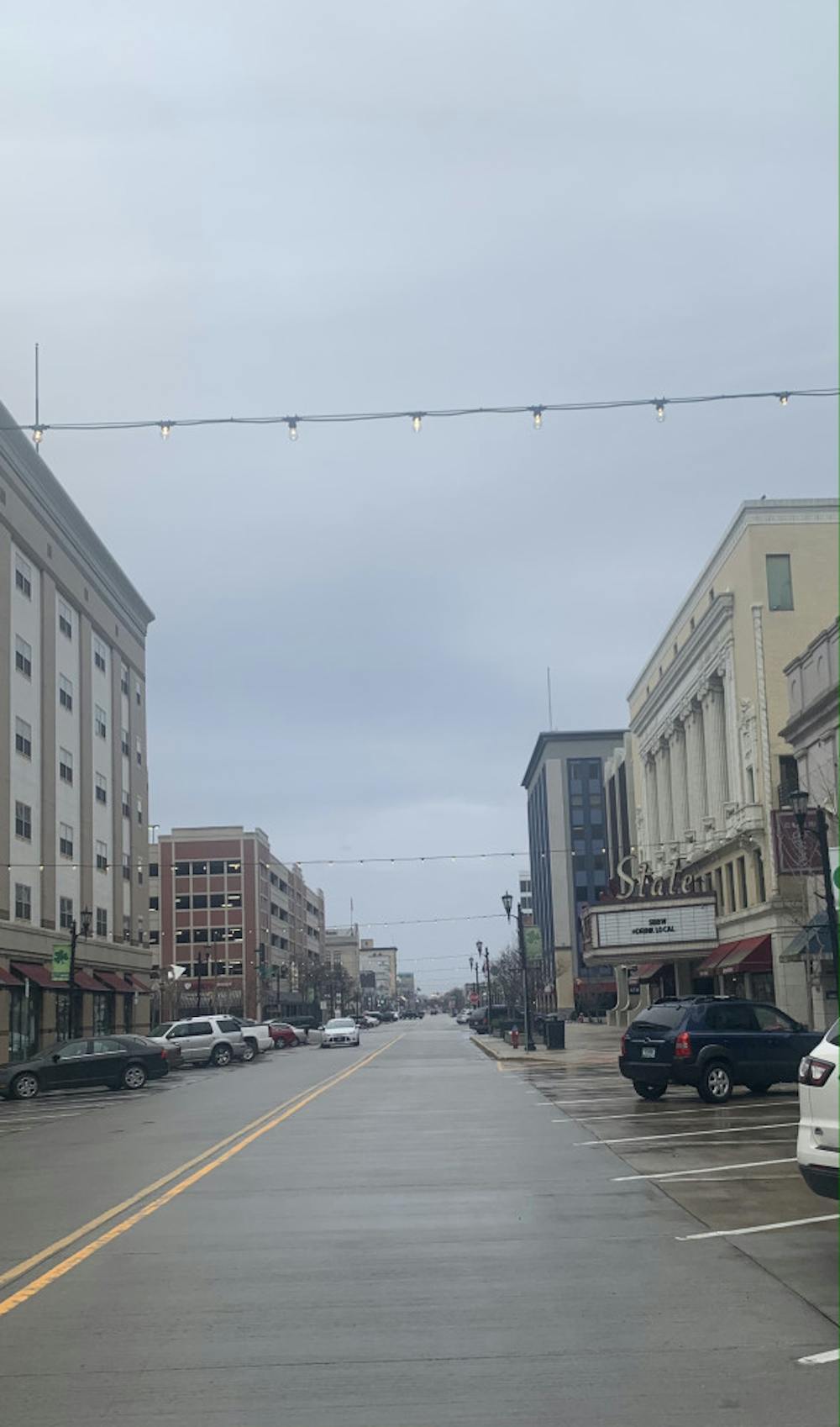
Not too long ago, I heard a comment from one of my classmates during a discussion that struck me in all the wrong ways. Amid remarking on the state of press associations in America (typical political science banter), this classmate blurted out, “There is no news in South Bend.” They were referring to the presumption that our local newspaper, “The South Bend Tribune,” was struggling due to a lack of local news because there wasn’t enough worthy information to report. Our professor, a resident of South Bend, quickly refuted this claim. A back-and-forth ensued, but my mind remained transfixed on the initial statement. How could someone believe that nothing happens at all in a city? Especially a city they live right next to? The student body of Notre Dame has become increasingly insulated from the broader South Bend community, to the point where some of us no longer believe anything of importance occurs outside of the Notre Dame bubble.
The University of Notre Dame notably has a complicated relationship with the city of South Bend. First, and most importantly, Notre Dame’s campus is carved out of South Bend’s city limits. Notre Dame resides in Notre Dame, Indiana: an unincorporated community just north of South Bend. This is abnormal, even for a small private university. Other similar-sized schools, such as Georgetown University, Duke University and Boston College are located within the city limits of their host cities.
In addition to Notre Dame’s unique zip-code status, the University has also been extensively involved in developing areas off-campus within the city limits of South Bend. Notre Dame invested millions in the development of the Eddy Street Commons, creating over 900 apartments and townhomes and two hotels while attracting more than 2 million visitors annually.
Between Notre Dame’s unique designation as an unincorporated community and the continued development of areas surrounding campus, the school has created a substantial and exceedingly palpable bubble. However, Notre Dame’s physical boundary is not alone in contributing to the sense of insulation I ascribe to our student body. The second and most harmful form of insulation is social and driven by the lack of relationships between Notre Dame students and the South Bend community.
When reflecting on what one can infer by stating “There is no news in South Bend,” one thought comes to mind: this individual has never fruitfully experienced South Bend. No, trips to Newfs or South Bend Cubs games do not score you points for meaningful community engagement. One can only assume nothing of the place they reside when they are completely disengaged – unaware of the circumstances or surroundings that exist right beside them.
It’s worth noting that Notre Dame students volunteer extensively, with more than 80% of Notre Dame students participating in some formal service activity on campus. Given that this number is more than double the national average, Notre Dame students’ commitment to service should be commended. The impact of this service, however, varies — while many students are motivated by genuine goodwill, some activities do not meaningfully engage them with members of the South Bend community.
Every residence hall has a service event, in which money is raised for a school, nonprofit, or local organization in need. These events run — often very successfully — and the proceeds are given to the intended entity. While I do not aim to downplay the value of such efforts, I wish to note the non-contact nature of some of these events. A student on campus, who is heavily involved in dorm activities, can play an essential role in raising thousands of dollars for a school without ever meeting a single child who attends it. A good deed is done, but a genuine connection is not formed. I understand this dynamic to be the root of our social insulation from South Bend. We are involved with the community, but we are not involved in the community.
Closing the gap between South Bend and Notre Dame requires meeting people face-to-face and fostering lasting, authentic relationships. Several clubs and organizations on campus facilitate this form of service, such as Domers Mentoring Kids, Mercy Works or TutorND. All of these groups provide opportunities for Notre Dame students to meet, interact and build relationships with members of our community. I understand that these methods of engagement are time-consuming, and the ever-occupied Notre Dame student may be unable to commit to driving off-campus to tutor or mentor on a weekly basis. Yet, forming just one tangible connection can begin to remove the layers of social isolation.
When I drive through South Bend, I think not just of a city near where I attend school, but of a vibrant community. I think of the students I have tutored, the athletes I’ve coached and the teachers I have worked alongside. I think of their joy, enthusiasm and genuine care for one another and their surroundings. The extent of my off-campus involvement does not have to be emulated by every Notre Dame student, but I challenge all of us to seek opportunities that push us to engage meaningfully with the South Bend community.
So yes, there is news in South Bend. It does not lie in the national headlines, but between the lines – in the places where community ties are knotted. Our bubble exists, but like any real bubble, it is thin, flexible and easily reshaped — or even bursted — by the connections we choose to make. Once we reach beyond this delicate surface, we will finally see South Bend not as the city we happen to live by, but a community that we belong to.
Naasei is a junior from Portland, Oregon living in the Coyle Community in Zahm Hall. When not burdened with overwhelming political science coursework, he enjoys photography and baking. He can be reached at wlynn@nd.edu.


