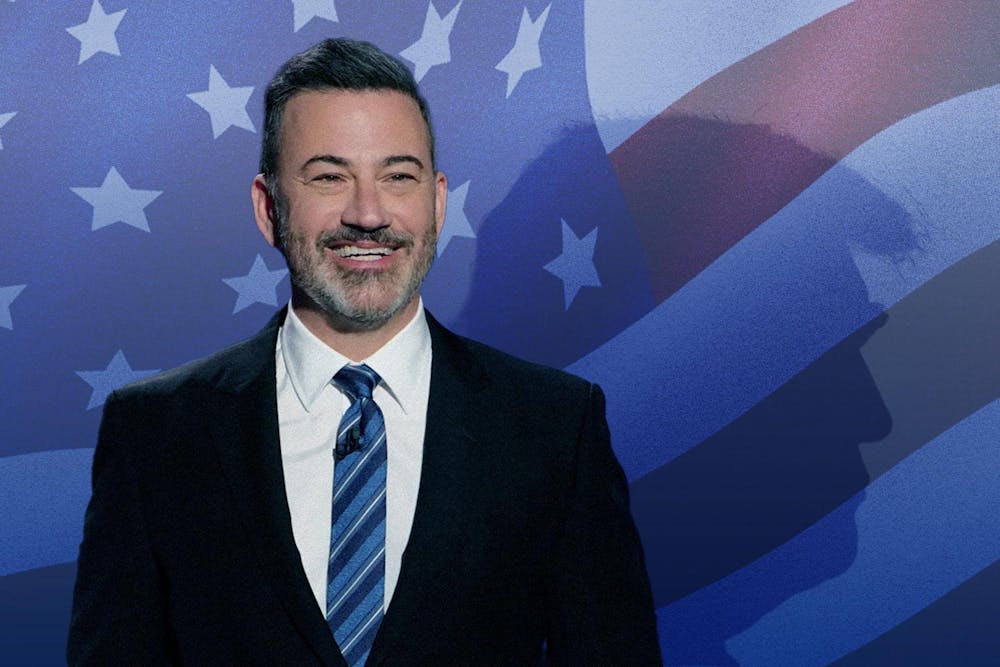
Jimmy Kimmel is an American TV host who has been hosting “Jimmy Kimmel Live!” since 2003, which is longer than most freshman and sophomores have been alive. Unless you’ve been living under a rock, you’ve likely seen the dramatic pulling and reinstating of his show after he made a comment on the murder of podcaster Charlie Kirk.
America is supposed to be a democracy, and in a democracy everyone should be allowed to express an opinion, whether or not it is contrary to that of the government. Kimmel has been critical of President Trump in the past, and President Trump has been critical of Kimmel. A good example is during the Oscars last year, in which Jimmy Kimmel read out President Trump’s tweet, which said to “get rid of Kimmel” amongst other insults. After reading it aloud, Kimmel quipped back with, “Isn’t it past your jail time?” Childish on both parts? Yes. Hilarious on both parts? Also yes. However, the most important thing is that both were able to freely express how they felt. Kimmel’s suspension marks both the loss of free speech and subsequent rise of censorship.
When people are no longer able to express their thoughts and opinions without fear of being silenced, we are no longer free but instead fearful. It is natural to fear consequence; that fear has been hammered into us from a young age. You steal someone’s juice box in kindergarten? Naturally, you fear the consequences if the teachers find out. But I’m not talking about fearing natural consequences. I’m talking about the unnatural ones — the consequences where the punishment strongly outweighs the perceived wrongdoing. Kimmel said that the “MAGA gang” was “desperately trying to characterize this kid who murdered Charlie Kirk as anything other than one of them” and accused them of “trying to score political points” regarding his death. It was these comments that caused the controversy.
On Sept. 17, ABC announced it would be indefinitely suspending Kimmel’s show. Prior to this action, on a podcast with Benny Johnson, FCC Chairman Brendan Carr said there could be “a path forward for suspension over this” and urged media companies to “push back” and stop airing the show. Nexstar, a large station owner, also made a statement condemning Kimmel. Interestingly, Nexstar is currently trying to complete a merger with another TV giant. This merger would require the approval of the FCC. The sequence of these events shows the power of the federal government over the allegedly “free” media. We can of course speculate to what extent financial reasoning influenced Kimmel’s suspension, but writing about the power of money in a capitalist society is like writing about chicken in Chick-fil-A — obvious and unnecessary.
So, what’s the big deal? For someone not into politics, it just seems like Kimmel got fired for being insensitive, whoopty doo. But his suspension has deeper meaning. I find it to be an indicator of what I see as the height of intolerance. It is troubling how in the current political climate, opinions no longer create discourse but instead have debilitating effects on one’s life. We now live in a time where people defend hate speech as opinion as long as it aligns with their agenda and treat opposing views as hate speech. We no longer allow the democratic process to run its course. We no longer allow for natural consequences.
If the people deemed Kimmel offensive, they would stop watching.
There is no need for a meddling middleman in the form of government officials. We, the people, do not need interference when it comes to forming opinions. It is diversity of opinion that allows a democracy to thrive. If we only see one opinion in the media, we forget there is an opposition. To forget there is an opposition is to forget there is a choice, and to forget there is a choice ultimately means to accept undue authority over every aspect of your being, even your mind.
The silver lining, if you made it this far, is that Kimmel was reinstated. It was contested. That shows that notions of democracy are still alive and still fighting for their place in our society.
Amaris O'Connor is a sophomore from London, United Kingdom currently living in Flaherty Hall. She is a political science major and spends most of her free time reading or making different iced coffee combinations. You can contact Amaris at aoconn27@nd.edu.