This July, St. John Henry Newman became the 38th Doctor of the Church. The saint, who was canonized in 2019 by Pope Francis, was elevated to join the ranks of influential Catholic Church fathers like St. Ambrose, St. Augustine, St. Thomas Aquinas and St. Anthony of Padua.
Each of the 38 Doctors of the Church, including Newman, are canonized saints that have a significant body of writings that were both influential during their lives and continue to be so during the modern age.
The final step in being named a Doctor of the Church is for scholars to make a case for the proposed Doctor in a set of writings called a positio. The positio defends the claim that the proposed Doctor has made a significant and lasting impact on the modern Church through his studies, teachings or doctrine.
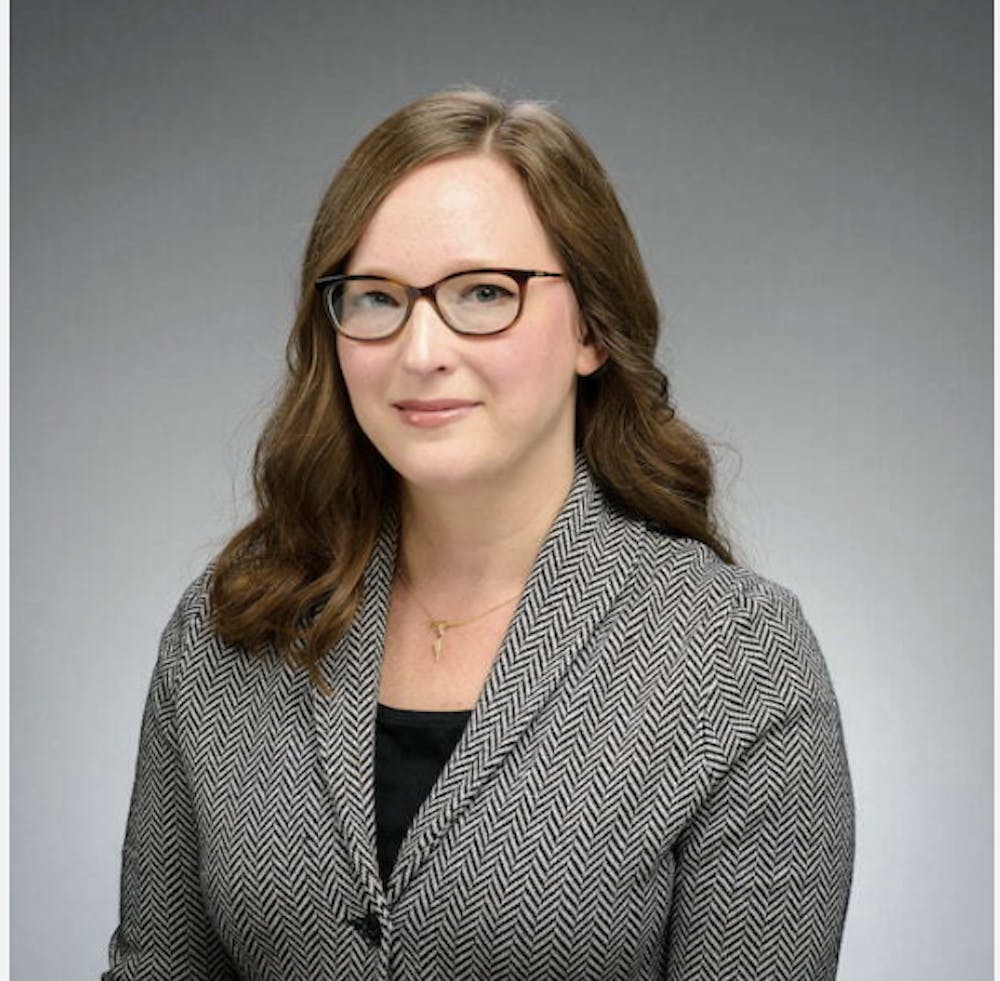
Notre Dame professor Jennifer Newsome Martin was one of the contributors to the positio submitted to the Vatican last fall. The 19th century Englishman is very close to Martin’s heart.
“Newman has always been a bit of a companion, I think, through my own conversion,” Martin said. “Newman himself had a very kind of public and very important conversion from Anglicanism to Roman Catholicism.”
Like Newman, Martin’s path to being an expert on Catholic theology was unpredictable.
“I grew up as the child of a Protestant minister in the deep south of North Carolina, so the odds that I would be teaching Catholic theology at the U.S.’ premier Catholic, flagship university. It strains credibility in certain ways, it's hard to believe,” she said.
She now teaches classes in the program of liberal studies and serves as the director of the de Nicola Center for Ethics and Culture. After attending Notre Dame for graduate school, Martin applied to teach at Notre Dame, first as a visiting professor and then for a tenure-track job.
“I came to Notre Dame in 2005 and thought I would be here for two years, but this is year 20,” she said. “So it's just pretty special, it's a pretty special place, you know, you never want to leave. And then I was really lucky, because I never had to.”
Even for a professor at one of the best theology schools in the world, contributing to a positio like this is no small feat. The effort to name Newman a Doctor of the Church spanned across an ocean, originated in Newman’s native England.
“The English bishops wanted Newman to be elevated, and then they partnered with a group in the US, in the National Institute for Newman Studies in Pittsburgh. They have been extraordinarily key in making this happen,” Martin said. “They basically digitized almost all, if not all of Newman's writings, and made them available online.”
Martin had worked previously with the National Institute for Newman Studies (NINS). When the wheels started turning on the process to get Newman named a Doctor of the Church, she was ready.
“I had just actually given a talk the year prior, on the sensus fidelium, or the sense of the faithful, and they asked me just to write the chapter on the sense of the faithful and the laity,” Martin said.
In order to be named a Doctor, Newman’s teaching had to be relevant to the Universal Church, even today. NINS collaborated with a Vatican dicastery to compile the positio.
“The idea is that there's something about that saint's holiness or sanctity or teaching or doctrine, there's something about that saint that is eminent. That's the language that's often used,” Martin said. “The doctrine is eminent, and it means that it basically has abiding and contemporary value in the church.”
Martin’s chapter of the positio focused on sensus fidelium, concerning the relationship between the church and the laity.
“In the church, there's a kind of, communal, ecclesial instinct is the language that gets used, an instinct for the faith, this capacity to recognize the faith,” she said.
Newman strongly advocated for the Church of his era to consult lay people more on issues such as education. Many of Newman’s writings are concerned with education, especially what a university should be. He also wrote about religious epistemology, or what can be known about religion.
“He gives this really amazing example of a man who’s fallen off a cliff and someone is throwing him a rope, and he’s like, ‘No, I need a steel beam. I can't possibly pull myself up on a rope because it may break,’” Martin said. “And he said that would be ridiculous, just as ridiculous as it is for someone to insist upon empirical proof.”
Newman’s writings span a wide range of theological issues.
“Newman is a very complicated figure insofar as it is impossible to pigeonhole him into a binary of liberal or progressive or right or left which I find really refreshing,” Martin said.
Newman can cause division, not just in a political sense, but an ecclesial sense as well.
“He is interested in the church, interested in the past, interested in tradition and in conserving the tradition, but he sometimes gets accused of being too interested in innovation,” Martin said. “He gets criticized from everybody, which makes me think he’s doing it right.”
Now that he’s a Doctor of the Church, Martin said she hopes that Newman’s works will be read more often and can create positive momentum for the church.
“Newman could be a figure that is quite a bridge builder, that could heal some of the divisions in our ecclesial and political landscape,” she said.
The entire positio, most of which take five to six years to finish, was completed in just a few months. The quick turnaround was primarily so Newman could be officially declared to the honor in the 2025 Jubilee Year.
“I think there's something really beautiful about Jubilee Years,” Martin said. “I mean, there's a lot of energy around the church in the Jubilee … there's something about a Jubilee Year that kind of interrupts time in a way, and the nowness and newness of the Catholic faith kind of asserts itself.”
The plan to make Newman a doctor during the Jubilee went on pause, however, when Pope Francis passed away in April.
“[The positio] was originally to be presented to Pope Francis, who was very enthusiastic about Newman becoming a Doctor of the Church. And so when he passed, everything kind of stalled for a little bit,” Martin said.
Pope Leo XIV put the stamp of approval on Newman’s case for Doctor on July 31.
“It was actually this moment of providence, maybe, or at least poetic loveliness.” Martin said. “It was Leo XIII who made Newman a cardinal, and then Leo XIV who made him a Doctor of the Church. There's a certain kind of like bookend quality to that, which I think is actually quite nice.”