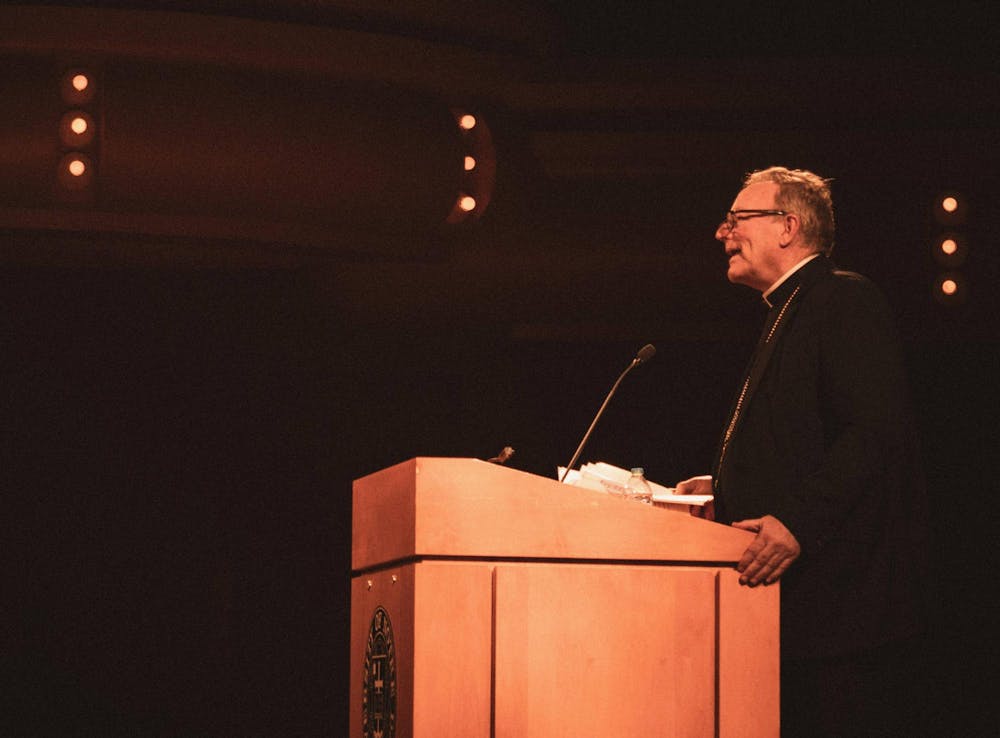
Bishop Robert Barron, one of the best-known Catholic bishops in the United States because of his media engagement and popular Word on Fire Ministry, drew a nearly full crowd for a lecture in Leighton Concert Hall on March 5. Even as many students had departed campus early for spring break, a crowd of over 600 attended to hear Barron speak at the annual Maritain Lecture on “An Old Testament Theology of God.”
Therese Cory, director of the Jacques Maritain Center, began the night by introducing Barron, acknowledging his accolades and describing him as “a longtime friend of Notre Dame.”
Barron opened by noting that he was a freshman residing in Flanner Hall at Notre Dame in 1977-78 before entering the seminary. He credited Fr. Thomas McNally for setting him on a path toward the priesthood.
He also brought up his time as a scholar in residence at Notre Dame, during which he stayed at Moreau Seminary. He described Fr. Bill Miscamble, then the rector at Moreau, as a “good friend.” Miscamble is known for his outspoken voice arguing Notre Dame has failed to live up to its Catholic mission, recently criticizing the University for its appointment of Susan Ostermann because of her advocacy for abortion rights. Ostermann has since declined this appointment. After a shout in support of Miscamble by an audience member, Barron jokingly asked, “Bill has one fan?” which garnered loud laughter and an eruption of applause from the audience.
Barron had also critiqued Notre Dame for its appointment of Ostermann a month prior to his visit to campus, posting on X, “I believe that going ahead with this appointment is repugnant to the identity and mission of that great center of Catholic learning.”
Several other Holy Cross priests received shout outs from Barron. Barron said Fr. Stephen Koeth, professor in the Notre Dame history department; Fr. Gregory Haake, who has been appointed vice president for mission engagement and Church affairs; and Fr. Pete McCormick, assistant vice president of Campus Ministry, were in seminary or young priests during his time at Moreau Seminary.
“I used to tell them, ‘You guys need to really move into this university and have a big impact on it.’ So, I really mean, I do feel a father’s pride in seeing how they have done that,” Barron said.
This lecture stemmed from his work to create a two-volume commentary on the Old Testament for the Word on Fire series, placing biblical texts alongside art and commentary.
While some have critiqued him for not being formally trained in biblical exegesis, he argued that “without a doubt the most significant biblical interpreters in the ancient church were precisely bishop theologians.”
“Despite Vatican II’s call for a renewal of biblical study, and a deepening of a scriptural sensibility, much of our preaching has become less biblical and more experiential,” Barron said.
He continued on to share insights “gleaned from an unapologetically theological reading of the Hebrew scriptures.”
The first part of his lecture focused on “God’s incomparability,” drawing from the Book of Isaiah. “One might conclude that this judging and redeeming God is the divinity, who is especially devoted to a particular people, Israel, a powerful deity indeed, but one among many. But second, Isaiah wants to make eminently clear that such an interpretation would be crucially inadequate. For again and again with almost comedic repetitiveness, he insists on the incomparability of the God of Israel,” Barron said.
Despite God’s status as creator, Barron highlighted how Thomas Aquinas answers that God does not have to be within the genus of things that exist. Aquinas shows “how a medieval scholastic would, in philosophically technical language, express the divine incomparability of which Isaiah speaks,” Barron said.
Calling upon the burning bush image from Exodus, Barron further elaborated on God’s role as creator. “See, the God who is not ingredient in the world, hence not competitive with it, can set the world on fire without destroying it,” he said.
Reflecting on the book of Job, Barron acknowledged that it deals with “the most famously insoluble problem of theology: how to reconcile the goodness of God with the fact of evil?” Barron explained the problem of evil as a syllogism. “If one of two contraries be infinite, the other would be altogether destroyed, but God is called the infinite good. If God exists, therefore, there would be no evil, but there is evil. Therefore, God does not exist,” Barron said.
While describing this as “a darn good argument,” Barron said, “The Book of Deuteronomy presents a fairly straightforward proposal to the effect that a just and loving God will reward those who abide by his laws and will punish those who violate them.” In turn understanding a simultaneous goodness of God and presence of evil.
The lecture closed with a question-and-answer session, with questions from students pre-selected by the Jacques Maritian Center.
Jeffrey Campbell, professor of economics, explained that he was present because, “I am a Jew, and the title intrigued me.” He continued, “I thought he was an outstanding speaker, and I learned a lot about Catholicism from him. It was refreshing to see how a different religion reads our holy text.”
Anna Chase, a freshman at Holy Cross College, said, “I learned a lot about how the Bible should be interpreted theologically and not only historically, and how spirituality, theology and the Bible all should be in unity with each other.”
David Rosentrater, a local who lives about a half-hour away, said, “I am very happy I came. Bishop Barron is somebody we have seen on some podcasts in the past and I have a great deal of respect for him. He is an engaging person. I was looking forward to being able to hear him and see him in person.”
Cory said, “I thought it was very important to recover this idea of a theological reading of Scripture. It is something that I think can make Scripture come alive, not only in preaching that we hear at Mass, but also in our own reading of scripture.”
The last time that Barron was publicly on campus was March 2, 2023. He presided over Mass before lecturing to a crowd of around 700 about what makes a university Catholic.
The event was originally scheduled to be held in the Smith Ballroom of the Morris Inn but was relocated to Leighton Concert Hall in the days preceding the event. In an interview with The Observer, Cory explained that as planning continued, they realized the popularity of this lecture, given the attendance at the last lecture he held, was not going to fit with the 250-person limit of the Smith Ballroom. This event ended up gathering a crowd of similar size of around 700 with no one being turned away.
Henry Jagodzinski contributed reporting to this story.