Fr. Gustavo Gutiérrez, a renowned theologian and former Cardinal O’Hara professor of theology at the University of Notre Dame, said that he hoped to live as a testimony to the message that God loves the insignificant above all. In his life, he not only emphasized the importance of caring for the poor but left an immense legacy as the father of liberation theology. At its core, liberation theology focuses on the dignity of the impoverished, on action rather than theory and the liberation of those who suffer from the systems that cause their oppression. It is the integration of faithfulness, a command to live as Jesus did and action against injustice. It represents a true call to movement within the Catholic Church, for accompaniment and to walk alongside those in their suffering. For, as Jesus preached good news to the poor and not the wealthy and as Mary called on God to feed the hungry and send the rich away, we, as God’s servants, should also accompany and walk alongside the marginalized.
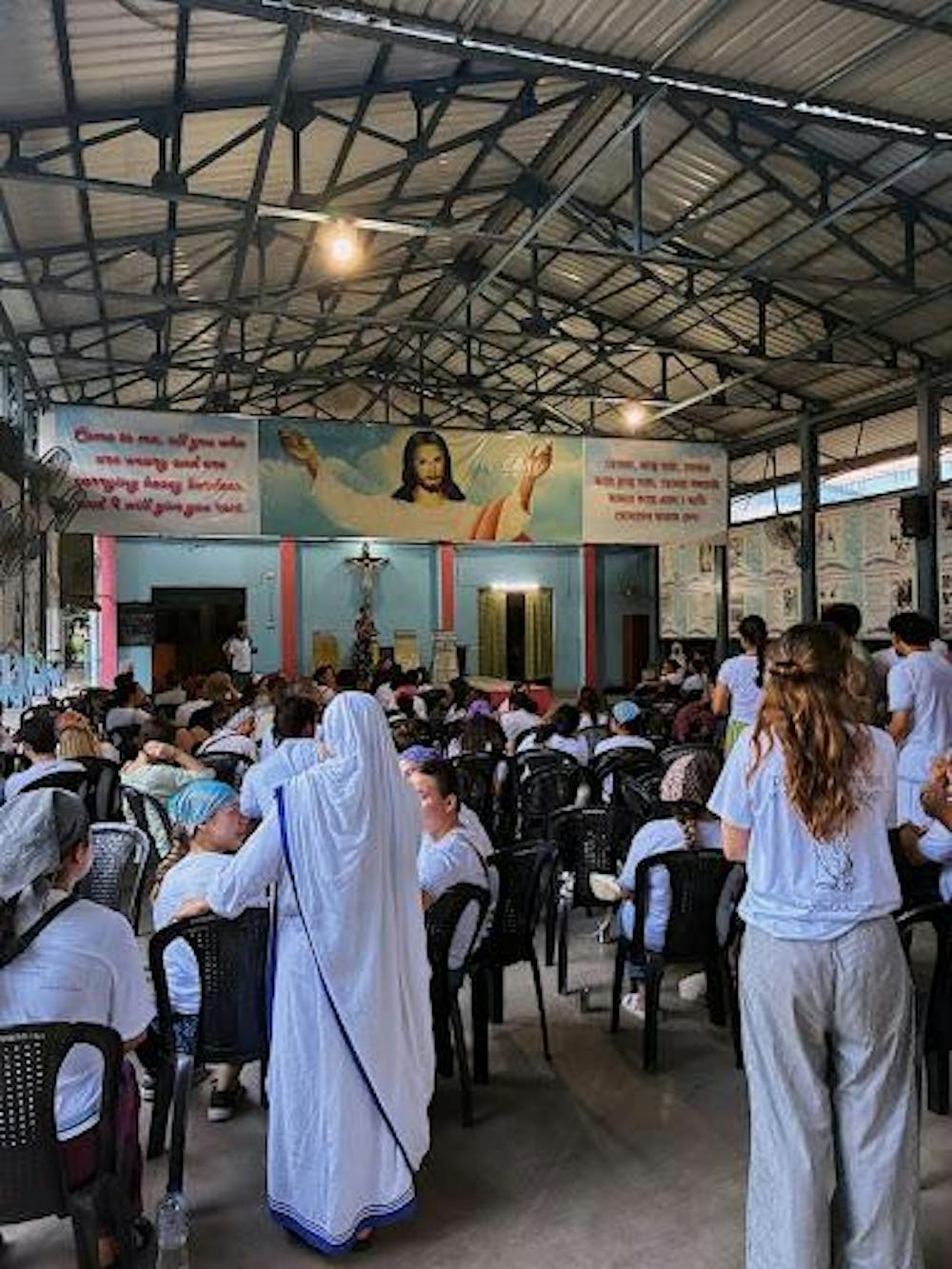
After reading some works by Paul Farmer that explored the ideals of liberation theology in health care, I couldn’t escape this idea of accompaniment. I spent my summer working with the Missionaries of Charity at the Kalighat Home for the Dying and Destitute, also known as “Nirmal Hriday,” or “Mother’s First Love.” The home was founded to treat and serve those who were left in the streets in dire need of medical service, but whom hospitals and doctors alike turned away. The service is in the name itself: for the dying and destitute. It seems to live and breathe the ideals of accompaniment — it was the first home Mother Teresa founded for MC service, and remains today one of the most active homes in Kolkata. It has an approximate capacity of 50 men and 50 women, separated into two wards, and further houses around 15 residential sisters on the second floor of the home.
The residential sisters provide a majority of the labor, supplemented by around five paid workers, or “masis,” per ward, and one part-time nurse. A doctor visits once a week, usually spending a few minutes with the more severe cases in the home. And then, of course, volunteers like me flood in and out of Kalighat, most rarely staying for more than one week. Through working roughly 40 hours a week for two months at Kalighat, I consider myself more familiar with the home than most of the volunteers. I was able to witness a call to accompaniment firsthand, but also witness just how this call may have been led astray.
“Voluntourism” is where people combine a vacation with volunteer work, most often in another country. Although most voluntourists are well-meaning, their increased popularity has a growing shadow of ethical concern. While I had the privilege of working within the home for the majority of my summer, most of my peer volunteers arrived in waves, with church groups or “mission trips” for spans of several days before continuing their travels, often to elaborate spas and resorts. It is almost always admirable to dedicate time and manpower to a meaningful cause, but how much can one really help after being picked up and placed in a brand new context and setting? How can one ensure that a volunteer’s skillset aligns with the work being done?
Further, when I continue to explore the core tenets of liberation theology, I keep returning back to this idea of accompaniment. This is something that Notre Dame, specifically the Institute of Social Concerns (ISC), with whom I completed my summer fellowship, emphasizes heavily through all of their pre-departure training and meetings. By ensuring that their fellows spend eight weeks living with and working at their sites, the ISC pushes for accompaniment in the very structure of their programs. Accompaniment is the act of walking along someone in their suffering and moment of crises; it represents a shared journey of solidarity rather than a surface level approach. Voluntourism somewhat works against that shared journey; as I saw in my summer, most voluntourists are somewhat transient and do not work within a location long enough to grow connection and a fruitful relationship that allows for mutual benefit.
Ultimately, the call to service or to do something greater isn’t something that should be ignored. The issue lies in a true vocation and motivation for volunteer work — do you feel called to spend a week or two working with a marginalized community because it would look good on a resume or would grant you some sort of do-gooder satisfaction? Or do you feel compelled to enrich your life and the lives of others by dedicating yourself to the work for a substantial period of time? Seeking personal growth or a transformative experience is admirable, but one shouldn’t do it at the expense of the community you feel so called to help. This is the importance of accompaniment; with not only time, but an intimate dedication to walk alongside suffering, to actually grapple with the context and constraints of a situation … that’s where the true good in service work can be found.
Ivy Clark is a senior pre-med studying neuroscience and behavior with a minor in global health and the Glynn Program. Despite living in the midwest her entire life, she has visited 11 countries and is excited to share her most recent endeavors working with the Missionaries of Charity in Kolkata, India. If Ivy could get dinner with any historical figure, it would be Paul Farmer or Samantha Power, whose memoir inspired her column name. You can reach her at iclark@nd.edu.