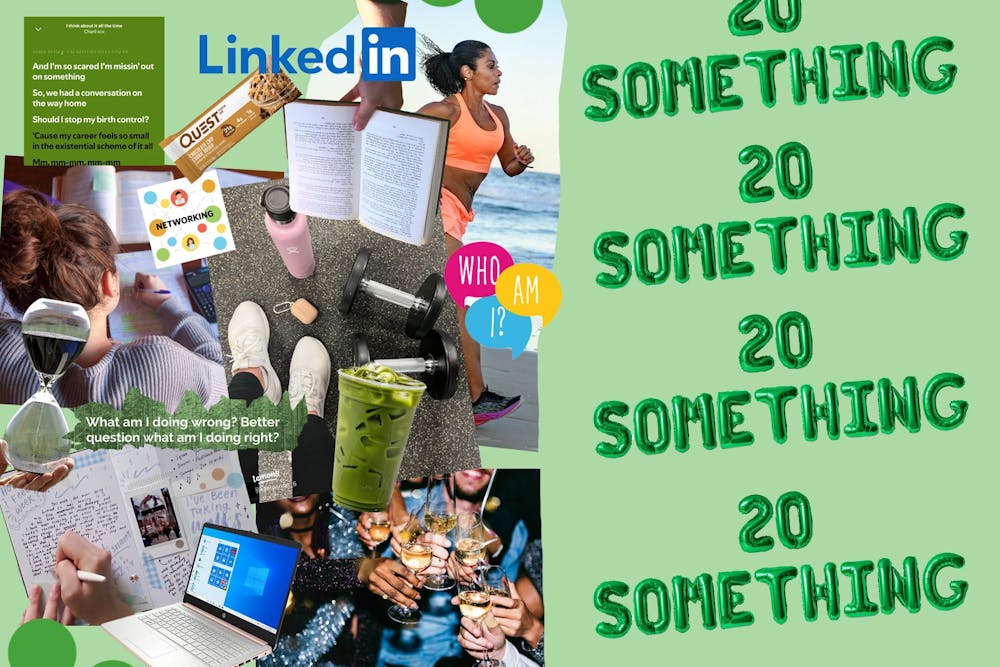
In your 20s, you should:
“Forget work-life balance.” “Grind now, build your empire.” “You’ll never be this free again, don’t waste your youth on work.” The scale tips a little differently after every scroll. One reel urges you to wake up at 5 a.m., journal, drink green juice and maximize your potential, while another declares that hustle culture is toxic, you should go out and have fun, because if not now when, right? Lost between so many contradictions, we’re expected to decipher the “right” path.
This is the paradox of our 20s: to be told to take everything seriously, but not too seriously; to have a five-year plan, but also “live in the moment;” to go to the gym, but not for vanity; to party, but only for the memories; to network, but make it look effortless. We are encouraged to find purpose but warned against expecting too much of life. The result: a quiet, anxious exhaustion that comes from trying to live every possible version of our 20s at once.
The problem isn’t the abundance of advice, but the illusion that all of it can be followed simultaneously or that it somehow must. Isolate every piece of guidance and there’s wisdom to be found: Work hard, because discipline does build character, and by all means, go out — because connection and fun matter too. Place them together, however, and they seem to cancel each other out. For we are asked to be both ambitious and carefree, intentional but spontaneous, among other contradicting advice; but how in the world can we be both?
I believe the confusion can be attributed to the fact that this decade is beautifully suspended between two ideals: the romantic chaos of youth and the sober reality of adulthood. This is a phase in which we are expected to enjoy and transcend, to be reckless but wise — these are the years in which every choice feels high stakes because people keep reminding you that these are “the years that define you” and yet every mistake is supposedly recoverable because “you’re still young.”
We live in a double bind: Nothing matters, yet everything does.
Of course, the older generations had their own contradictions, but I think the difference now is how exposed and performative these contradictions have become. Advice is no longer whispered by close friends or relatives; it is broadcast, branded and algorithmically spread, such that it becomes simple to believe if you could only pick the right mix of advice — some gym, a little therapy or a dash of travel — you might finally arrive at yourself. But the self, inconveniently or not so inconveniently, doesn’t work like that.
Perhaps that’s what we need to remember: Our 20s are not a puzzle to solve but a walking contradiction that insists we embrace it. And maybe that’s how we should be seeing these contradictions, a small reminder: You can be flexible in your identity. You can love your work and still dream of quitting it; you can crave solitude and still need people desperately; you can go out too much and then crave quiet mornings. These shifts, thankfully, are not failures of identity; they are identity, and embracing these contradictions is how we allow ourselves to decipher who we are.
If there is any wisdom to extract from this chaos, it might be this: We must learn to tolerate contradictions, embracing opposing truths without rushing to stick to one or judging the rest. In this way, we can allow our 20s to be a decade, not of optimization or perfection, but of becoming imperfect, contradictive and without a single guiding formula. The advice will keep on coming, but maybe the best thing you can do is to lower the volume, tune into your own rhythm and remember that uncertainty might not be a sign that you’re behind. Actually, it might be the sound of growing up. So, navigate these contradictions without judgment, and allow your 20s to simply be.
In your 20s, you should be and let be.