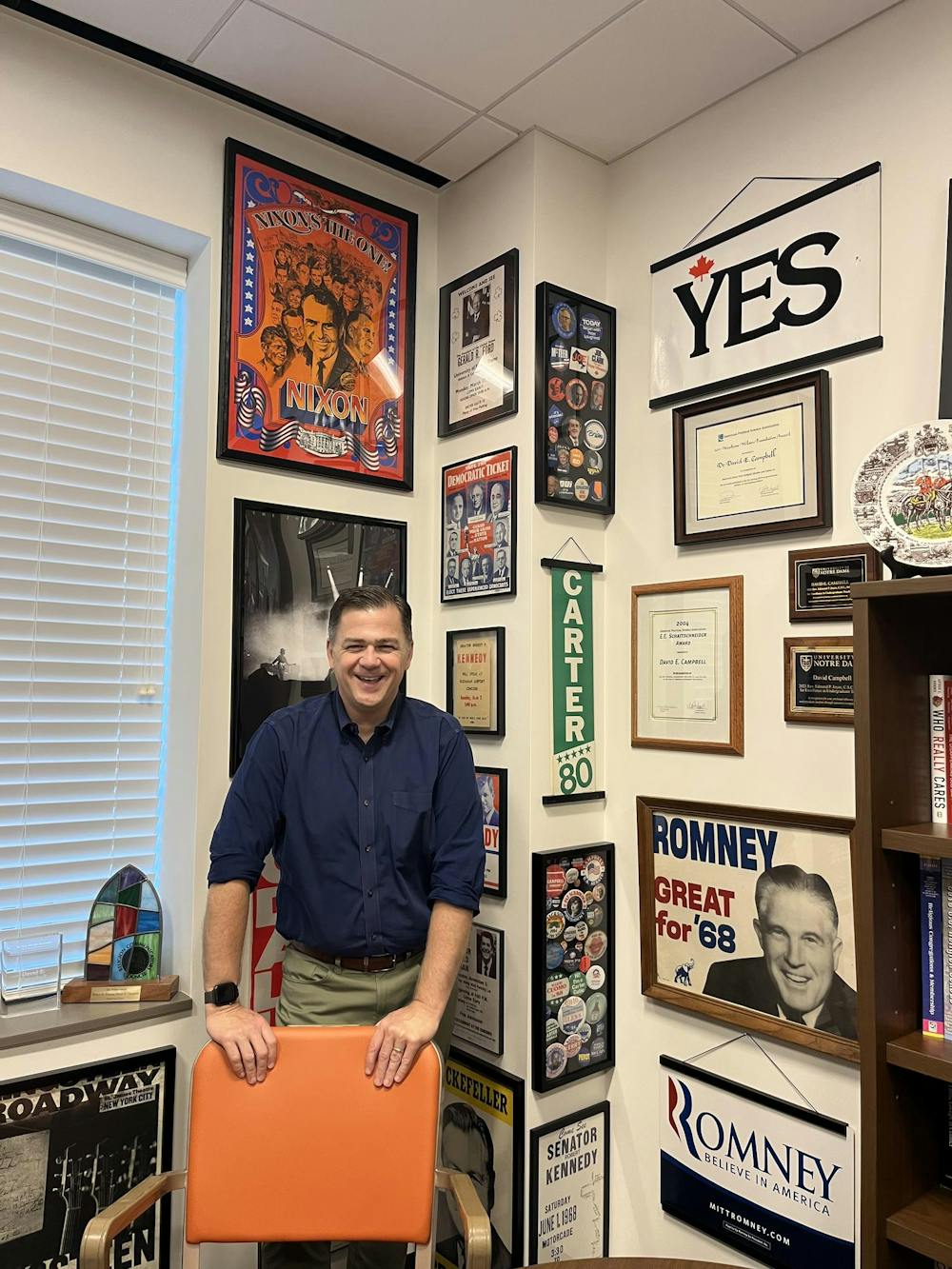
I crane my neck to look around Professor David Campbell’s office. “Let’s just say that I spend a lot of time on eBay,” he laughs, pointing out his favorites of the election pins and campaign posters covering the walls.
“Some may say it’s a problem, but I prefer to think of it as a museum,” he says.
Such a robust collection of political science memorabilia makes sense for someone who thinks a lot about democracy. On campus, Campbell teaches courses focused on American politics and serves as the director of the Notre Dame Democracy Initiative. His popular introductory American politics course titled “Keeping the Republic” focuses on the current state of democracy in the United States. Having taken the class as a freshman, I found this column was the perfect excuse to catch up with one of my favorite ND professors.
“Let me show you one Notre Dame poster,” he says. It’s a picture of Gerald Ford, framed by four shamrocks, advertising the President’s convocation address at Notre Dame on St. Patrick’s Day, 1975.
In his speech, Ford called on Notre Dame graduates to reject what he called “new isolationism.” He argued against politicians who sought to cut foreign aid and limit American involvement abroad, seeing the U.S. as a necessary global moral leader. Standing in the Athletic and Convocation Center, Ford stressed the need for “peaceful accommodation with neighbors,” not just on a global level but on a personal one, as well: “just as we seek to build bridges to other nations, we must unite at home ... People depend on each other more than they realize.”
One could argue that since Ford’s speech, America — on a political and personal level — has moved in the opposite direction. Trust is low, polarization is high and longstanding democratic norms are being threatened. While some scholars suggest that the U.S. is on the brink of a new civil war, others argue that things are not as bad as they seem. Exploring these themes, Campbell’s “Keeping the Republic” class tackles big questions about the current state of democracy in the U.S.
Campbell leans back in his chair before he starts speaking. “The big question of what makes for a healthy democracy is something that I have long thought about,” Campbell explains. In graduate school, he worked with political scientist Robert Putnam, who was in the process of writing “Bowling Alone” at the time. Using the decline of bowling leagues as a microcosm of a larger issue, Bowling Alone traces the decline of social capital in America. Specifically, it explores why it has declined since the 1960s and what that means for democracy. During Campbell’s time working with Putnam, he researched how to improve the quality of democracy, tracking factors like civic participation levels and the efficacy of electoral processes.
Today, Campbell is less concerned with whipping democracy into shape than he is with keeping it from bleeding out.
“I realize that that might sound a little dramatic,” he admits. “But collectively, political scientists have said for decades that democracy is a very fragile thing. It turns out to be true.” After a tumultuous election, a global pandemic, and worldwide political protests, Campbell and his colleagues created “Keeping the Republic” in 2022 in an attempt to give Notre Dame students the tools to respond to these tumultuous times for American democracy.
Despite Campbell’s shift in priorities, one idea persists: the vital importance of “social capital” (the only term from KTR whose definition I still have memorized). Social capital is “social networks, and the norms of reciprocity and trustworthiness that arise from them.” People accumulate social capital through building relationships: It’s learning the name of your local grocer, the fuzzy feeling you get from helping a neighbor fix their sink, the new friend you make at book club. Social capital is a testament to our inherently social nature as human beings — our tendency to organize around shared purposes. Simply put, social capital is the glue that holds our lives and — society — together.
But America seems to be suffering a glue shortage.
In a certain sense, we’re more connected than we have ever been: Digital platforms allow us to be plugged into what’s 24/7. But according to Campbell, this is actually part of the problem. “It is easy, whether you’re on the left, the right, the center … to nonetheless get caught up in a daily maelstrom of news that can seem overwhelming, and I don’t think that’s healthy.” Living in an increasingly digital world makes social capital — and being able to reach across the divide — more important than ever.
Campbell is uniquely qualified to try to reach across this divide, not just because of his doctorate degree, but also due to his small-town upbringing in Alberta, Canada. “I was very fortunate in that I went to a high school with fantastic social studies teachers, and I’m very grateful for that,” he explains, talking about a pair of conservative and liberal teachers that both taught social studies at his school. “It’s a relatively small place, so I knew their kids, you know, community … in fact, I was exposed very early on in high school to the respectful exchange of ideological differences.”
Campbell tries to encourage this type of civil discourse not only through KTR but also through his work at the Notre Dame Democracy Initiative. As a part of the University strategic framework for 2033, the ND Democracy Initiative hopes to establish Notre Dame as a leader in interdisciplinary research, education and policy efforts focused on strengthening global democracy.
I was lucky enough to attend one of the Initiative’s “Democracy Talks” in September — an event so popular that it was relocated to the DeBartolo Performing Arts Center to meet demand. University President Robert Dowd moderated a conversation between Gov. Michelle Lujan Grisham (D-NM) and Gov. Spencer Cox (R-UT) titled “Pragmatism Over Polarization: A Conversation with U.S. Governors.”
“That event is, I think, a perfect illustration of what we are hoping to do with the Democracy Initiative. Here we had a Republican and a Democrat on stage talking about the pragmatic things that they have to do as governors and showcasing the fact that those two are actually friends … We want to demonstrate that it really is possible for people to talk to one another across the divide, and we want Notre Dame to be a place where those conversations happen.”
Campbell hopes that by hosting such conversations at Notre Dame, the student body will learn how to be good citizens. “This is a unique time in your life when you are able to have conversations with people across lines that you may not have again in your life, that you’re making friendships here that are based on something other than, I hope, politics.” He hopes that students “discover that these people, who you share a lot in common with, we all cheer for the same team.”
At the end of our interview, Campbell had one last piece of advice for Americans concerned with keeping the republic: “Get a dog.”
At first, I thought he was joking. But Campbell genuinely attributes at least some of his good citizenship to his dog, Murphy. “By walking my dog every day, I meet all of the other dog walkers, joggers, [and] walkers … in the neighborhood … It turns out people of all ages, backgrounds, political affiliations, what not [all have dogs]. It has enabled me to make connections with people that I would not otherwise make. And in a world where that has become increasingly difficult, I consider that to be quite valuable.”
Often, attempting to reach across the political divide is easier said than done. But Campbell manages to practice what he preaches in every aspect of his life — with a little help from his dog, Murphy.
Allison Elshoff is a senior business analytics major with minors in the Hesburgh Program of Public Service and impact consulting. Her top three things to exist are hammocks, outfit repeating and mini spoons. You can reach her at aelshoff@nd.edu.