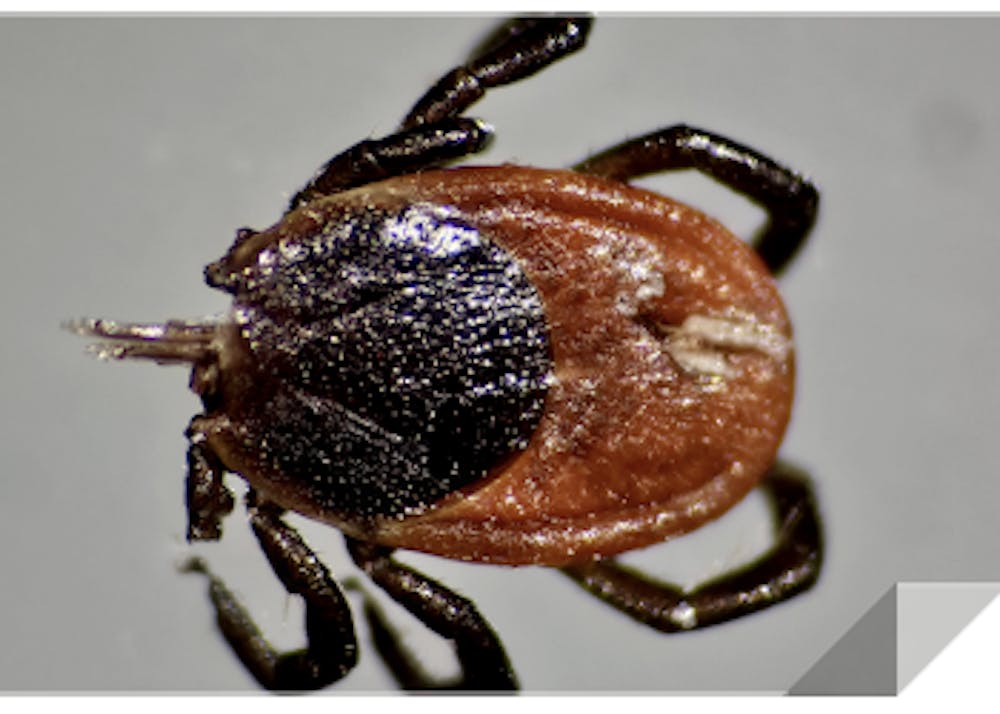
For many, when they consider Indiana pests, they first think of mosquitoes. But according to local researchers, the bigger and more persistent threat may now come from a smaller, nearly invisible creature: the tick.
“Ticks are highly adaptable creatures and generally very tolerant to the cold,” Lee Haines, associate research professor in Notre Dame’s department of biological science, wrote in an email.
Haines noted the larger presence of ticks in the county is due to climate factors and increasing animal presence.
“With warmer winters, they are not dying off. Add in the fact we have lots of deer in St. Joe County — meaning the larger ticks have easy access to fine dining,” she wrote. “Another factor contributing to increasing tick numbers is the population explosion of mice! Mice have more litters when summers are longer and winters are less harsh, making it easier for young ticks to feed on blood. Together, all these factors mean the black-legged ticks that spread Lyme disease thrive.”
Brett Davis, the former St. Joseph County Department of Health’s vector coordinator, has been studying ticks and their effect on local residents and visitors since 2017. Although he no longer works with the St. Joseph County Department of Health, Davis shared that he believes that local residents and visitors are at an enhanced risk for tick-borne illness and accordingly has continued to monitor how the environment affects tick populations.
Davis discussed his early research into the presence and effect of ticks in the county.
“I began looking at ticks and their effect on the residents and visitors of St. Joseph County in 2017,” Davis wrote. “The St. Joseph River corridor is an ideal conduit for ticks and their hosts to come south unimpeded. St. Joe County residents also have lots of opportunities to interact with these environments, whether it’s by visiting recreation areas or even having backyards that double as nice tick habitats.”
Haines, who arrived in the United States in 2023 during what she described as “the July 12th tornado at O’Hare,” added that her interest in local tick populations was sparked by personal experience.
“Since I arrived in the USA, I have heard whispers of high tick populations here and an alarming number of colleagues with Lyme disease,” she wrote. “When I found a tick embedded in my belly in November 2024, I decided I needed to focus some of my attention, as a vector biologist, on ticks.”
One method used by researchers and students to study tick populations is the “tick drag.” The name, according to both Haines and Davis, is literal.
“The very complex and scientific process of pulling a piece of cloth by a string behind you as you walk is actually very useful in identifying where the ticks actually are, and what kind of ticks are in an area,” Davis wrote via email. “You stop after a couple of yards and inspect the drag cloth to find ticks, some of which are smaller than a poppy seed, and then collect them to catalog them. The presence of different life stages can also forecast what future tick populations could look like.”
Haines wrote that Brett was being sarcastic regarding the complexity of the process, where people also typically wear white clothes to further identify any ticks while doing the grab.
One of the more unusual tick-related health concerns emerging nationwide is Alpha-gal syndrome, an allergic reaction to red meat products caused by certain tick bites.
“Because Alpha-Gal is an anaphylactic reaction and not a formal disease, we don’t have the empirical epidemiological data to say exactly how many cases there are in the area,” Davis wrote. “Luckily, the primary vector, the Lone Star Tick, does not seem to have established a population in St. Joseph County yet, so theoretically, cases are still on the lower side.”
Haines cautioned that data on Alpha-gal syndrome is limited, as it’s not yet considered a reportable illness in the United States.
“Bottom line: we don’t know and without municipal insect and tick surveillance programs, it is impossible to know when the Lone Star Tick will establish populations in the county,” she wrote via email. “It is not if, but when.”
She added that while most local cases are believed to have been contracted elsewhere, there is growing evidence that bites from other tick species could trigger Alpha-gal.
“A woman in Maine who was bitten by the black-legged deer tick alone was diagnosed to have AGS,” Haines wrote.
Both researchers emphasized that misinformation about ticks and their removal can make things worse.
“There are all sorts of home remedies and nonstandard ways that people swear by as means of getting ticks off of them — a lit match, nail polish, olive oil, etc.,” Davis wrote. “They aren’t actually that effective and could make the situation worse. Simple tweezers close to the skin, pulling straight up, is the best way to remove a tick.”
Haines agreed and expanded on proper removal methods.
“Your skin will look like it is being pulled up as well — do not worry, that is just the tick holding on for dear life to not lose its chance of getting a good meal. Keep pulling straight up,” she wrote. “And when you have it separated from your skin, keep it — pop it into a ziplock bag and toss it in the freezer. Should you fall ill, your doctor will want to see what species it was and to test it for any diseases it may be carrying.”
Notre Dame researchers are continuing to expand their work on tick surveillance and prevention.
“My survey on AGS in St. Joe County was a joint venture between Notre Dame and the Health Department,” Davis wrote. “One of the research projects is surveying the local population and analyzing what type of human behavioral risk factors may be contributing to tick-borne disease.”
In addition, Haines shared that multiple campus labs are exploring new dimensions of tick biology.
“In the lab of Dr. Álvaro Acosta-Serrano, we are studying where in the tick lurks the source of the alpha-gal sugar — saliva, gut, microbiota — and in what forms the sugar exists,” she wrote. “This is a project our new Ph.D. student, Jalynn Murry, started this summer.”
Haines also collaborates with Shahir Rizk, associate professor of biochemistry at Indiana University South Bend, on developing a diagnostic tool to detect whether a tick carries bacteria that could cause illness in humans.
Emeritus professor and director of the Notre Dame Museum of Biodiversity, Ron Hellenthal, teaches the course “Arthropods and Human Disease,” where students get to perform tick drags on campus.
The warming climate is also playing a key role in why ticks are spreading and surviving farther north.
“The prolonged warm weather means that people are out enjoying the environment more, which means that there is simply more exposure,” Davis wrote. “Warmer winters also make it easier for new types of ticks to migrate to our area and establish themselves.”
Haines added in the email, “The temperature must drop to 10°F for a good week to kill the ticks hiding in the leaf litter. As mentioned before, longer breeding seasons, more mice, and more deer add to this cycle.”
Both experts agreed that prevention is the best defense.
“Students should wear insect repellent that has either 30% DEET, IR3535, 20% Picaridin, or 30% Oil of Lemon Eucalyptus when spending time outdoors, and treating their clothes with permethrin is a great idea too,” Davis wrote via email. “If out walking or hiking, wear long sleeves and pants, stay on the trails, and after you return, check yourself for ticks.”
Haines recommended to check yourself for ticks near long grasses or in the woods when you lie down or walk in it.
She wrote, “Pull the ticks off you in the correct manner and store them in the freezer—or arrange to give them to me. I will gladly take them off your hands to add to my collection!”
New research and collaborations continue to emerge. Haines added that Samuel Rund, assistant research professor, has been brainstorming with Margaret McGuinness, assistant professor of aerospace and mechanical engineering, to find ways in directing tick patrols.
Both researchers also warned that ticks are not the only vector-borne threat in the region.
“West Nile Virus is endemic in our area, and cases seem to be on the rise,” Davis wrote. “We are also one of a select few counties in Indiana where there is a threat of Eastern Equine Encephalitis. Both of these are mosquito-borne diseases and can be avoided by wearing insect repellent, wearing long sleeves, and minimizing time spent in mosquito habitats between dawn and dusk.”
Still, Haines urged students not to fear the insect world entirely.
“Most insects are not harmful at all, and there are some pretty spectacular species on campus, including the Monarch butterfly in the summer,” she wrote. “Marie Curie said, ‘Nothing in life is to be feared, it is only to be understood.’ Now is the time to understand more, so that we may fear less.”