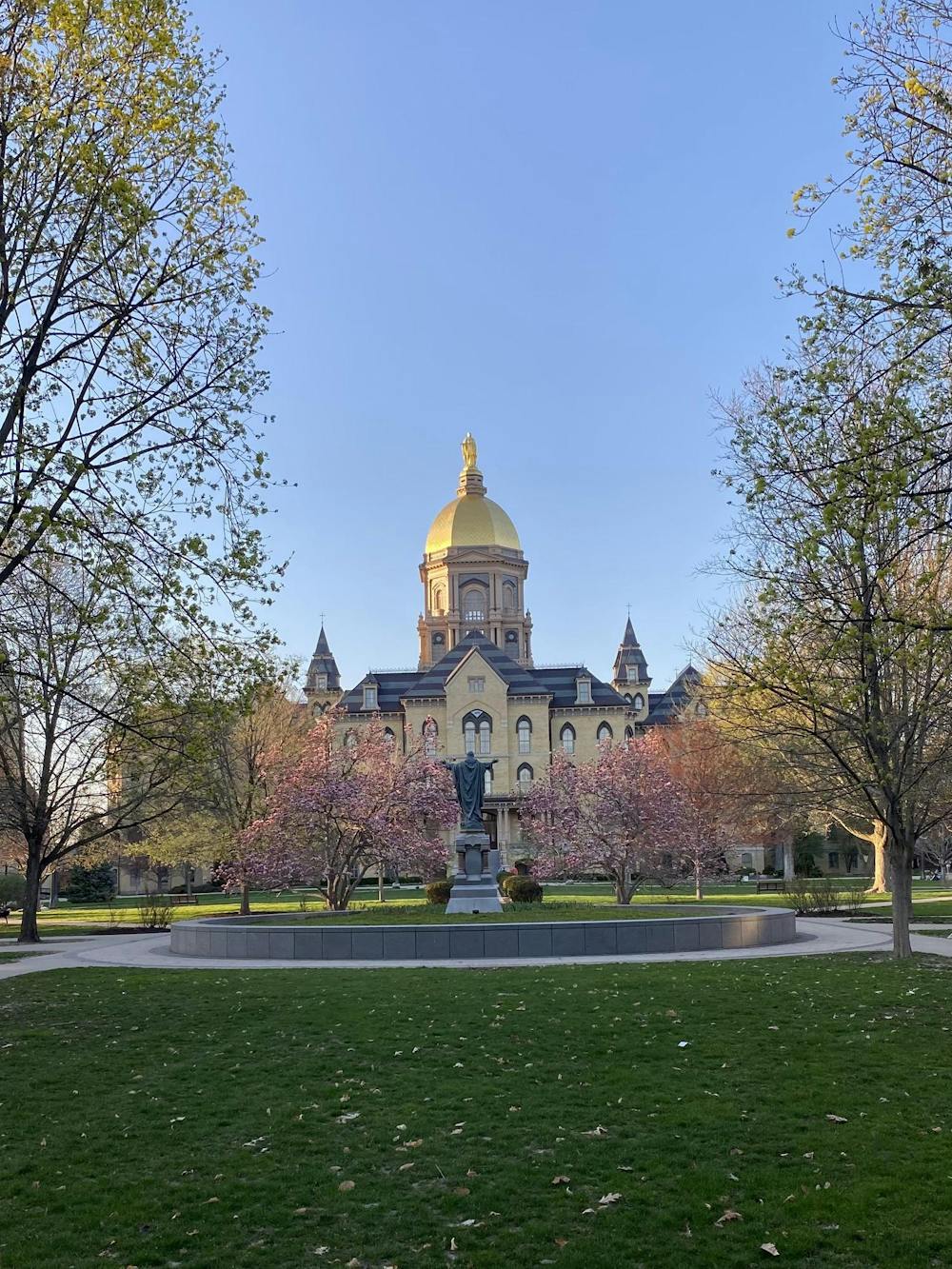
The restrictive early action deadline is tomorrow. Holy cow, the restrictive early action deadline is tomorrow.
It’s been a whole year since I hit submit on my college essays. And it’s been 10.5 months since I triumphantly emerged from the college admissions gauntlet, Notre Dame acceptance letter in hand.
I’m not one to stand on a soapbox — it’s way easier and more fun to be the one pointing and laughing at whichever poor fool climbs up there. And the amount of ink spilled on the college admissions process is absurd.
But I’m feeling pretty existential right now, as I sit cloistered away up in the tower of Hesburgh. And heck if I won’t use my platform to indulge in some philosophical musings from time to time. The novelty cereal beat only has so many leads, after all.
In high school we chased A’s and collected extracurriculars, orienting ourselves toward the bright horizon of college.
Now that we’re here, we’re chasing A’s and collecting extracurriculars, orienting ourselves towards the (slightly less) bright horizon of grad school, or a consulting job, or whatever else may come.
Once we get there, we’ll be chasing something new, orienting ourselves towards the (diminishingly) bright horizon of a promotion, fellowship or whatever comes next.
This pattern of endless pursuit, often at the expense of physical or mental well-being, has been exhaustively explored. We call it achievement culture. According to this achievement culture theory, the reason we put so much emphasis on college admissions is because there is a set of external pressures, unique to our modern age, that press you into a never-ending race for social, economic or whatever-else status.
But here’s the thing. I’ve been reading the 5000-year-old epic of Gilgamesh. I’ve been reading about today’s chapter in the epic AI arms race. Viewed in the context of human history, this narrow definition of achievement culture as an exclusively modern plight simply doesn’t hold.
For starters, there are so many other examples of this pattern throughout history.
Ancient Roman elites dedicated their lives to increasing their “virtue” in pursuit of higher office, greater status or larger wealth.
Imperial China developed a standardized examination system to confer important positions to those who performed best. For ambitious social climbers, holding a degree was a marker of elite status.
Second, look at the Epic of Gilgamesh. It’s an ancient piece, totally free of modern influence (It’s a relatively quick read, too). When Gilgamesh’s dominance is unchallenged, he is bored and becomes a terrorizer of his people. When he discovers a rival to his power, he grows excited and sets out on a thrilling quest to slay a beast of nature. Later in the epic, he is energetic in his quest for immortality, but then at the end of the road is met with denial and disappointment.
Gilgamesh seems happiest in the state of chasing something, only to be disappointed and unfulfilled in the end. Is this the point? Are we incapable of being content, no matter how great the reward or power we achieve? Is this what drives us to constantly chase bigger and better things? Not, despite what we may tell ourselves, for the prize at the end of the road, but for the chase itself?
Thousands of years later, the setting has changed, but it’s the same exact story.
The tech industry has changed a lot over the past 10 years.
The stereotype of the Silicon Valley engineer making six figures out of college, working four days a week from a plush beanbag, artisanal coffee in their hand, has evolved into a performance-driven, high stakes arms race for data centers and AI supremacy.
What can AI possibly do to make our lives better that justifies the steep prices we are paying to make these advances? Why was the tech industry not content with their comfortable lives and high salaries? Why did they insist on chasing this new goal that has made their lives demonstrably worse?
Perhaps it is our economic system that has been built to reward constant revenue growth and expansion through artificial agents like the stock market.
Perhaps it is the ego and drive of a select few moguls, using their power to drag society into their conquests, unconcerned with the collateral damage they cause to us.
Perhaps it is simply human nature. Perhaps in us all is an echo of Gilgamesh’s constant restlessness, his inability to be content no matter his power; no matter his successes. Perhaps in us all is that constant need to chase.
A year ago, I thought hitting “submit” would be the end of something. As it turns out, it was just the start of another race. Maybe that’s the point. Gilgamesh never found immortality, but he did keep moving forward. Maybe we’re not meant to escape the chase, just to learn how to embrace it. Let's do that.
Danny Baribeau is a freshman studying English. He is from Holliston, Mass. - but more importantly, he lives in O’Neill Family Hall. You’ve probably seen him running around Saint Joseph’s Lake, or grilling steaks with the Knights of Columbus. You can reach out to Danny at dbaribea@nd.edu.