
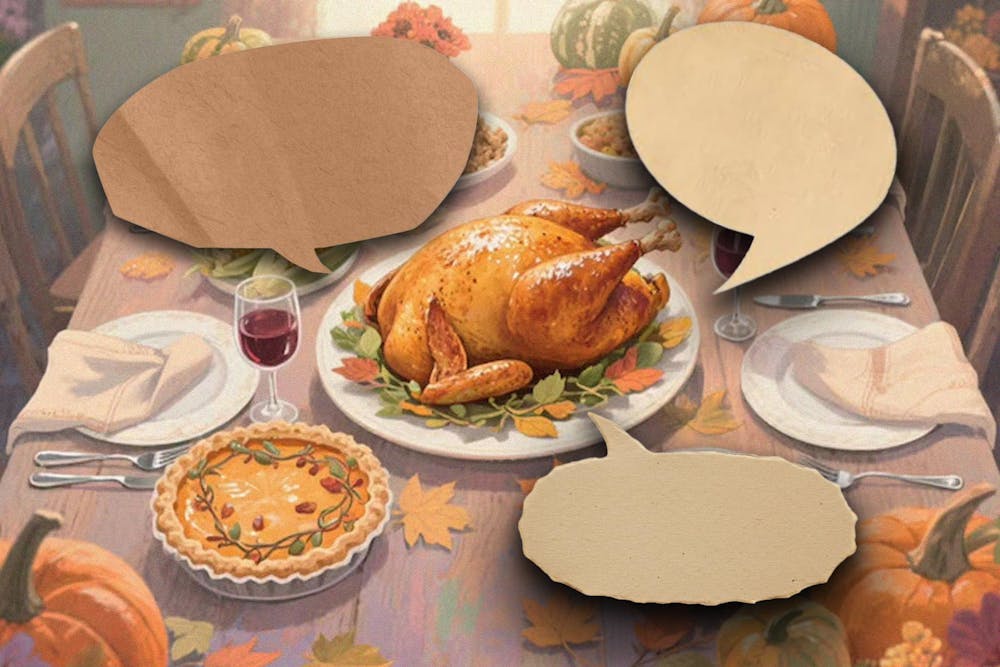
Now that we have all recovered from the frights of Halloweekend, it’s time to bury our costumes in the backs of drawers, toss out any straggling jack-o-lanterns and start mentally preparing for the next big holiday: Thanksgiving. Many of us are already dreaming about catching the quickest plane, bus or car back home in time for a cozy, home-cooked Thanksgiving dinner. There, we’ll gather with family and friends as healthy portions of turkey, stuffing and politics are inevitably served.
While the merits of turkey and stuffing are generally undisputed, there are mixed opinions on whether the subject of politics likewise deserves a place at the Thanksgiving dinner table. On the one hand, holidays are a time to enjoy being with our loved ones, and we shouldn’t let the intrusion of touchy subjects take that joy away. But, on the other hand, if we really love each other, shouldn’t we be able to have those conversations without stirring up resentment and anger?
These days, we increasingly live in our own political bubbles. Our phones make it easy for us to absorb whatever news we want with a simple click, swipe and scroll, which gradually encloses us in an echo chamber in which any dissenting opinion is seen as a threat. Obviously, this is a net negative for our society, and we see evidence of that all the time. Just since coming to campus a few months ago, I’ve heard everything from “All conservatives are racist” to “Liberals are the dumbest people in this country.” The statistics also seem to suggest rising levels of political polarization in our nation. According to a recent study by the Pew Research Center, 61% of U.S. adults find it “stressful and frustrating” to have a conversation with someone they disagree with politically. Intolerance for other people’s political opinions has escalated so much that it has culminated in a recent surge of politically motivated attacks, making it impossible to ignore how serious our nation’s crisis of polarization has become.
Collectively, we need to address this issue, and that starts on an individual level. One way to start escaping our own echo chambers is to start reading news from both sides of the political spectrum, which helps expose us to different points of view and develop nuanced opinions based on all and not some of the facts. This can also help us become more media literate — we’ll improve at distinguishing truth from lies. But at some point, we have to put our phones down and talk to an actual, real-life human being. We can’t be afraid to engage with people who are different from us.
This is where friendship comes in. For many of us, an important priority in choosing our friends is shared values. It’s completely fine and normal to desire friendships with people with whom we have things in common, especially when those things are highly important to us. Having shared values immediately provides a foundation for a relationship that makes it stronger and more likely to last. However, when we always gravitate towards people who think much the same way as we do politically, it can perpetuate the echo chamber we have built through our phones by continuing to homogenize the views to which we are exposed on a daily basis.
So, what does it mean to be friends with someone you disagree with? I think the most important part is simple: just spend time with them. Find activities you both like to do, things you have in common and allow yourself to just enjoy their company, as you would with any other friend. You may disagree on certain subjects, but that shouldn’t dominate the nature of your relationship with them. Focus on who they are beyond their opinions. And when a topic of disagreement naturally arises, you should feel comfortable enough to have an honest conversation with them, having already built a relationship founded on mutual respect and trust. These types of honest friendships can be some of the most unconventional, yet some of the most rewarding – they broaden our worldview, introduce us to new perspectives and teach us how to engage in respectful and constructive disagreement.
Unlikely political friendships between public figures line the pages of history. Take Supreme Court justices Ruth Bader Ginsburg and Antonin Scalia, for example, two colleagues with opposing political views who enjoyed a warm friendship over the course of their careers. The two bonded over their love for opera and came to genuinely value each other’s company, going so far as spending holidays with each other’s families. And, of course, there’s the relationship between two of our nation’s founding fathers, John Adams and Thomas Jefferson. The surprising friendship between an uptight northerner and a cool southerner blossomed as they united for the sake of the Revolution, and although they experienced a period of conflict over their different opinions on government, the two men eventually reconciled and remained close until their deaths.
Imagine how different our political climate would look if people weren’t afraid to befriend (or at least view favorably) their political opponents. I believe we would see polarization de-escalate, for one. I also think there would be an increase in tolerance, empathy and — dare I say — progress in passing legislation? Maybe once we remember the humanity of the opposite political party, we wouldn’t straw-man their arguments so much, label them as dumb without first listening to them speak or let petty squabbles get in the way of everyday improving our country together.
Now that I think about it, maybe politics doesn’t belong at Thanksgiving dinner. No matter how tolerant we may be ourselves, there will always be people offended and perhaps it’s not worth souring the taste of Grandma’s homemade stuffing by bringing up immigration policy or suggesting who’s to blame for the government shutdown. But in the spirit of the first Thanksgiving, which brought together the European colonists and Native American tribes to share a meal, the pure act of coming together out of mutual respect and love for each other shows we are being intentional about growing relationships with the people we love, despite conflicting political beliefs. And that, in itself, is a small step toward a country less divided.
Noirin Dempsey is a freshman from Lake Geneva, Wisconsin currently living in McGlinn Hall. When she’s not studying English and journalism, she can usually be found playing piano in the McGlinn chapel, wandering the snack aisle at Trader Joe’s or watching the Chicago Bears lose football games. You can contact Noirin at ndempsey@nd.edu.


