With Thanksgiving approaching, I would like to reflect on my experience of celebrating it as someone who did not grow up with this tradition and on my relationship with adapting to American culture as an international student. Each November, as conversations on campus turn toward family gatherings and travel plans, I reflect on what this holiday means to me as an international student. I have found it profoundly meaningful to share my journey of negotiating these identities, to acknowledge the vulnerability of my early encounters with this culture and to value the strength that comes from belonging to both worlds.
When I first came to the United States in eighth grade, I already knew what Thanksgiving was supposed to be; my international school back in Beijing, China taught me everything about its history, the turkey meal and the opportunity to express gratitude to those important to us. I thought I understood everything about it.
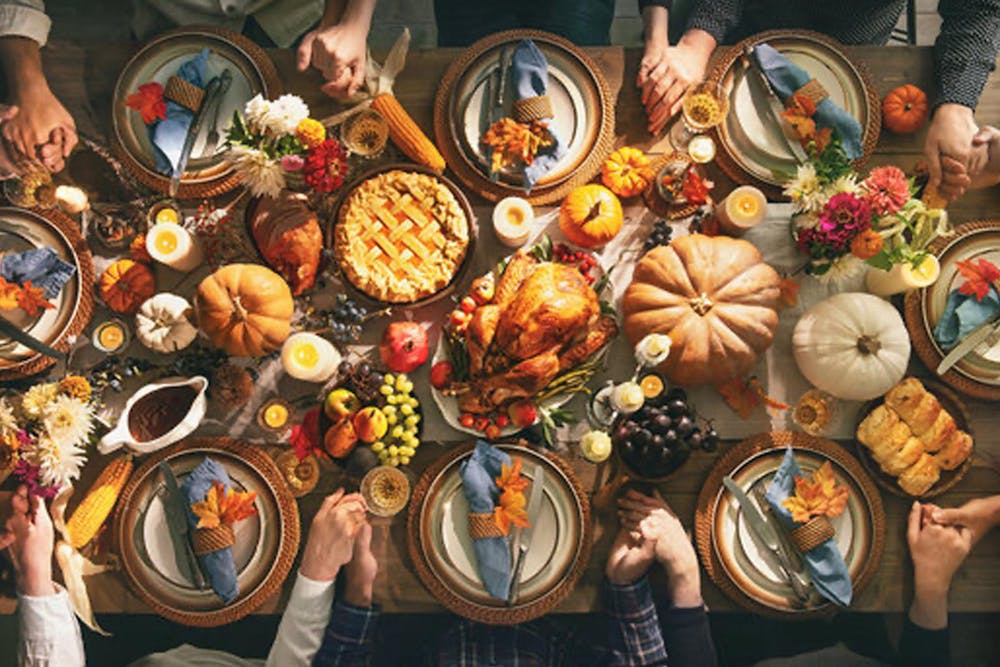
So, when I was invited to my first Thanksgiving dinner at a friend’s home, I expected familiarity. But once I arrived, surrounded by the smell of turkey and the warmth of family conversation, I felt a kind of unease, yet I didn’t know why. That discomfort was subtle but persistent. It wasn’t simply homesickness; it was the awareness of being included in something deeply communal that was not, in any real sense, mine.
I carried that confusion with me through high school and into college. Over the years, through courses on global diversity, cultural theory and transnational identity, I began to find a language for what I had felt. What I experienced was not alienation, but the tension inherent in cultural adaptation: the negotiation between learning from a culture and being shaped by it. That tension is central to the experience of almost all international students: the constant recalibration between understanding a place and being understood by it.
Taking relevant courses has enlightened me that cultural adaptation is not a linear process, nor is it simply about “fitting in.” Scholars describe it as a dialogic exchange between self and environment, where our identity is continuously reconstructed through interaction. My early discomfort at my friend’s Thanksgiving dinner marked my initial confrontation with cultural differences. Over the years, I have come to understand that such encounters are ongoing: some compel vulnerability, while others cultivate resilience.
Having the privilege to connect with peers who share my experiences, both at my high school, Blair Academy, and Notre Dame, through shared dialogues, I came to realize that I am not alone and that cultural assimilation does not necessarily carry a negative connotation. For a long time, I associated assimilation with a quiet erasure of one’s origin in the pursuit of belonging. But I have come to understand that it could also be the accumulation of perspectives, values and languages that enrich rather than dilute one’s sense of self.
Today, I take pride in possessing an identity that bridges both Chinese and Western cultures. I no longer feel the need to choose between them. Instead, I have learned to navigate the space between, from which I gained courage and confidence in who I am. This is exactly why I feel the necessity of sharing the vulnerability that I felt when I navigated through this journey.
Now, when Thanksgiving arrives, I find comfort in participating on my own will. This year, I will be traveling to Chicago with friends from home who also go to colleges in the States. Though our celebration will not replicate the traditional American Thanksgiving, it will still embody the sense of gratitude, reflection and connection embedded in the traditional American Thanksgiving.
I found it more important to realize that the core values of Thanksgiving — community, reflection and gratitude — transcend national boundaries. In that sense, it has taught me something fundamental about belonging: that it is not defined by cultural purity, but by participation and empathy.
The process of balancing multiple identities remains ongoing. I sometimes still feel a sense of ambiguity that words can’t describe, yet I have learned to embrace these moments of uncertainty and confusion. Cultural duality allows me to perceive the world with greater dimensionality, to see both where I come from and where I am now as parts of a continuous narrative rather than competing ones.
In retrospect, I no longer see my first Thanksgiving discomfort as something to overcome. It was an essential moment of awareness, with countless other moments like this, that taught me the fluidity and transformative nature of our identity. Gratitude, I’ve realized, is not confined to a single culture or table. It is a universal gesture of recognition.
Molly Wu is a junior studying political science and economics. While she was originally from Beijing, she went to a boarding school in New Jersey since high school. Growing in an environment that stresses the importance of diversity, she enjoys absorbing and sharing different perspectives. You can contact Molly at lwu5@nd.edu.