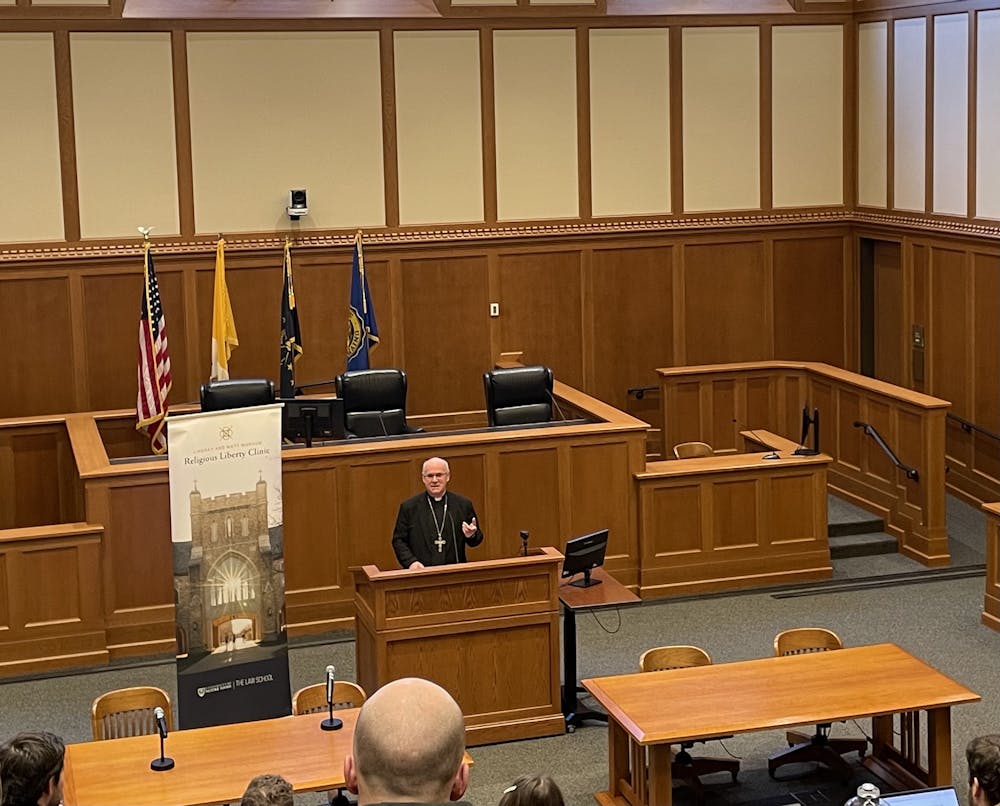
Just a week after the United States Conference of Catholic Bishops issued its first special message in 12 years condemning the Trump administration’s deportation tactics, Bishop Kevin Rhoades of the Diocese of Fort Wayne-South Bend spoke at the Notre Dame Law School. He delivered a message on the importance of religious liberty and humane care for immigrants.
Rhoades serves as an advisor to the White House’s Religious Liberty Commission and until last week was the chairman of the USCCB’s Committee for Religious Liberty, when he was elected secretary of the USCCB.
In his speech, delivered Monday afternoon in the McCartan Courtroom and sponsored by the Law School’s Lindsay and Matt Moroun Religious Liberty Clinic, Rhoades offered his support for the USCCB’s special message and condemned the anti-immigrant rhetoric and deportation policies of the Trump administration.
“In last week’s special message on immigration, we expressed our strong opposition to the indiscriminate mass deportation of undocumented immigrants, we expressed our serious concerns for the welfare of immigrants, living in fear and anxiety around questions of profiling and immigration enforcement, along with the vilification of immigrants,” Rhoades said.
At the same time however, Rhoades recognized the right of the United States to defend its borders and ensure immigration occurs legally.
“We truly do recognize our nation’s responsibility to regulate its borders and to have a just and orderly immigration system for the common good,” he said. “We note that without such processes, immigrants face the risk of trafficking and other forms of exploitation.”
Rhoades drew particular attention to the ways in which Catholic charities have been limited in their ability to provide humanitarian aid to immigrants at the border and throughout the country. He noted that the federal government has cut funding to Catholic charity groups that merely provide food and housing for immigrants without legal permission. Rhoades also criticized Texas attorney general Ken Paxton for investigating the Catholic charity Annunciation House, which provides support for immigrants, and refuted his charge that the organization was harboring immigrants living in the country illegally.
Rhoades also lamented that the Diocese of Fort Wayne-South Bend was being investigated by Indiana attorney general Todd Rokita, who alleged that the diocese had information relevant to an investigation on human trafficking in Fort Wayne. Rhoades said the diocese has nothing to hide and is one of the foremost organizations providing support to victims of human trafficking.
“I don’t really understand what they’re after … To my knowledge, we have no responsibility to check someone’s immigration status or to report to the government if we know somebody is undocumented. We’re not an arm of ICE,” Rhoades said. “I don’t know where this is going to go, but [it] kind of gives you an idea of the atmosphere.”
Rhoades also said the Church has been advocating to the federal government that serving immigrants does not constitute harboring them and that religious organizations should be able to serve people without inquiring about their immigration status. He insisted on the importance of the work of Catholic charities, despite the pressure from the government.
“The Church is just doing the work of the Gospels,” Rhoades said. “Ministry to migrants is not peripheral to the work of the Church. It’s part of Christian discipleship.”
When it came to threats to religious liberty of migrants, Rhoades focused on the ability of immigrants without legal permission to worship without fear of arrests and receive pastoral care and the sacraments when detained. He condemned the Trump administration’s rescinding of a rule preventing deportation operations at churches, schools and hospitals and stated that the USCCB had filed an amicus brief in the Mennonite Church U.S.A. v. U.S. Department of Homeland Security case challenging these deportations tactics.
Rhoades and the Church have also condemned the restriction of access to the sacraments in an ICE detention center in Illinois and other parts of the country. Rhoades said he had been hesitant to issue a statement on the matter when priests had not gone through proper protocols to enter the facilities, but he issued a statement when the priests were still denied access after going through the proper channels.
“We will continue to work on this issue of religious liberty, access to the sacraments and pastoral ministry for immigrants in detention centers,” Rhoades said.
He also urged the government to accept more refugees and to offer pathways to legal status for immigrants who have been in the country for a long time.
While the USCCB’s special message focused on the actions of the Trump administration, Rhoades stressed that threats to religious liberty and the Church’s ability to conduct its mission have come from Democrats as well. He pointed in particular to a Biden-era U.S. Department of Health and Human Services policy, the Office of Refugee Resettlement rule, which required organizations receiving funding to pay for transportation for abortion and “gender-affirming care” for migrants. He also recalled that the bishops’ special message 12 years ago was in response to a contraception mandate by the Obama administration.
Rhoades said the bishops try to comment only on moral issues and not stray into making political judgments.
“We only deal with issues that are moral issues that have to do with the rights, human rights of people and human dignity,” he said.
Rhoades ultimately urged his audience to put their identity as Catholics above their political identities.
“There are some who are so taken by the ideology of the left or the right that what the Church says is secondary to their ideology,” Rhoades said. “That’s very troubling, because I’ve always said, be Catholic first, be a disciple of Jesus first, before being a Democrat or being a Republican. And I think, to be honest, the majority of our people get it.”