
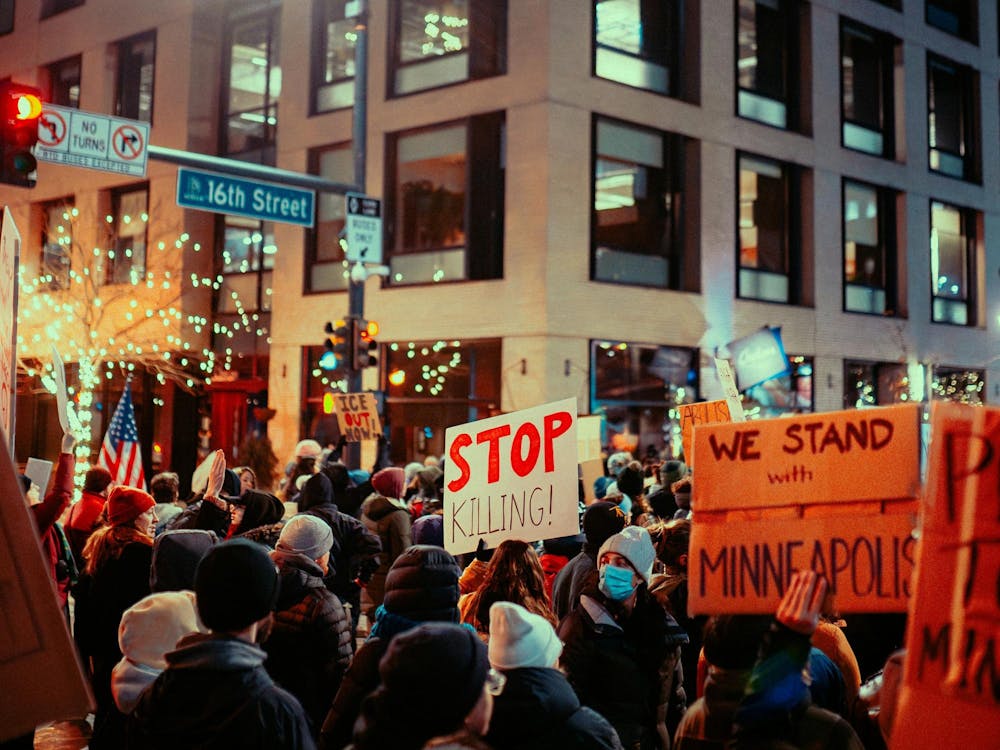
Last December, the Trump administration announced Operation “Metro Surge,” a major federal immigration enforcement campaign focused on the Twin Cities of Minneapolis and St. Paul.
The effort has sparked nationwide controversy following the deaths of Renée Good and Alex Pretti, two U.S. citizens killed during encounters with federal immigration agents, triggering widespread protests and debate over ICE's enforcement practices.
“When families are torn apart, citizens are unjustifiably killed, and entire communities are forced to live in fear, immigration enforcement ceases to be about law and becomes an instrument of cruelty,“ Notre Dame College Democrats wrote in a statement to The Observer. “Catholic Social Teaching shows us the inherent dignity of every human person … the administration’s actions through ICE stand in direct opposition to these principles.”
Meanwhile, the Notre Dame College Republicans voiced firm support for President Trump's immigration enforcement policies in their own statement to The Observer.
“The Notre Dame College Republicans unequivocally endorse the President’s resolute enforcement of federal immigration statutes. These deportation mandates were duly enacted by Congress through the constitutional legislative process and carry the full force of United States law,” the club wrote. “Should agitation escalate into sustained violence or armed interference against federal law enforcement officers, we strongly urge the President to immediately invoke the Insurrection Act of 1807, deploying the United States military as necessary to restore order, suppress the rebellion, and ensure the faithful execution of the nation's laws.”
For Notre Dame students and faculty alike, the discussion over ICE’s activities has been shaped by the University's Catholic mission, which advocates for the human treatment and protection of migrants. Professor Antônio Lemos, a teaching scholar in the Notre Dame Department of Theology who published a dissertation on migration ethics in July 2025, noted the Church's longstanding support of migration.
“It was very unanimous in the 20th century, pretty much every single Pope said that people have a right to migrate,” Lemos said. “It's not just that we should be nice to migrants, but that migrants have a claim to migrate across international borders.”
Catholic Social Teaching emphasizes the human dignity of all people, but Lemos emphasized that this obligation does not absolve a society of its right and responsibility to secure its borders. For Lemos, the core policy question for Catholics is how to craft a system that both recognizes the human dignity of all people while allowing the state to care for its citizens.
“Popes realized [migration] was not an absolute right. People cannot just migrate whenever they want … states have a duty, not just a right, but a duty, to secure their borders, to avoid criminals, to stop terrorists and to make sure that their communities have everything they need,” he said. “You cannot receive migrants and put them on the streets during winter because you don't have a place to accommodate them. So for the migrants themselves, each country must take into consideration how many people they can receive.”
Theology professor David Cloutier, who specializes in moral theology and Christian ethics, also argued for a prudent immigration policy, highlighting the need to address what he views as structural issues within America's immigration system.
“I don't know how anyone can look at the present American system, even if they want low migration, and think that our system is working … Migration that is not well planned is very hard for societies to handle, no matter how rich they are,” he said. “There are inevitably structural problems that have to be dealt with. Big problems in the world require various kinds of planning ... and right now we're particularly bad on the question of these operations.”
Minneapolis has become a flashpoint of this broader immigration debate. The White House has framed Operation “Metro Surge” as a vital step in “removing [dangerous criminal illegal aliens] from our country,” while critics argue that ICE has acted unethically by using excessive force and possibly violating civil rights.
“Another problem our local bishop, Kevin Rhodes, was denouncing is the violence, but also the limitations to religious freedom,” Lemos said. “Church raids, that’s bad, or people who were arrested and cannot have the support of a minister … [meaning] priests or pastors cannot visit them in their retaining centers.”
For Minneapolis students at Notre Dame, the situation is particularly personal and divisive. Drew Hemmesch, a sophomore in O'Neill Family Hall, viewed the Trump administration's enforcement practices as a pretext to inflict harm and terror across immigrant communities.
“ICE’s operations in my home city of Minneapolis over the past year and particularly over the past few months have been extremely reprehensible and repulsive,” he said. “Although ICE is supposed to be a government institution that upholds the law, they have made an egregious overreach of power and have continually terrorized and killed the people of Minneapolis that they were supposed to protect … people do not understand the severity of the situation for immigrants in Minnesota.”
Nathan Ward, a sophomore from Minneapolis living in Graham Family Hall, offered a contrasting perspective, viewing ICE’s actions as a justified response to rising crime in the Twin Cities.
“Crime has gone up. They need to figure out a way to deal with the unrest. I understand that the actions the current administration is taking are not popular with everyone,“ he said. “People do have concerns about the human aspect, and I think those are warranted concerns to have, but at the same time, I think … there is a duty to make sure we are following the rule of law and are promoting our own stability as a country. All that is to say, I generally am supportive of what is going on right now.”
Nolan LaMere, a Siegfried Hall freshman who also hails from the Twin Cities, expressed reservations about ICE's actions. While in favor of enforcing immigration law, he specifically had problems with its implementation.
“I think that immigration policies should be enforced, but there are a number of groups that should be prioritized more than others,” he said. “Recent crossers who have not established roots, individuals with extensive criminal histories and consolidated crossers near the border. Individuals who have established roots in the United States, while still being here illegally, should be de-prioritized in immigration enforcement.”
Although Operation “Metro Surge” remains ongoing, the Trump administration recently announced a partial drawdown, withdrawing roughly 700 agents from Minneapolis, even as the effort continues to fuel national debate.
“I recognize that the immigration issue is a very nuanced and complex problem that requires a lot of sensitivity and a lot of thought,” Ward said. “At the same time, two things can be true. I think we are called to show dignity and concern for all while still respecting the rule of law … I think we must keep that in mind so that we as Americans can promote human flourishing for all people.”


