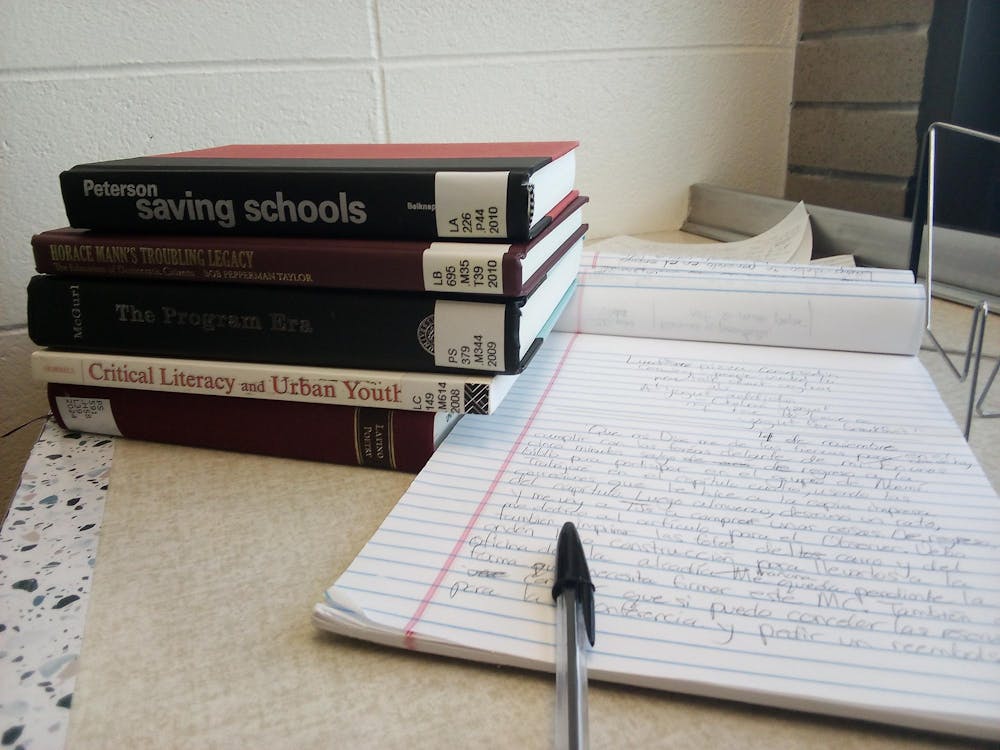
Over the last week and a half, I have scrupulously avoided asking people about their fall break. To do so would have entailed giving a reciprocal explanation of what I did. I would have had to explain how fall break, spring break’s less-glamorous cousin, saw me sweating it out at a dissertation boot camp in Hesburgh Library. I would have groaned. I would have griped. I would have cursed in my head while marveling outwardly at how much work I got done. Thankfully, it’s November now. So people don’t care about fall break anymore.
But I’ll tell you about it, anyway, dear reader. Just to get it off my chest. From roughly 8:30 a.m. to 4:30 p.m., Monday to Friday, I was part of a crew of about 30 graduate students from a variety of disciplines who gathered in the northwest wing of the library’s second floor to write in three-hour blocks. Some were first years barely scratching the surface of this battle of the nerds we call graduate school. Others, like myself, were several chapters deep into their dissertation, with scores of gray hairs and forehead wrinkles to show for it.
Every morning, a tray of breakfast foods, including bagels, yogurt and eggs, would greet us. For lunch, we got catering from a variety of local restaurants. Then, in the afternoon, one of the librarians would wheel in a snack cart with cookies, chips and chocolates. There were two Keurig coffee machines and instant coffee, so I was wired the whole week. On Monday, we had lunch from Aladdin’s; Tuesday, we ate Panera; Wednesday, there was Franky’s Tacos; Thursday, we got Jimmy John’s; and Friday, lunch was Cottage Inn Pizza. By day three, my stomach felt like hot garbage. But I kept eating and pounding down the coffee like a madman. I went all five days and worked diligently. I accomplished my goal of writing a 15-page conference paper that would also serve as the basis of one of my dissertation chapters.
At the end of the week, though, I was wiped out. And sad that my break was over. I began to question myself. When did I become this person? The one who foregoes vacations to duke it out with dusty books in the silence of the library? I look back and see myself caught in some monstrous time warp. The four years I spent working after my bachelor’s degree are a blur. The seven years I’ve spent in graduate school a mirage. Was it intellectual curiosity or intellectual masochism that put me on the Ph.D. path? How did I go from being a married man to a divorcé with two cats? Maybe, at the end of the year, I will have a good answer for you, dear reader. For now, I’ll keep writing about the boot camp and see where that takes me.
Fourth-year Ph.D. student Nidhi Surendranath, who, like me, is in the English Department, used the boot camp to work on her first chapter. Her project focuses on contemporary British and American elegies — that is, poems that mourn the dead. She’s interested in how these compositions interact with other media, such as songs and television, to reanimate the departed (very apropos Halloween). This is Nidhi’s first year writing her dissertation. “Basically, after coursework, you are told to go away and write,” she said. This can be a lonely and bewildering experience. So the structure of the boot camp, with goal-setting in the morning, and a wrap-up the afternoon, was especially helpful, she said.
Lauren Mayer, a fifth-year Ph.D. student in Integrated Biomedical Sciences, said something similar. The boot camp set-up “really works for people who are Type A,” she said. “Personally, I really thrive on schedules and having things at the same time.” Mayer studies irritable bowel disease within the human digestive system. Even though she had to step out for a day to check on her mice experiment, she was able to get a ton of writing done — around 5,000 words, in fact. “My advisor was really impressed,” she said.
My friend Noemi Fernandez Labarga participated and also led the morning goal-setting (full disclosure: Both of us are graduate tutors who work for the University Writing Center. I did the afternoon wrap-up for the boot camp). During lunch one day, Nidhi and I joked that Noemi, a fifth-year in English, should get an award from the dean of the library. She’s done every boot camp since spring 2022, which amounts to eight. Noemi describes herself as a binger, meaning that she gets the most work done in spurts of intense writing, such as these camps. “Just being in a room where people are doing the same thing makes you feel like you are part of something bigger,” she said. “It helps knowing that you are not the only one having such a bad time” with the writing.
Well said. For my part, I will try to emulate Noemi and do as many boot camps as I can. Until next time, dear reader.
Oliver "Oli" Ortega is a Ph.D. candidate in English specializing in contemporary Mexican-American and Latino literatures. Originally from Queens, NY, he has called the Midwest home for 15 years. He lives in downtown South Bend. You can contact Oliver at oortega1@nd.edu.