
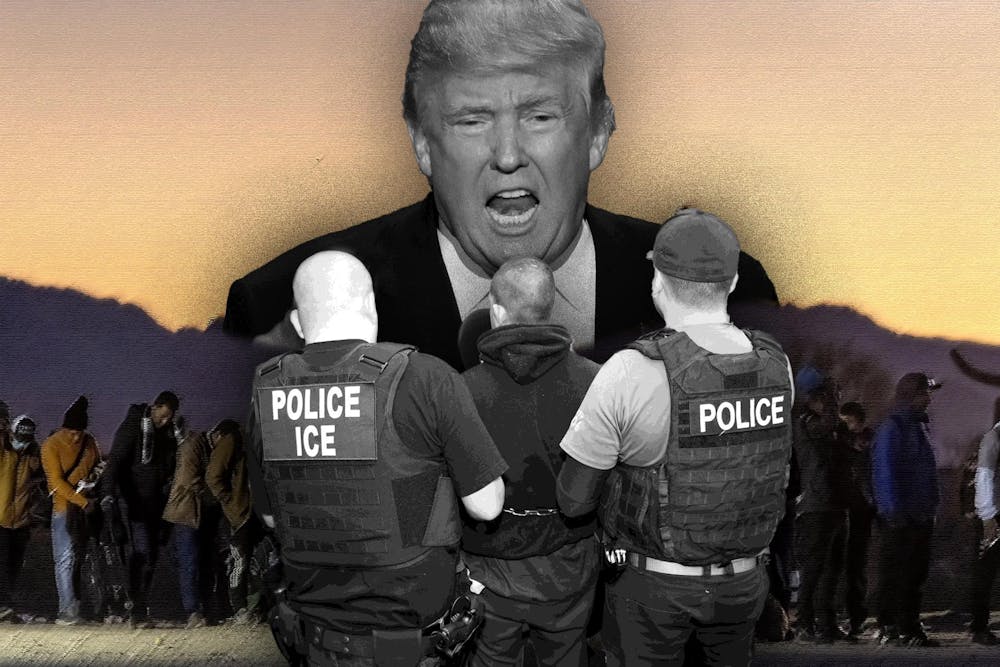
As a child, the word “alien” evoked thoughts of E.T., space and the unknown. As a young adult, when I hear aliens, I think of what I know — and that is more terrifying to me.
“The Democrats say, ‘Please don’t call them animals. They’re humans.’ I said, ‘No, they’re not humans, they’re not humans, they’re animals,’” That was the current president’s words in 2024, talking about immigrants in Michigan.
He was speaking about Laken Riley’s murder. The perpetrator was someone who did not have legal immigration status. Many of you reading will wonder if I am going to be yet another person who monopolizes violence against women for my own agenda. The answer is no. Violence against women is an epidemic infecting the entire world, and it is prevalent in countries with varying levels of immigration.
I want to focus on the dehumanizing language toward immigrants used by the current administration. I want to emphasize that the dehumanization of even one person is dangerous to the dignity of everyone. Dehumanization is simply an easy way to dismiss the fact all humans are capable of great evils. Dehumanizing one group is an attempt to isolate their unfavorable behavior from the rest of society, but there is no singular group that alone is susceptible to unfavorable acts.
Trump’s consistent dehumanization of immigrants has prompted a revival of words like “alien” in the media. The power of language is incomparable, and “alien” reinforces the idea that immigrants are from some other world and completely different from us, as does the word “animal.” Using language that likens anyone, whether they have legal status or not, to a sub-human creature is dangerous.
White House press secretary Karoline Leavitt told us, “It’s a big culture shift in our nation to view someone who breaks our immigration laws as a criminal,” and that is what the current administration has done. But how do we not see the inherent dangers in doing so? Not all undocumented people are criminals, and to assume so is to completely negate the fact that many pay taxes, contribute to the economy, go to school and work hard.
Being undocumented is a civil violation. It is only classed as criminal in specific situations, including illegal entry and fraudulent documents. Overstaying a visa, for example, is, on its own, not a criminal violation in the United States. We have entered into a period where lines are becoming blurred and important distinctions are becoming lost in favor of generalizations.
The notion that if you’re here legally, it’s no problem, is commonly stated, but holds little truth. ICE is creating fear amongst communities across the country. In September, the Supreme Court voted 6-3 in Noem v. Vazquez Perdomo, which halted federal district court judge Maame Ewusi-Mensah Frimpong’s order to effectively bar “roving patrols” from snatching people off of the California streets and questioning them based on how they look, what language they speak or where they were from. The Supreme Court issued a brief, unsigned order that overturned what Ewusi-Mensah Frimpong said.
The order is not final, but it is an indicator that the Supreme Court potentially might not uphold the previous strict constitutional limits on the authority of immigration agents. ICE is essentially granted the power to question and harass anyone they think is an immigrant. Many of these people are simply on their way to work or to see their families, friends and loved ones.
They live in this country as you do, and they love just as you do. Why are we giving federal agents the power to treat anyone they choose as a second-class citizen? Is this not the land of the free? Currently, it is looking like the land of the free for some, not for all. ICE is an extension of the government; if the president refers to people as aliens and animals, that is exactly how ICE will treat them. I urge you to look beyond yourself for a moment and think about the power we are allowing these actors to have.
in her dissent to Noem v. Vazquez Perdomo, Justice Sonia Sotomayor wrote, “We should not have to live in a country where the Government can seize anyone who looks Latino, speaks Spanish and appears to work a low-wage job. Rather than stand idly by while our constitutional freedoms are lost, I dissent.”
We are all standing by as more and more constitutional freedoms are lost. If you are thinking this could never happen to you, I urge caution. Persecuted groups have, and will, continue to change. Just because it’s not you today doesn’t mean it won’t be you tomorrow.
Amaris O'Connor is a sophomore from London, United Kingdom currently living in Flaherty Hall. She is a political science major and spends most of her free time reading or making different iced coffee combinations. You can contact Amaris at aoconn27@nd.edu.


