The Notre Dame Chorale’s annual Christmastime performance of “Messiah” was conspicuously absent from the DeBartolo Performing Arts Center’s schedule this year, but fear not: A student-led version of the popular concert is on at St. Joseph Catholic Church in Mishawaka at 7:30 p.m. on Friday, Dec. 5.
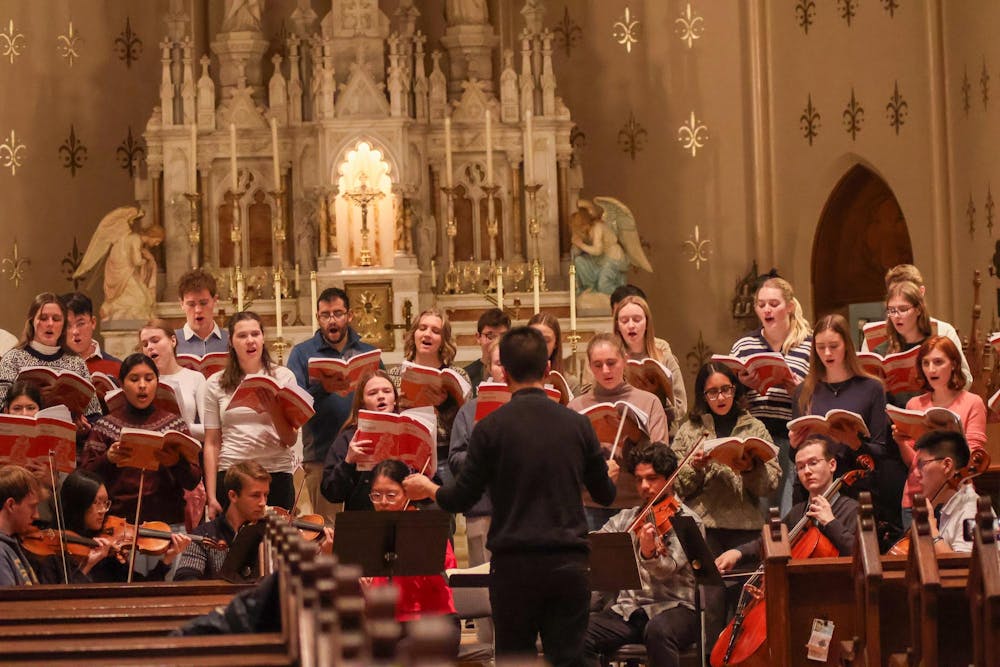
Having attended the choir and orchestra’s Monday rehearsal, I feel I can say it’s much the same “Messiah” we’re used to. At the very least, it’s many of the same musicians — and the exact same vocal scores — as always. Soprano Madeline Huie told me they’re even using the same portative organ, former Chorale director Alex Blachly’s very own.
Inevitably, though, much is not the same, the most striking difference being the performance space: St. Joseph is a far cry from DPAC’s Leighton Concert Hall, the traditional home of “Messiah” at Notre Dame.
I spied at least three musicians genuflecting and two blessing themselves with holy water on their way into rehearsal; no doubt many more did the same. As conductor Desheng Huang and senior alto Molly Mendenhall arranged the choir in the chancel, Mendenhall asked, “Where’s the soloist going to go?”
“In the pulpit!” a chorister joked.
The venue is nevertheless charming, albeit different. “I like the scenery better,” senior concertmaster Andrew Mangini remarked.
Mendenhall, something like the group’s ringleader (i.e., it’s her signature on the program notes), concurred. “Since Handel’s ‘Messiah’ is a sacred oratorio, it is a blessing to have the opportunity to perform such an incredible piece of sacred music in a religious setting,” she said.
Freshman soprano Sasha Gilders agreed too, saying, “I actually kind of like the atmosphere of the church. I think the acoustics here are actually better than they are in the giant concert hall, because when you have a smaller space you can really hear everyone, and it really brings the choir together.”
The acoustic really is beautiful, one power-hitter vocalists like sophomore bass Daniel Balof — who sings the oratorio’s first vocal numbers — can revel in filling. Although a bit of a schlep from campus, St. Joseph seems like an ideal pick and a natural home away from home for the students’ “Messiah.”
“There’s some relationship between Notre Dame and this parish,” Jerome Cole — the church’s director of sacred music — said. “There’s some former students who are parishioners here. They know me and they reached out to me to see if the space was available.”
About the logistics behind the show, Huang said, “It's really a lot of work, from recruiting to finding a venue, and finding schedules that work for the majority of the singers and players. I understand this is not a class or a university event, so people, including me, are doing our best to adjust our schedule to make it work, and I appreciate it.”
Unlike Chorale’s typical performances of “Messiah,” which tried to use period-accurate instruments, this production’s orchestra is modern and relatively large. For me, that’s a plus. Call me a kook, but I don’t want restraint out of my Handel — I want bombast. I don’t want the sublime, I want a melodrama. When the bass sings “The People that Walked in Darkness,” you want a dismal, enveloping sound to match his voice and the text. Later, when a multitude of the heavenly host suddenly appears to shepherds abiding in the field, you want the opposite, a sound that’s diaphanous and technicolor. It’s a lot harder to get those effects out of a tiny orchestra of players using gut strings, no matter how historically accurate it may be.
When the orchestra and the choir are driving at full throttle — the violins slashing away, the oboes sounding out, the hefty three-cello bassi section thrumming below, the singers weaving in and out of the texture — it’s great. There’s nothing like a good performance of “For Unto Us a Child is Born.” (I have an embarrassing predilection for the synth version by The Roches). The choruses are probably the best thing about Handel, being the dessert of his oratorios.
Mendenhall said that among her favorite moments of the rehearsal process was the first time the choir and orchestra played through the piece together. “That was the moment when I felt like the concert was starting to come together and that we would actually be able to pull this whole thing off,” she said.
If the choruses are dessert, that would make the arias the vegetables (the recitatives are either the soup or the salad), but the soloists managed to make them palatable. Of what I heard, the renditions of “O Thou that Tellest Good Tidings to Zion” by senior alto Grace Organ and “Rejoice Greatly, O Daughter of Zion” by senior soprano Claire Burks were particularly enjoyable.
If you can make it, this concert — the guerrilla stepchild of Chorale’s beloved “Messiah” performances — will be worth your time. And it’s free and unticketed, so it’ll certainly be worth your money.
“Everybody has worked extremely hard inside and outside of the rehearsal process to create a beautiful concert that I hope the South Bend and Mishawaka communities will enjoy,” Mendenhall said.