
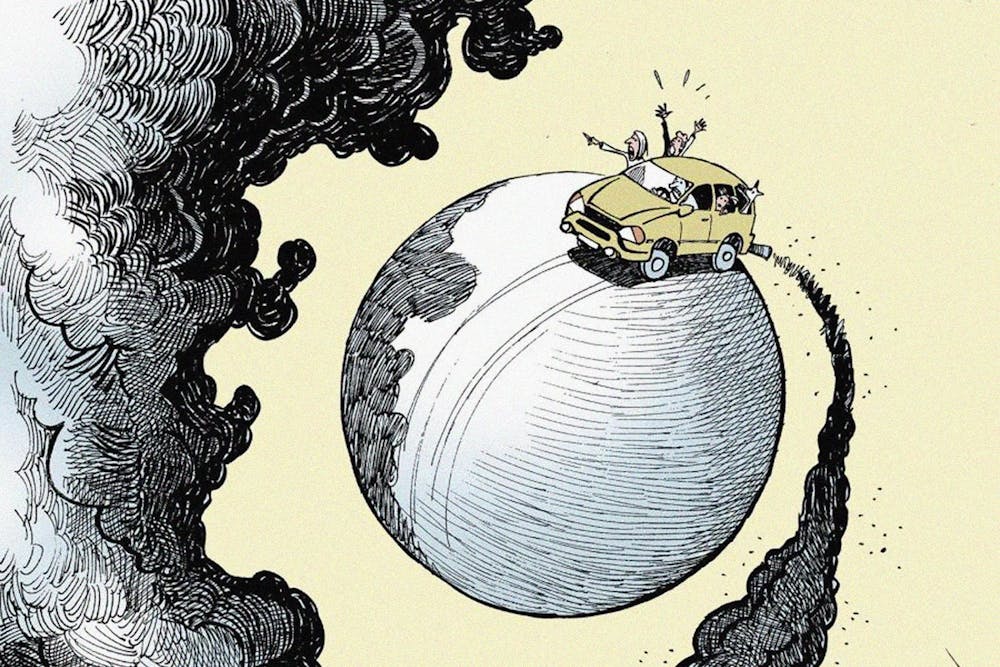
We’re entering an era where environmental instability is no longer theoretical. It’s visible in rising temperatures, extreme weather and accelerating ecological loss. Shared threats should bring societies together. Instead, polarization widens, distrust grows and political identities harden in the face of climate change.
Why do environmental threats drive us further apart when they should pull us together? As University President Fr. Robert Dowd warned in his inaugural address, “Democracies are in crisis … political polarization has reached a fever pitch. People seem so entrenched, it’s difficult to have thoughtful, constructive conversations across differences — even on college and university campuses.” His breakdown in dialogue is not just a political problem; it is an existential one.
From wildfires to flooding, these events often deepen divides rather than unify people. The public’s reaction to environmental issues is not merely scientific disagreement; it is rooted in deeper psychological responses to ecological forces. Environmentalists often blame polarization on misinformation or partisanship. But the divide runs deeper: Ecological threats shape ideological tendencies, often pushing societies toward conservatism.
Environmental politics as human anxiety
Environmental polarization reflects a deeper truth about how humans respond to existential insecurity. Ideology is not formed only by media or upbringing. Ecological conditions shape the mindset of entire societies. A study demonstrates that pathogen prevalence correlates strongly with more authoritarian and conservative attitudes. Harsh climates, natural disasters and resource scarcity similarly promote resistance to change and preference for hierarchy.
When the world becomes unpredictable, people turn toward what feels familiar and stable. These ideological reactions are psychological defense mechanisms. Research shows harsh climates create a social need for predictability and structure. We seek order in a chaotic world, even when that order prevents necessary change.
The ecology of ideology
As environmental threats intensify, conservatism and ideological rigidity tend to rise. Without cooperation, political polarization prevents collaborative environmental solutions. Dowd puts it starkly: Without the ability to cooperate across differences, we cannot meet “big challenges like our climate and environmental crisis.”
‘Conserving nature, resisting change’
Another study reveals an irony. Conservatism aligns strongly with wilderness preservation, a nostalgic love of untouched landscapes. But when environmentalism demands systemic transformation, such as environmental justice or ecomodernism, it confronts the structures that conservatism seeks to maintain.
Environmental justice is threatening because it is not only a policy agenda; it is a moral indictment of social and economic systems. It challenges values of order and stability. Policy debates are not just ideological disagreements. They are psychological responses to perceived threats.
The racial dimension of environmental fear
These ideological patterns are strongest among white Americans, especially white conservatives. Black and Latin Americans show higher support for environmental justice and weaker correlations between conservatism and anti-environmentalism. Groups harmed by environmental injustice are less threatened by systemic change because they have benefited least from the status quo.
Those who benefit most from the existing system feel most threatened by reform. Those who have suffered under it see transformation not as threat, but as hope.
What we must rethink
Environmental policy needs to acknowledge the psychological roots of ideology rather than assuming people reject climate action out of ignorance. Framing matters: Solutions that reduce perceived threat and emphasize unity may help bridge polarization.
Real climate solutions confront structural inequality, even if it triggers ideological resistance. Environmental crises force us to confront not only our impacts but also fear of uncertainty and attachment to order. True climate action requires humility: the courage to accept that our systems and our defenses of them are part of the problem.
Polarization as an existential feedback loop
Ecological degradation increases our sense of threat. That strengthens attachment to existing structures. That attachment impedes reform and the degradation worsens. A warming world pushes us toward the very ideologies that prevent us from cooling it.
Dowd warns that “either-or thinking” pulls us away from universal values. Environmental justice asks us to think beyond rigid binaries, yet our psychology pushes us toward them. Polarization erodes the cooperation required to break the cycle of fear and resistance.
Pope Francis calls for a new politics based on solidarity and civic friendship. “Every violation of solidarity and civic friendship harms the environment.”
The question we face
This crisis of cooperation is itself part of the climate problem. The planet is changing. The question is whether we can change with it. If fear drives us to cling to the world we know, we may lose the world we have.
Sofia Dahl-Santoro
Saint Mary’s College class of 2027
Dec. 1


