
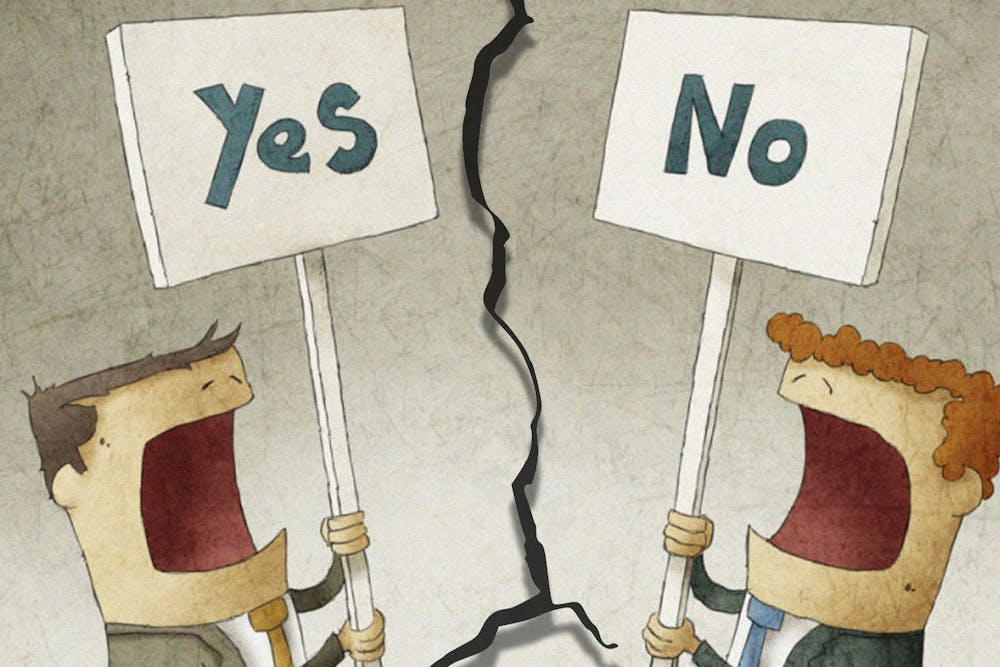
On Nov. 19, I read The Observer column “An era of consensus,” written by Sam Marchand. I frankly found myself baffled by the reasoning by which Marchand asserts that the United States has reached consensus on Trump policy. I would like to discuss that here.
To preface, Marchand does not offer his own opinion on the Republican policies he mentions, though it’s straightforward to infer he aligns with them (His language provides him an out to claim otherwise, but to do so would be akin to putting Occam’s razor against a belt sander.). I am opposed to him politically (though I wouldn’t call myself a Democrat). But my frustration with his column is only partly about political positions. It is also about his idea of consensus, and the implications therein.
“Consensus” is an imprecise term, one which could imply a litany of different things depending on context. In his use of the word, Marchand partly lays consensus at the feet of basic practicalities of politics. As Marchand states, President Trump has indeed been able to pass legislation with a congressional trifecta (and a 6-3 favorable SCOTUS). That’s not particularly shocking. Marchand is content to dismiss President Biden’s one-time trifecta by alluding to “steep opposition” (unspecified), without deigning to cite one of the 400 bipartisan bills signed over the entirety of his presidency (the CHIPS and Science Act, there’s one for free).
So, legislative success equals consensus. If, in the 2026 midterms, the Democrats gain back a majority in the House and Senate, will Trump suddenly become a divisive figure to Marchand? In his first term, a blue House impeached him twice, and his second trial saw seven senators of his party break ranks for a guilty vote. Did Trump suddenly learn how to create an agreeable political climate in his second term? As is so often the case in politics, even wins aren’t always pretty for Trump. The Democrats who sided with Trump on the shutdown issue (creating a health care crisis for millions) were responded to by their voters with outrage and betrayal. Is that a sign of consensus on Trump policy?
Disturbingly, Marchand also positively highlights consolidation of power into the executive branch and big government by the Supreme Court. These SCOTUS actions include gutting preliminary injunctions, permitting ICE to racially profile suspects and lifting anti-discrimination measures in the armed forces. These are conservative wins, certainly. Do they mean consensus simply because Marchand asserts so?
Extreme rhetoric also seems to be an important concern of Marchand’s regarding consensus. Indeed, for him, Kamala Harris’ labeling of Trump as a fascist seems enough to torpedo any sentiment of consensus in the Biden term. I wonder whether Marchand considers Trump’s blatant call for Democratic congresspeople to be executed (stated the day after his column was published) to be divisive. Perhaps Trump’s continued unhinged posting of AI slop content showing him going to war with protesters and the city of Chicago might qualify. By Marchand’s standards, it certainly should, since any hyperbolic or violence-implying language from the previous president and vice president does.
The only thesis statement I can glean from Marchand’s column is a celebration that his candidate and policies are currently seeing success. “We won, you lost. Nyah, nyah.” It is a show of artless partisanship, hiding behind a conveniently nebulous word.
Frankly, Marchand wastes his time entertaining an argument like this. His energy should go to promoting and defending the policies he favors, arguing for them on their merits instead of dressing them up post-hoc with the rosy word he favors.
Historically, Marchand’s logic could be used to defend a multitude of reprehensible ideas. Slavery, genocide, repression: all things which had (or have) popular support, institutional backing and foundation in law. We can both agree that their social legitimization does not equate to their correctness.
Follow this logic tree with me. Regarding some opinion or policy: Is there a majority? Consensus! Only a plurality? Consensus! Only a favorable comparison to something else? Consensus! Oh, and if any of the above are predicated on the failures of establishments or elected representatives? Too bad. Consensus!
The consequences? Our neighbors are being kidnapped by ICE. Our health care costs are skyrocketing. Our friends are scared to be out of the closet at work or school. Our money is being stolen by billionaires.
Consensus. You keep using that word...
Aaron Fassler
2026 Ph.D. candidate
Nov. 25


