
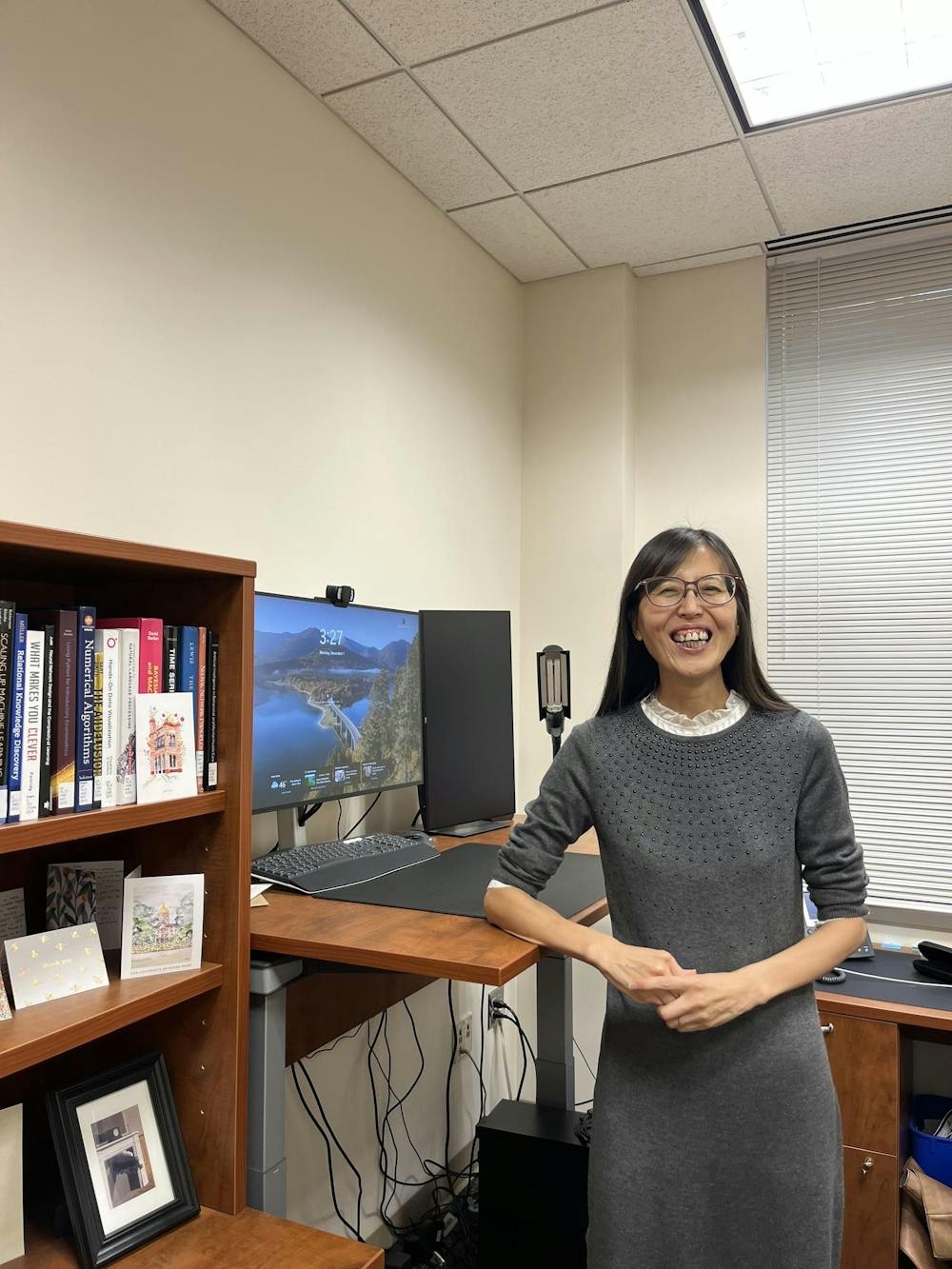
Professor Xiaojing Duan is typing at her standing desk when I knock on the door.
As the most energetic professor I’ve had at Notre Dame, it doesn't surprise me to find her on her feet. “Come in, come in!” she smiles, waving me into her office.
It’s difficult to graduate from the Mendoza College of Business without taking a class taught by Duan. Her “Foundations of Coding with Python” — a required course for all undergraduate business majors — enrolls around 60 students across multiple sections each semester. Duan has become a beloved legend among students for her far-reaching, infectious energy.
“I always wanted to be a teacher,” she explained. But she grew up in Xi'An, China after the Cultural Revolution of the 60s, where teaching was often looked down upon as a profession. Her parents encouraged Duan to pursue a degree with more secure job prospects, instead.
That’s how she found herself studying electrical engineering in college. “It wasn’t my choice,” she laughed. But the experience did have value — namely, in how she discovered a love for coding.
Duan recalled the first time she wrote her own code to turn off the light on a circuit board: “That was so empowering, because I grew up in an environment where students — especially girls — were not encouraged to ask questions, to voice [their] opinions. I felt like, ‘Oh, my voice can be heard. I'm in control.’”
It’s clear that Duan never forgot that feeling of empowerment — or her dream of becoming a teacher. She went on to study computer science in graduate school before moving to the U.S. for a one-year, educational technology program. Wanting to be in the higher education environment, she then took a full-time analytics job in the Office of Information Technology at Notre Dame.
But it didn’t take long for Duan to be noticed by Mendoza’s Information Technology, Analytics and Operations (ITAO) department, who quickly pulled her to develop an introductory coding course for business students. And for how much students love her now, it’s difficult to imagine that Duan started at Notre Dame as anything other than a professor.
She hosts multiple office hours a week, demystifying the coding process for students by answering their questions and debugging their code. “I hope to use these office hours as an opportunity to build a relationship with the students. My favorite part is to see the ‘aha’ moment after we work through a problem,” she said.
I was curious if the “AI Boom” in higher education means that Duan experiences less of these personal “aha” moments with students. “Definitely, [there’s] less traffic during the office hours,” she said. Before ChatGPT came out, she remembers students posting at least 20 questions a week to her discussion board on Canvas. When ChatGPT was first released, she saw the number decrease to 10 questions per week. Today? “Zero questions,” she admitted.
“I don't agree with the idea that we need to ban AI,” she clarified. Yet, she is concerned that some students think AI can replace their learning process. She compares it to learning how to ride a bike: “AI can amplify our cognitive capabilities, but it cannot do the learning for us. We have to fall before we can learn to ride a bike. The same thing … [students] have to make mistakes to learn how it works.”
Duan is now on a mission to integrate AI into her classroom in a way that enhances, rather than inhibits, student learning. She turned her computer screen to show me an AI system she’s been working on. Within seconds, it can generate coding comprehension questions and provide students with personal feedback on their response.
But Duan doesn’t want to stop there. “I'm concerned about this emerging AI divide between people who know how to use AI well and those who do not — especially the gender gap,” she said. In the future, she hopes to start a women in AI club that would offer technical workshops and training for female students wanting to better integrate the technology into their lives.
As AI seeps into more aspects of daily life, we face a choice: control AI, or let AI control us. I’d like to take a page out of Duan’s book and choose agency over comfort, to use new technology in a way that unlocks our potential instead of threatening it. But we must be willing to take the time — and perhaps attend Duan’s office hours — to learn how.
Allison Elshoff is a senior business analytics major with minors in the Hesburgh Program of Public Service and impact consulting. Her top three things to exist are hammocks, outfit repeating and mini spoons. You can reach her at aelshoff@nd.edu.


