
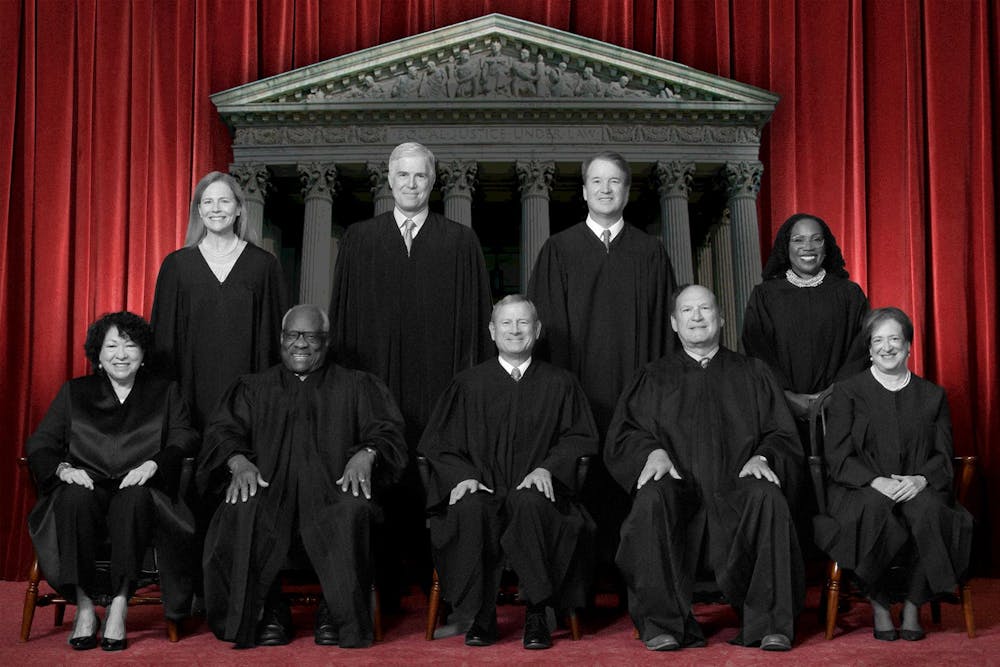
The Supreme Court has nine justices, but its decisions impact the entire nation. In recent times, there have been a plethora of controversial and social policy-shaping decisions — the overturning of Roe v. Wade and the striking down of affirmative action among them. Do these positions reflect a changing society? Or simply a change in who is in power?
The purpose of the Supreme Court is to interpret the Constitution and its amendments, serve as a check on the power of the other branches and protect the rights of individuals and states. Yet in recent times, the judicial branch seems to me increasingly partisan. To be clear, just by the appointment process of justices, the Supreme Court will never truly be rid of partisan influence. If you are nominated by a member of a party, it is usually because your beliefs broadly align with that party’s. However, that is not to say that the justices are tied to party lines or anything of the sort. In the words of Amy Coney Barrett, “I’m nobody’s justice.” Her stance is the one that all justices should have; she shows a commitment to the Constitution above all else. Even if you don’t agree with her decisions and interpretations, that is an admirable stance. But every part of the Supreme Court — from the nomination to the relationships between judges and the federal government — has become politicized.
Let’s go back to 2016. Then-President Obama tried to nominate Merrick Garland to the Supreme Court. The Senate refused the nomination. The reasoning — Obama wanted to replace Justice Antonin Scalia (an ultra-conservative) with a more centrist justice. If the Senate approved, the court would no longer have been skewed to the conservative side. However, this was not the official reason Republicans refused to even hear the nomination. It was toward the end of Obama’s term — and legitimacy — and it was argued that the next president should choose the next Supreme Court justice.
In theory, that decision holds weight. The appointment of a Supreme Court justice has an effect for decades, and their decisions could have an impact for several lifetimes. If someone’s term is ending, there is an argument that they shouldn’t be able to dictate that. At least, that is what many Republicans articulated.
The issue was, in 2016 — the start of this awfully polarized political era we are in the midst of — a precedent was set. I liked to think of the Supreme Court as “above party politics,” but over the last decade that has been compromised. In 2020, the death of the late Justice Ruth Bader Ginsburg saw a Supreme Court vacancy rise at the end of President Trump’s first term. Republicans did not remain consistent to the principle they applied to Obama, illustrating that the refusal to hear Garland’s nomination was actually just for partisan advantage.
If we want laws truly considered and analyzed on how they affect everyone, then we need a range of viewpoints that reflect everyone. There is no simple answer to most modern-day constitutional questions, but having justices with varied philosophies is important for richer debate. Think of all the times you’ve had an opinion in any discussion-based class, then think of all the times you heard opinions you’d never even considered before. Maybe it changed your mind or perhaps it made you more certain in your own beliefs. Hearing different opinions either makes you change your argument or strengthens it. But, if you are always around people where your opinion is held by the majority, your ability to see issues from other perspectives weakens.
Balance is essential for debate, and debate is essential in protecting the law. So, any extreme in the Supreme Court is negative. Case decisions must be a product of balance. If the citizens of a country are expected to tolerate, respect and consider other people’s perspectives, it is only right that all of our institutions are expected to do the same.
Amaris O'Connor is a sophomore from London, United Kingdom currently living in Flaherty Hall. She is a political science major and spends most of her free time reading or making different iced coffee combinations. You can contact Amaris at aoconn27@nd.edu.


