
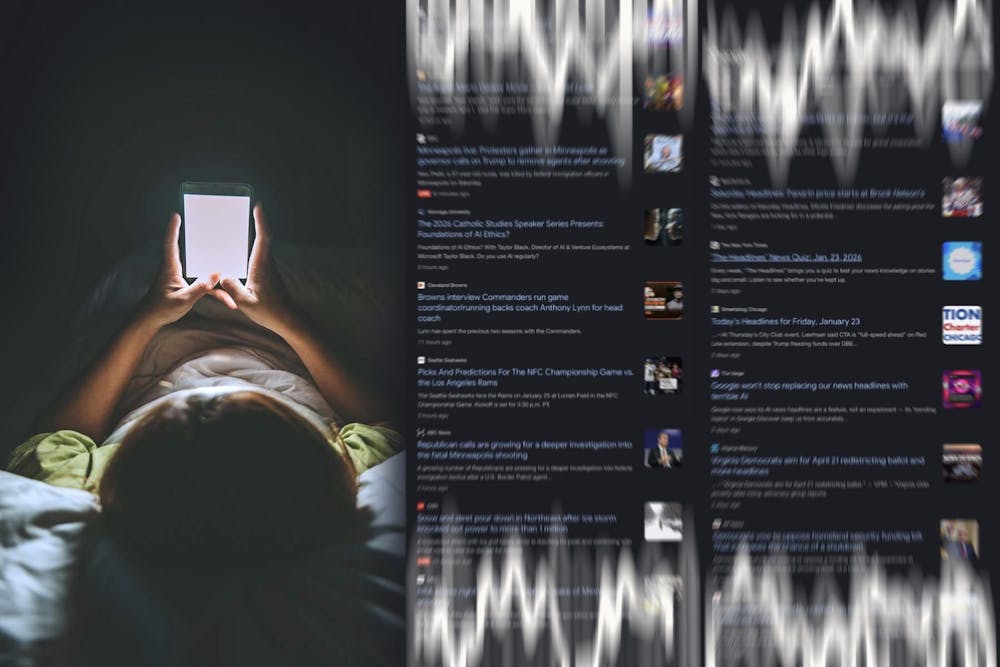
I, like many during this winter break, fell into the deceptively destructive routine of waking up, working out (shoutout CorePower Yoga!), getting ready and then spending the rest of my day in bed doomscrolling. My comatose state lasted hours and consisted of nothing but scrolling through TikTok and — in classic political science fashion — The New York Times.
Greenland. 2026 rebrand. ICE. The Golden Globes. Minnesota. Top 10 destinations of the New Year. Trump. The cognitive whiplash of content was jarring. The fact that I could go from a video of a U.S. citizen getting killed by an ICE officer to someone’s 2026 fashion predictions scared me — how quickly I could shield myself from reality with the simple swipe of my thumb.
But what if I don’t swipe away? What if I stay? Watch 100 thinkpieces on Trump’s potential acquisition of Greenland, find every angle of Renee Good’s devastating death, even watch the Heated Rivalry segment of the Golden Globes. This unending access to content, at first glance, seems like a good thing. We are the most informed generation in history, after all. However, this ability to constantly observe fresh news without actually having to engage with it goes beyond the tired diagnosis of “information overload.” Rather, it reduces our ability to make any substantive judgment on anything. That makes us dangerously shapeable.
As previously mentioned, the technological revolution has made news, ideas and beliefs more accessible than ever before. Nothing is stopping any of us from posting a 15-second Instagram reel on whatever happens to be in The Washington Post that day. Constant novelty has quickly defined the culture of news consumption — there is an expectation that any headline needs to have endless perspectives while being both nuanced and under 25 seconds. As a result, we have shortened our attention spans to a dangerously low level. And since we don’t have the energy to actually think about the snippets we consume, we absorb those beliefs and carry them with us until the next video provides us with something else to latch onto. What’s worse, we seem to think that we came to our “beliefs” organically. But they are nothing but products of our algorithms that exist to keep us easily influenced.
This isn’t accidental. We become “better” consumers for those who benefit when we are malleable. Platforms like X (formerly known as Twitter) profit when users remain reactive rather than reflective. They want us to angrily engage with points that challenge our newly formed, unsteady judgments.
Now, I want to say that I am not against reforming our opinions. I repeat, reform and evolution are good! But it becomes concerning when beliefs change proportionally to the increase in new media. We no longer sit with what we consume because there is simply no time. Different viewpoints and stances enter the mainstream so quickly that all we can do is consume, consume, consume.
Excessive consumption leads to malleability. Politically, malleability makes citizens easier to mobilize emotionally and harder to organize rationally. Morally, malleability weakens ethical frameworks since there is no time to sit with complexity. Malleability causes identity to become provisional — constantly updated rather than deliberately formed.
We do not know too little; we know too much, too shallowly. We are highly informed yet poorly oriented. How can we fix this? We have to slow down. We have to sit. Views were not meant to go in one ear and out the other, nor were they meant to be poorly debated in a TikTok comment section optimized for ragebait. We need to research outside of social media, talk with the people in our circles and overall find methods of exploring information that don’t promote frivolous interaction. Oftentimes, we’ll find that our beliefs don’t necessarily coincide with public opinion, and that is okay. Not everything we think needs to have originated from a political influencer.
Discernment requires time. Without time, information heedlessly transforms from power to control.
Sophia Lekeufack is a freshman from Boyds, Md. currently living in Lyons Hall. When she's not studying political science or crying doing her Program of Liberal Studies readings, you can find her crocheting, walking or playing BS. You can contact Sophia at slekeufa@nd.edu


