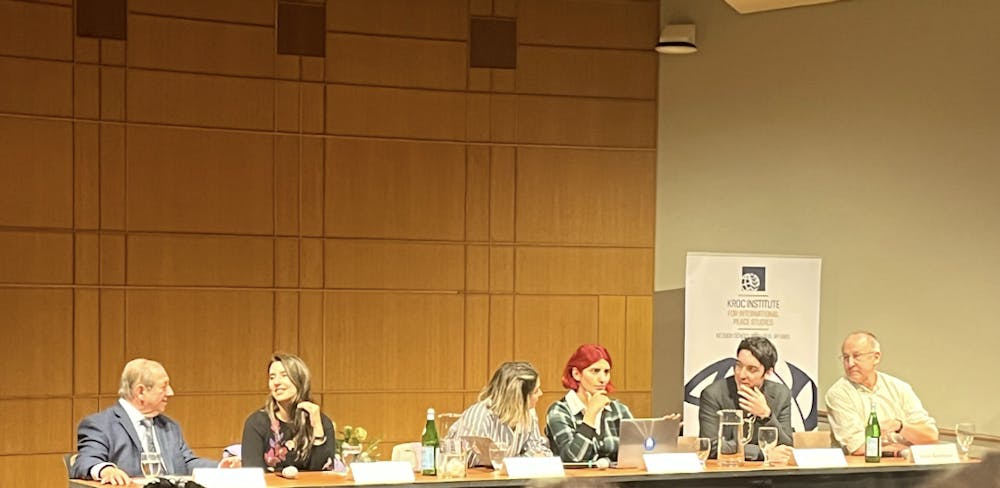
On Tuesday afternoon, the Hesburgh Center for International Studies hosted a panel discussion entitled “Iran in Crisis: Protest, Suppression, and Paths Forward.” The lecture featured six panelists who spoke about the roots and current trajectory of Iran’s response to an unprecedented wave of protests, as well as the economic, social and political turmoil currently unfolding in the country.
The panelists approached the conflict through a global lens, reflecting on how this instability affects other nations in the region as well as the broader international community.
The lecture began with a brief history of the current conflict in Iran, which began with the collapse of the nation’s currency and rapidly grew into a mass movement in which Iranians demanded human rights and government reform. The government of Iran, however, quickly suppressed any form of resistance by imprisoning thousands of protesters and restricting freedom of speech and assembly as a means of reasserting control.
The discussion shifted to the first panelist, Vahid Jadidi, a sociology Ph.D. student at Notre Dame, who provided insight into how the Iranian regime has relied on certain tactics such as repression and discrimination, leading many to believe that true liberation can only come as a result of complete regime change not merely social or political reform. Jadidi also emphasized how Iran has a history of using violence as a tool to suppress its civilians and prevent uprisings.
“It’s not new that Iran’s regime has been killing people for forty years ... longtime violence against ordinary people has encouraged uprisings against the regime,” Jadidi said.
Jadidi also addressed the impact of international economic sanctions, highlighting that they do not weaken those in power but also serve to further aggravate the lives of Iranians who are already forced to deal with the harsh economic and social realities in their country.
“Sanctions do not hurt those in power. They only hurt ordinary people,” said Jadidi.
Atefeh Esmaeili, a Ph.D. student in the Medieval Institute, gave a brief history behind the current economic and instability that Iran is facing. Esmaeili emphasized how the Iranian government often used physical and psychological violence against people to maintain control. According to Esmaeili, the potential collapse of the current regime could result in the emergence of a new social order that is more responsive to the people.
During one particular period of unrest, Esmaeili described how the Iranian government used suppression tactics to quell dissent and expand control.
Nevertheless, Esmaeili emphasized that the Iranians continue to reach for a new social, economic and political governmental structure that would restore power to the people.
“The Iranian people have been in constant struggle to assert their agency,” Esmaeili said.
The discussion then shifted to English professor Azareen Van Der Vliet Oloomi, who characterized the current Iranian regime as deeply repressive. She described the current state of gender apartheid in the country and discussed the conditions of paranoia that permeate the national government, labeling it as a virus that affects ordinary Iranian people.
“Paranoia exists within the different factions of the Islamic republic,” Azareen Van Der Vliet Oloomi said.
Perin Gürel, an associate professor of American studies, detailed how the conflict in Iran affects the broader region of the Middle East, namely the nation of Turkey. Gürel explained how Turkey has been positioning itself as a key regional bridge to prevent a broader escalation of the conflict. She also described paranoia occurring inside Turkey.
“What Turkey is fearing more than anything is Iran’s destabilization and the nation descending into a civil war,” Gürel said.
The lecture concluded with panelists George Lopez, professor emeritus of Peace Studies, and Asher Kaufman, director of the Kroc Institute for International Peace Studies, discussing U.S. policy and how it is linked to Iran and the broader Middle East region.
Ultimately, each of the panelists emphasized the immediate need for a de-escalation of the conflict in Iran and the establishment of a new social order that promotes universal human rights and quality for all people.
“What people want is simple: dignity, peace, and the right to choose their own beliefs and future,” Jadidi said.