
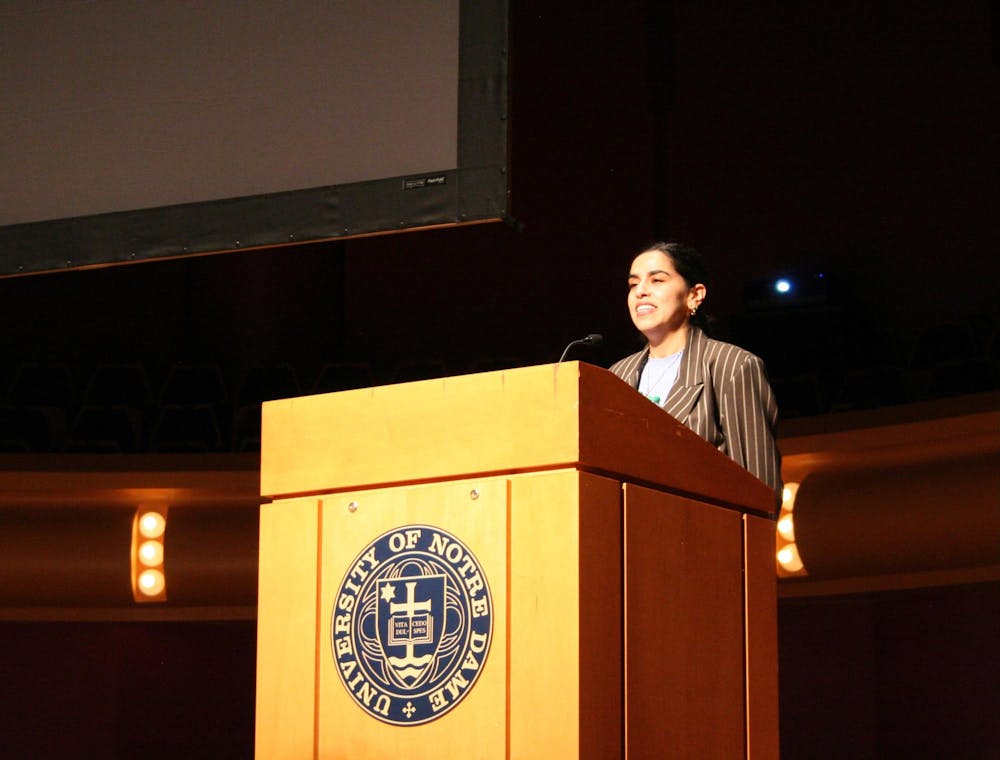
Data journalist Mona Chalabi lectured for the 207th birthday of John Ruskin, presented by the John J. Reilly Center for Science, Technology and Values. The event took place in Leighton Concert Hall of the DeBartolo Performing Arts Center, with a hundred individuals present, including faculty, professors and students.
The event included American Sign Language translation by interpreter Kristen Gingrich. The Notre Dame Police Department was also on site — a requirement for lectures discussing the Israel-Palestine conflict.
Robert Goulding, an associate professor of the Program of Liberal Studies, introduced the lecture and described Ruskin as an admirable person in his writing who resembles current times.
“He was a great Victorian intellectual, writer, art critic, painter, teacher, social reformer, one of those figures from the past who now seem to have had something profound to say on everything. Not only that, he turned his ideals and beliefs into action, founding schools and institutions that continue to exist and do good work to this day,” Goulding stated.
Goulding went on to relate Ruskin to Chalabi, offering that both cover a variety of subjects and vocally advocate against war for the goal of seeking power and domination.
Chalabi then opened by offering an alternative perspective to the idea of working on oneself and living in the present. While she said that many think as a journalist she would be good at living in the present, she disagrees.
“Hundreds of articles are published every minute of every day. They have been hastily compiled by writers across the country, then clicked on and sh*t out by readers who barely take a moment to digest what they have skimmed,” Chalabi said.
Chalabi offers that the analytics on news websites, pioneered by the porn industry, show that many readers bounce, and “it is hard to hold people in the present.”
To counter this, she offers that the job of the journalist must shift to capture people where they are and hold their attention. From this notion, she took her data and turned her statistics into drawings. As she garnered success in this format, she shifted her attention to covering subjects she cared about, including gun violence in the United States and the U.S.-led invasion of Iraq.
“I realized that the work of a journalist is never really about the present at all. Our job is somehow to take a summary of the past and a hypothetical about the future and combine them to refract it through the lens of now, and slowly, the present became less and less important in my work,” Chalabi said, adding that living in the present “is a specific form of oppression.”
She applied this concept to Palestine, arguing its history has been warped by the Western press and Zionism’s greatness “lies in our inability to imagine a future of Palestine.”
In an anecdote of talking to someone who described people who support Palestine as “a bit annoying,” because they “keep on going on and on and on about it” she conceded that he is right.
Chalabi shared that the genocide can look more like a cycle considering the more than 100-year history.
While she clarified that this is not to undermine new technology, “it is to acknowledge that the Israeli ship has always been built on Palestinian destruction.”
She pointed out that even AI has broken notions of justice due to the ways in which it is built on biased Western journalism.
To illustrate her point, she shared screenshots in which on a brand new account, she asked ChatGPT, “Do Israelis deserve justice?” and was informed, “Everybody deserves justice.” When asking “Do Palestinians deserve justice?” she was informed, “It is complicated.”
She provided a story in which she tried psychedelic mushrooms and did not experience any effects while surrounded by others under its influence. She compared it to the differences of the headlines of opinion articles and news articles, and explained how all too often we are looking at the same facts and reaching wildly different conclusions.
To counter this, Chalabi suggests that we need to stop trying to live in the present as we currently know it, but rather work together to agree on some common facts and rebuild from the ground up.
“If me and you do not agree that Israel is committing a genocide in Palestine. If you cannot agree that the Israeli state has always been built on Palestinian suffering, then I just do not believe we can work together to build a better future,” Chalabi said.
Following the lecture, Atalia Omer, professor of religion, conflict and peace studies at the Kroc Institute for International Peace Studies, moderated a Q&A session.
Senior Yara Obeidi brought up Chalabi’s critique of the New York Times’ disproportionate coverage between Israeli and Palestinian deaths, despite earning a Pulitzer Prize for her formerly published work in the newspaper.
In response, Chalabi stated that she stands by her critiques of organizations like the New York Times, among others, emphasizing that support of these organizations and their actions enables genocide. Regarding solutions to this problem, Chalabi offered that we need to build new institutions because, at some level, the public cannot unpick the systemic issues out of these institutions without rebuilding them from scratch.
She continued on to emphasize that boycotting brands and making change takes self-sacrifice and requires discomfort.
“It means giving something up, and I think we are looking for these frictionless solutions that just do not exist,” she said.


