After the 1993 terror attack on the World Trade Center, lifelong Notre Dame fan Pat McGarry vowed he would never work there again. Eight years later during the Sept. 11th attacks, his biggest fear of another attack came to fruition. This time, there was no escaping the grief.
McGarry was working on the 95th floor of the South Tower in 1993 when terrorists conducted a van-bomb attack intended to collapse the North Tower onto the South Tower. Although the North Tower did not collapse, the damage was severe. Six people were killed and over 1,000 more were injured. Not accounted for was the harrowing psychological toll left on those working in the buildings.
“It had a profound impact on me. I did not even know it. I just took off and said ‘I’m out of here’. I didn’t know what PTSD was or anything of that crap, but I was gone,” McGarry said.
McGarry, who had been living with his sister Katie in Hoboken, New Jersey, fled for a fresh start.
“I kind of wandered for five years,” McGarry recalls. “I went to Chicago; I worked at the Board of Trade. I went down to Fort Lauderdale. I went back up to help my dad start his business. I then went to Tampa to get into the energy business and then to Jacksonville.”
In the years he spent zipping from one place to the next, McGarry didn’t realize he was “carrying a piece of what happened” with him.
Then came Sept. 11, 2001, the day McGarry’s wound from 1993 was painfully reopened.
“On 9/11, I was getting ready to fly home that morning from Glacier National Park with two of my best friends – they’re my brothers,” McGarry said. One of those men was Brian Lamb, a 1986 Notre Dame graduate and McGarry’s long-time neighbor.
McGarry’s day started routinely. As always, he got up early and made a fresh cup of coffee at his small hotel. But things started to change when he walked outside.
“I saw the National Guard out there loading their rifles,” McGarry remembers. “I said ‘Hey, what’s going on?’ They said ‘The country is under attack.’”
McGarry ran to the television, where he and a group of other outdoorsmen were glued to the screen, all watching helplessly as live coverage showed the Twin Towers engulfed in flames.
McGarry called his mom to tell them he was okay. That’s when his life changed forever.
“She told me that my sister was there. And to this day I still do not believe it,” said McGarry.
“At the last second she was asked to attend this conference. She had been married for five months, her husband worked for Lehman Brothers 40 floors below where this happened,” McGarry said. He later shared, “She was having fun but really looking to settle down and hoping life wasn’t going to pass her by.”
That day, the day when American history was changed forever, was only the start of the most confusing, heart-breaking period in McGarry’s life.
“Like a lot of people we never got her back – her physical remains. Even that is kind of weird. We’re Catholic, so we had to have a funeral. We had a casket, but there is nobody in there,” McGarry said. “The whole thing is just bizarre. It didn’t seem real.”
It was during this time in which McGarry was forced to confront the weight of his suffering. He could try to run from it. Or, he could face it head on.
His decision was an easy one.
“I just made a pledge that I would never forget her. She wouldn’t be forgotten,” said McGarry.
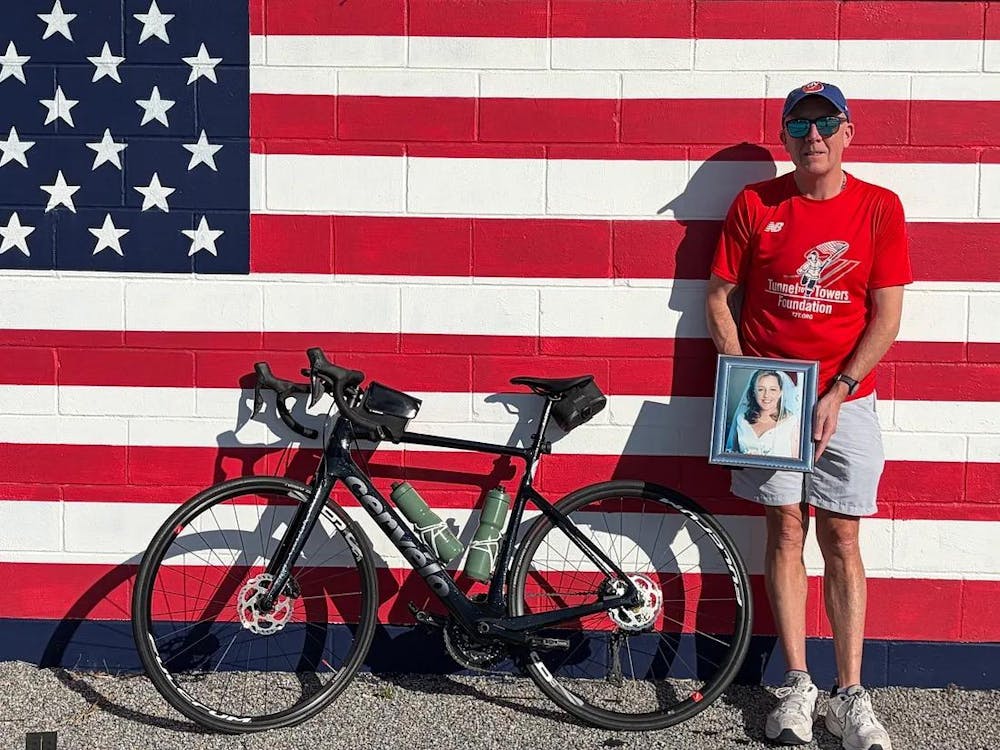
McGarry’s commitment to his promise will see him cycle across the country this spring, with a goal of fundraising $100,000 for the Tunnel to Towers Foundation along the way.
The idea started during COVID, when McGarry used cycling as a way to escape the house. One pedal at a time, McGarry slowly but surely started to pile on more mileage to his daily rides.
Now with a dedicated training program, McGarry is full steam ahead for his goal. His ride will commence on March 6, just south of Jacksonville, Florida. The nationwide trek takes him across the southern border, passing by El Paso before eventually concluding in San Diego.
“I ride probably five to six days a week. I’m averaging 60-70 miles a day,” McGarry said. “It’s either on my bicycle outside or on my Tacx Trainer. I live in Florida, so what I did was I downloaded the route. I live in Florida, so I have all the GPS files. So, I can simulate my ride I’ll be on. Particularly the ascents, because that I can’t practice here.”
McGarry also works with a physical trainer and has found a group of fellow cyclists he trains with in preparation for the ride. By the time his training is done, McGarry will have ridden over 10,000 miles in total.
Although McGarry says he’s “scared to death,” the lifelong Irish fan, who is often cycling indoors with his Notre Dame hat handy, knows he is right where he needs to be.
“Everytime I hit the wall – I do hit the wall, I hit it yesterday – I think back to my sister. I think back to the last hour of her life. I’m going to get through it,” said McGarry.
McGarry also thinks of those who were there for his sister in those last moments. The people who risked their own lives to help.
“One of the things about 9/11 is when I was watching it on TV I was so frustrated. I was horrified. I literally wanted to run through the screen and I wanted to try to help her,” McGarry said.
“This trip is kind of like a thank you letter on behalf of my sister to the first responders and the military. Thank you for what you did,” he said. “And it’s a ride not to mention just the horrible things that happened but all the good and love – how unified the country was. All of the yelling and screaming today, we’re still capable of being together. I want to make sure that’s not forgotten.”
McGarry especially hopes to unite Notre Dame fans behind his mission. An Irishman through and through, McGarry is as devoted a Notre Dame fan as they come. Both McGarry’s father and nephew attended Notre Dame, and although he went to Fairfield University, his love for Notre Dame is no less.
McGarry’s ride can be tracked on his website, aridetoremember2026.com, where visitors can view a map of McGarry’s ride, pictures of his family and donate to the cause.