
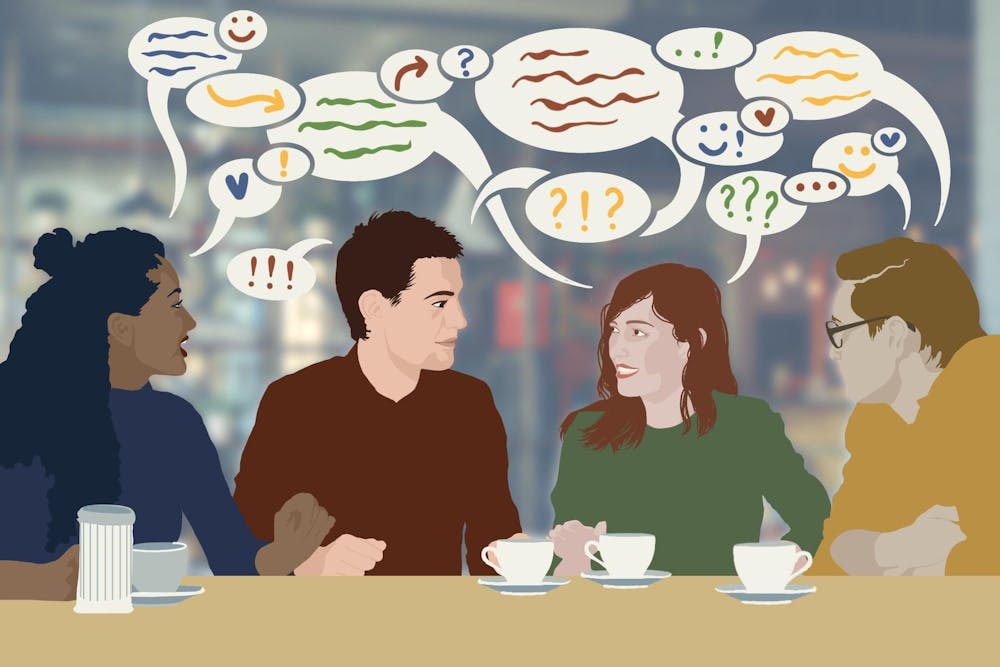
As a first-year college student, I am constantly surrounded by people at school. From professors and classmates within the walls of my classrooms, the neighbors who live next door to my dorm room, the club members I see at organization gatherings, the people I pass by on my walks to Notre Dame and the students I meet by chance through social media. Even though I am surrounded by these people, building connections with people who truly want to know the whole you is rare.
I have noticed through most conversations when talking to someone residing within the usual safe boundaries of social interaction, “Where are you from?” “What dormitory do you live in?” “Do you like your major?” While I am not saying the general icebreakers are bad when you are just meeting someone, these safe boundaries often never seem to go deeper.
People know each other’s schedules, names, roles they play, some likes and dislikes, but not how their minds work, how they think, how they see the world, what they feel and what they experience. To me, it seems that people accept the temporary, surface-level information and interaction with another person rather than taking the time to truly know someone for who they are. People give them barely any time or chance for them to break down their layers to reveal the roots of their soul, what makes them who they are, before the person turns their head and is off to the next one.
The lack of genuine interest in getting to know others has created a quiet form of dehumanization, where individuals are seen as temporary or replaceable, rather than complex human beings with thoughts, emotions, experiences, inner worlds and a soul that was carefully crafted by the hands of God.
Would anyone really care that I have such a strong passion for art that I spent my winter break making a 3D whale shark out of cardboard? The reason why my favorite movie of all time is Coraline? Why I believe there is a God? Or why do I hold onto my morals so tightly? Was that stuff that people wanted to know about me, or are they satisfied with the person I presented on the outside, without the information that created who I was?
Curiosity is a gift of having the strong desire to learn and understand something or someone; a value that humans lack when getting to know people. Conversations with others, words being exchanged, becoming predictable like something someone could read from a script. Asking how someone is doing, yet not waiting for the true answer or not going deeper when the truth is told. Learning the facts behind someone’s life, yet not taking the time to learn the meaning behind them. Why do they feel that way? How do they react in that situation?
They do not ask what shaped someone into who they are today, what they fear or what they believe in. It is as if knowing the surface of a person is considered enough, when in reality, it is only a small fraction of who they truly are. And sometimes, that small fraction could not even be the truth, just one of the many versions they put on so people will be interested in talking to them. When people stop being curious about others, they stop seeing them as individuals with depth and complexity.
Part of this dehumanization comes from the fact that truly understanding someone requires effort and vulnerability. It requires listening, asking meaningful questions, desiring to go deeper past those safe boundaries and caring about the answers that are presented before them.
It requires patience to see someone as they really are, not just how they appear on the outside. However, many people avoid this effort because it is easier to stay on the surface. It is easier to accept shallow relationships than to risk emotional closeness and the hurt that could come from it. But in choosing what is easy, people lose the opportunity to form real, meaningful human connections.
This lack of deep connection leads to a sense of isolation, even when surrounded by others. A person can be physically present among friends, classmates or coworkers, and still feel unknown. Being seen is not the same as being understood. When no one takes the time to understand how someone thinks or feels, it can make them feel invisible, as if their inner self does not exist to others, that the only acceptable version of themselves is the one who locks away their true selves. This feeling is not caused by being alone, but by being unseen in a deeper, more human way.
I often feel frustrated with this in terms of relationships. In college, it is easy to become a victim of the party scene and hookup culture, and often form relationships where it is more transactional than meaningful. When getting into a relationship, it means you are willing to truly get to know someone for who they are as a person, to connect with them without having the same blood run through your veins.
You learn to love that person, how they carry themselves, their likes and dislikes, what they “nerd out” about, what drives them, what their morals are and what they believe in. You find yourself wanting to know everything about them and desiring them to see you the same way, yet society created the concept of transactional relationships. The relationships that make people replaceable, getting what they want and then moving on to the next, with no emotions or meaning behind it.
Human beings are complex and beautiful, shaped by their experiences, thoughts, emotions and struggles. Every person has an inner world that deserves to be understood, not ignored. When people take the time to truly listen and understand one another, they restore the humanity that shallow relationships often take away. They show that a person is not replaceable, but unique and valuable.
In a world where shallow connections have become normal, choosing to truly understand someone has become rare. Yet it is one of the most important things a person can do. Taking the time to know someone beyond the surface is what transforms relationships from temporary interactions into meaningful human connections. When people begin to see and understand each other fully, they begin to restore the humanity that has slowly been lost.
Sienna Stephens is a freshman at Saint Mary's College and planning on majoring in secondary education and English. When she is not taking a hike from SMC to Notre Dame, you will find her listening to music 24/7 and trying to make her Pinterest boards aesthetic. Feel free to reach out to her at sstephens01@saintmarys.edu


