Every time there is a sports game that draws a wide audience, debates over the role of politics in sports are presented. The International Olympic Committee highlighted that 5 billion people followed the Paris Olympics, and with the summer games coming, this number can only be expected to increase. The Olympics and other international sports tournaments have always had a large following. Now, with the combination of traditional media and social media, these games are more accessible to more people. However, a large following means that it is unable to be isolated and extracted from real life and all of its complications.
Recently, Vice President JD Vance was booed at the opening of the Olympics, once again drawing attention to the penetration of politics into the games. Sports, for many, serve as an escape. Immersing yourself in a game allows you to leave reality and stress behind, pouring your energy and attention into something else. Yet, ugly realities have a way of inserting themselves into every aspect of life.
NFL fans will know the name Colin Kaepernick. His choice to sit, eventually leading to kneeling during the national anthem, opened a wider dialogue around race in sports, even if he was never signed again. His initial example informed a wider trend that has been seen since then. It is not just limited to the NFL, but also the NBA and even in the Premier League, where players chose to take a knee for several games as a stand against racism. Taking the knee during the national anthem in the U.S. can be analyzed as disrespectful, brave, insulting or dutiful based on who you ask. But, the idea that sports and politics are two different spheres that have not previously overlapped is fiction, a lie based upon an opinion that complete social harmony was once achieved. Olympic history provides evidence for the lack of truth to this seemingly incurable longing for something that never was.
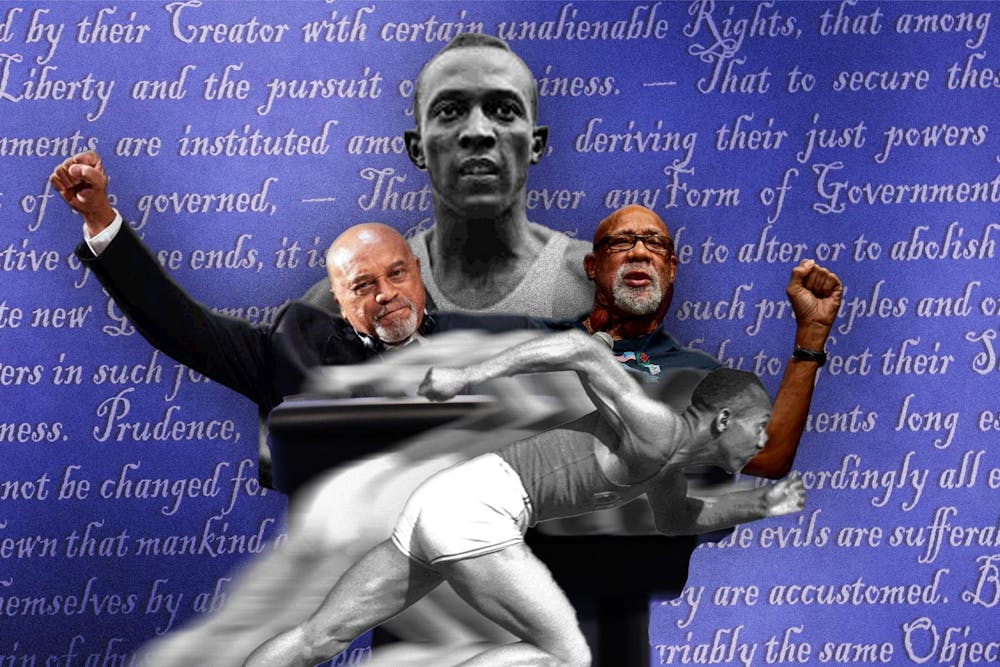
Let’s start with the 1936 games: Jesse Owens won several gold medals, rejecting Hitler’s ideology. Hitler’s snubbing of Owens and other black athletes — not wanting to shake their hands — was a political statement; Owens’ mere presence at the game was another. His wins were not enough to make him appreciated in his day, in his own words: “I wasn’t invited to shake hands with Hitler, but I wasn’t invited to shake hands with the President either.” Owens, as a person, can not be separated from the politics of the 1930s, both internationally and domestically.
In the 1968 Olympics, Tommie Smith and John Carlos raised their black-covered fists high in the air during the national anthem. Silent resistance was evident in every aspect of their stance, the lack of socks to represent poverty, a bead necklace around Carlos’s neck to represent lynchings, and a scarf for black pride. These acts are inherently political, symbolizing resistance to injustice. The 1980 boycott of the Moscow games, by the U.S. and its allies, was also a political choice, reflecting Cold War tensions.
The pattern is clear, evident in Olympic games, regional games and so forth. Protest is often punished in real time, key actors ostracized, but then make up our history books later on. Reflecting on the reactions from various political figures and influencers about Bad Bunny, criticizing him for speaking about ICE, and wanting to keep political ideals out of sports is unreasonable and hypocritical. You can not criticize individuals for expressing their beliefs in a free country without taking away one of the key components of democracy.
Looking forward to the Olympic Games and the inevitable rhetoric about politics and sports, which will once again return, I encourage everyone to look back and reflect. Sport has always been political — whether it's to do with systemic oppression or international conflicts. Sports do not serve as a fictional escape; they contain real people, and if seeing real people talk and express an opinion on politics enrages you, then you do not live in reality. If you want to escape, read a book, watch a film or get creative and write something yourself.
The people in your favorite sports programs are real, with thoughts, feelings and emotions and most importantly, a right to express them. Not agreeing with someone’s opinion should not mean they’re ostracized and subjected to mistreatment as Smith and Carlos were. As more major sporting events come up, it’s important to remember that ending polarization doesn’t mean there should be an absence of politics in the public sphere, but rather there should be freedom of expression and, more importantly, tolerance.
Amaris O'Connor is a sophomore from London, United Kingdom currently living in Flaherty Hall. She is a political science major and spends most of her free time reading or making different iced coffee combinations. You can contact Amaris at aoconn27@nd.edu.