When the majority speaks only of its own needs and perspectives, accepting these as the norm, it also states to the world that the minority is invisible, that they do not belong, that their concerns are not as relevant.
In journalism class last year, our professor asked us to read an editorial written by The Observer Editorial Board in 2024 titled “Boycott the Grubhub Robots.” The writers were very successful in laying out rational arguments on why they believed that the food delivery robots would adversely affect the strong sense of community we have created over the years on this campus. But as I listened to my screen reader read the article to me, I only experienced a sense of loneliness and alienation. “This article was written to the student body, for the Notre Dame community, but the writers’ words were not meant for me.”
As a blind person, I face unique barriers when thinking about getting food from on-campus restaurants. I am still unfamiliar with the routes to many buildings, and Google Maps, of course, is very inaccessible to use. And I hate relying on my friends to meet my necessities. Taking a trip to Au Bon Pain once a week to grab a meal with a friend is very different from being forced to reach out to the same friend one afternoon and ask her to walk with you because you are craving a brownie and you don’t know your way to the restaurant.
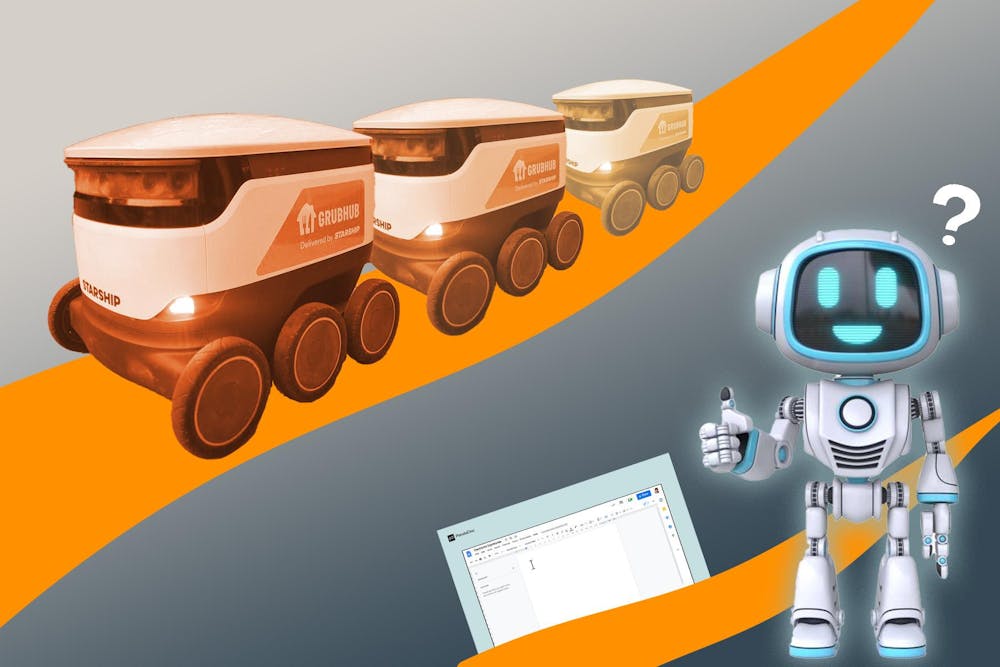
So when Grubhub robots emerged on campus, they changed my life, a tiny bit. I no longer had to depend on the kindness of friends or strangers to get the food I wanted; I no longer had to walk around like a fool looking for the food counter at the restaurant that I couldn’t see; I no longer had to wait at the counter and anxiously wonder if there was a person on the other side ready to take my order. Now I could easily order my food on the app that works well with VoiceOver on my phone, and collect my food from a robot that texted me its arrival.
The writers of the article put forward many arguments and considered many perspectives, all of which are valid and good. But they did not consider the impact that Grubhub robots have on the lives of blind students, other mobility-aid users and the disabled minority at Notre Dame.
This article reflects the larger trend within critical discourse to marginalize the experiences and perspectives of persons with disabilities. This tendency is exemplified by the recent scholarly and cultural discourse on the role of AI in today’s world. Almost always, I step away from these arenas of discourse feeling unsatisfied and isolated. Where do I, and my needs as a blind person, belong in these heated discussions? Does the non-disabled world truly believe that all of this is only about them, that AI has no role to play in the lives of people with disabilities?
One of the strongest arguments against artificial intelligence is that it erodes the dignity of human beings. In my limited interactions with AI as a disabled person, I have found the opposite to be true. When I stayed alone in Indianapolis in the summer of 2025, I relied on an app called Be My Eyes. This application allows me to take pictures of objects or documents, which it then analyzes using its AI function to provide me with a detailed description of the image. In a world of printed sheets and labels that are never in braille, Be My Eyes allows me to live a life of independence and self-reliance.
I had a similar positive experience using ChatGPT. I have always struggled with science and math classes, chiefly because these subjects are taught in an extremely visual manner. Professors often solve equations on the board and upload formulas and practice problem sets in formats that are not screen-reader accessible. It was while I was preparing for a science final at Notre Dame, and struggling to understand the contents of the study guide that had been provided as an inaccessible PDF, that I decided to turn to ChatGPT as a last resort. I prompted the algorithm to provide me with practice problem sets and their solutions in a screen-reader accessible format. It gave me exactly what I asked for, within seconds! And the impenetrable world of numbers finally opened its doors to me. That day, combining my human abilities of logical and rational thinking with ChatGPT’s ability to present information to me in an accessible format, I was finally able to figure out for myself an inclusive learning strategy that respected my unique needs as a student.
This experience has made me wonder about all artificial intelligence could do for blind students like me. I began dreaming of a world in which AI could be used to create inclusive lesson plans and accessible course materials by professors, enabling every kind of learner to thrive in the classroom environment.
Yet, as I returned to the chaos of conversation around AI, I listened vainly for voices that articulate my thoughts and perspectives as a disabled person. It saddens me that even Notre Dame’s faculty and leadership, who have approached the question of artificial intelligence with great thoughtfulness, have not sought to address the relationship between disability and AI or sought to invite disabled voices into these conversations.
This marginalization of people with disabilities and their perspectives, even if it comes from a place of ignorance or forgetfulness, is still an act of exclusion. When the majority speaks only of its own needs and perspectives, accepting these as the norm, it also states to the world that the minority is invisible, that they do not belong, that their concerns are not as relevant.
Last year, Notre Dame presented a Catholic response to the question of AI through the DELTA Network. This new initiative seeks to provide a faith-based framework to navigate the questions and challenges that are posed by the growth of artificial intelligence, by relying on the principles of dignity, embodiment, love, transcendence and agency. As this initiative grows, bears fruit and becomes a force for good within Notre Dame and the world at large, I hope that it will also serve as a space that invites all perspectives, and a framework that takes into thoughtful consideration the ways in which AI influences, both positively and negatively, the lives of people with disabilities, and other minorities. I hope that the DELTA Network and the larger Notre Dame community will strive to create inclusive arenas of discourse in which all voices and experiences are remembered, welcomed and thoughtfully attended to.
I too desire, not to stand silent and unheard on the sidelines, but to belong to the heart of the Notre Dame community.
Hannah Alice Simon was born and raised in Kerala, India, and moved to the U.S. for college with the dream of thriving in an intellectual environment that celebrates people with disabilities. On campus, you will mostly see her taking the longest routes to classrooms with her loyal cane, Riptide, by her side. She studies psychology and English with minors in musical theatre and theology. You can contact Hannah at hsimon2@nd.edu.