The recent letter to the editor by Kristan Hawkins calling for the dismissal of a University of Notre Dame professor makes a forceful case, but it rests on several assumptions — legal, institutional and theological — that deserve closer examination.
At its core is the claim that Notre Dame not only could, but should, terminate a faculty member for views at odds with Catholic teaching, and that doing so would clearly be upheld in court. That argument leans heavily on the “ministerial exception,” a doctrine developed in cases involving religious schools and employees directly responsible for faith formation.
But the comparison is not as straightforward as presented. The cases often cited involve high school teachers or counselors whose roles are explicitly tied to the religious mission of their schools. A university professor — particularly one working in a research institute unrelated to theology — occupies a different position. Courts have been far more cautious about applying the ministerial exception in higher education, especially outside religious instruction. To suggest that a dismissal here would be legally certain overstates the case.
More broadly, the editorial reflects a narrow understanding of what it means to be a Catholic university. Notre Dame does identify itself as a leading Catholic institution, but Catholic higher education has never required strict ideological uniformity among all faculty. The Church’s own guidance has long called for a balance: fidelity to its teachings alongside a genuine commitment to intellectual inquiry.
That balance is not always comfortable, but it is central to the university’s purpose. A Catholic university is not a seminary, nor is it a diocesan high school. It is a place where ideas are examined, argued and tested. The presence of faculty whose views diverge from Church teaching does not automatically signal a failure of mission. It reflects the reality that universities exist within a broader intellectual world — one Catholic institutions are meant to engage, not avoid.
The letter also leans on guilt by association in linking an individual’s work to the Population Council and, by extension, to China’s “one-child” policy. The moral questions surrounding that policy are serious. But assigning its full weight to any individual connected to a large and multifaceted research organization oversimplifies a complicated history. The Population Council has been involved in a wide range of global health and demographic work, and the connection drawn here is more rhetorical than precise.
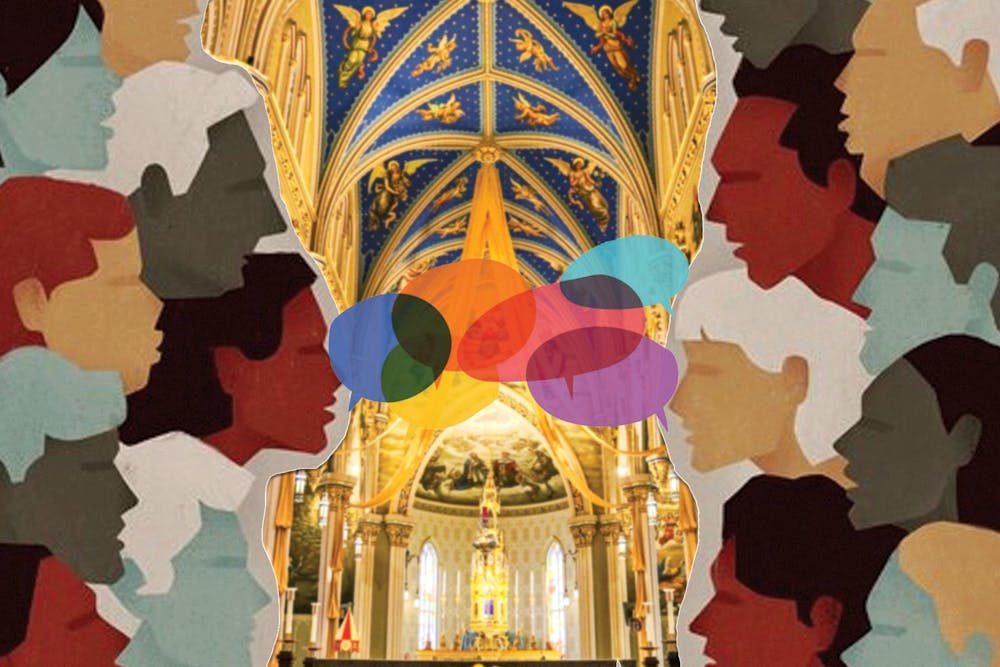
Beneath these points lies a more important question: What is a Catholic university for?
If the answer is that it must enforce strict conformity among its faculty on all contested moral questions, then institutions like Notre Dame would cease to function as universities in the fullest sense. They would become something narrower and more controlled. That may be a coherent vision, but it is not the one that has shaped the Catholic intellectual tradition.
That tradition has long been marked by engagement rather than withdrawal. From Augustine’s encounter with classical thought to Aquinas’s Aquinas’ integration of Aristotle, Catholic thinkers have operated with the confidence that truth can withstand scrutiny. Exposure to competing ideas has not been seen as a threat, threat but as an opportunity for deeper understanding.
None of this means Catholic identity is unimportant or endlessly flexible. On the contrary, it requires clarity and seriousness. But those qualities are best demonstrated through the strength of an institution’s teaching and witness, not through attempts to eliminate disagreement. A university that cannot tolerate internal differences risks becoming insular. One that loses its moral center risks something worse. The task is to hold both concerns in tension.
The language of the letter — speaking of betrayal, corruption and wolves in sheep’s clothing — may be effective rhetorically, but it closes off the kind of engagement a Catholic university is meant to foster. It treats disagreement as disloyalty and complexity as compromise.
Notre Dame, like any serious institution, will continue to face difficult questions about how it lives out its mission. Those questions deserve careful and good-faith debate. They are not well served by arguments that overstate legal certainty or reduce the university’s role to ideological enforcement.
If Notre Dame falls short, it will not be because it allowed disagreement within its faculty. It will be because it failed to articulate and live out its own convictions with clarity and confidence. The challenge is not to silence dissent, but to ensure that its Catholic voice remains thoughtful, credible and persuasive in the midst of that dissent.
David J. Noone
Class of 1987
March 20