
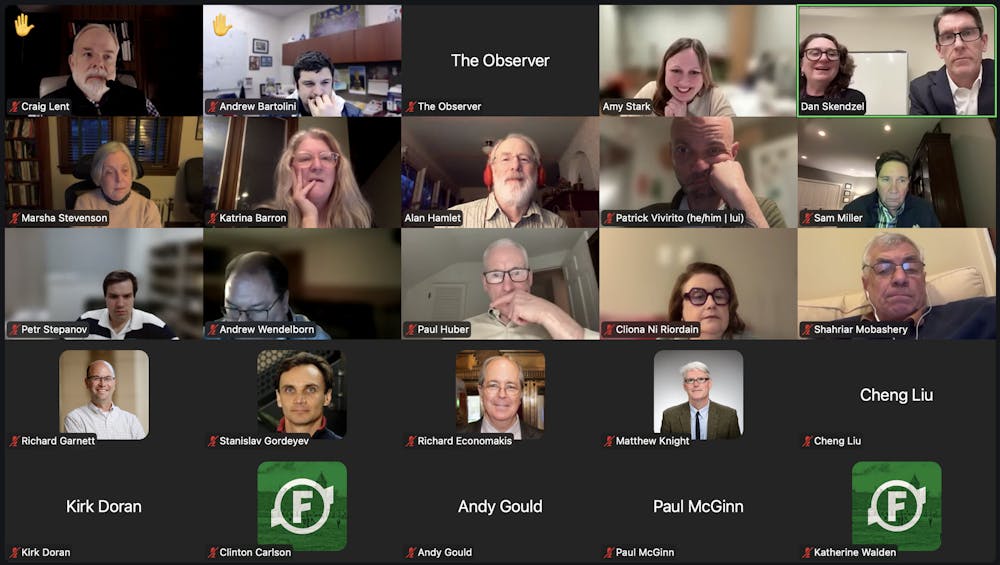
After opening in prayer followed by a land acknowledgment, this month’s meeting of the faculty senate delved into an update from the Office of Information Technology, updates from various committees and later a resolution regarding attendance policies, which received a motion to postpone.
Notre Dame’s faculty senate is composed of elected representatives who share concerns and comments from their colleagues while also passing resolutions to bring proposals up for faculty consideration.
Technology update
In November, the faculty senate passed a technology resolution on software licensing. The resolution noted some shared goals of OIT and the faculty while simultaneously raising concerns over how Adobe Creative Cloud licensure works — requiring faculty to pay an annual $120 fee effective October 2025.
This resolution also included requests for OIT to move at a slower pace to enable time for voices from the University Committee on Academic Technologies and faculty to be heard and considered.
OIT reported in this meeting’s update to the senate that changes to data storage continue, with Box storage access ending this summer. Additionally, the Google and Microsoft workspaces are moving away from offering unlimited free storage. As this transition occurs, faculty will only have 5 terabytes of free data storage. Faculty exceeding this limit will be able to buy extra storage for the cost of $150 per additional terabyte, or cut down the amount of data they are storing. According to OIT’s report, this will only affect about 50 accounts right now, and they are working with those accountholders.
The resolution’s request for a slowed pace on another issue appears to be working as following input from the UCAT team, OIT has delayed turning off Okta SMS verification for faculty in order to provide time to assist staff in setting up additional verification systems. Vice president for information technology Jane Livingston said this delay was made so that, “when we turn it off, they are not going to be dead in the water from a technology perspective.”
Susan Ostermann appointment
Regarding the recent news surrounding the appointment of professor Susan Ostermann to lead the Liu Institute for Asia and Asian Studies and her later declining of this offer, Amy Stark, the chair of the faculty senate and a biology professor, assured senators that their concerns on the matter were being heard.
“I have heard from many of you, as well as preliminary discussions within the Administrative Affairs Committee today and earlier last month, regarding concerns across the spectrum with the Ostermann appointment and changes in that respect. So what I will be doing, as chair of the senate, will be reaching out directly to the provost and Fr. Dowd to try and get a little bit more clarification about what the takeaways of the situation might be moving forward from their perspective and from the faculty perspective at large. We are not going to debate that or discuss it tonight. We are going to reach out directly to the sources to sort of see if there are further clarifications of information and what the takeaway messages will be moving forward,” she said.
Preprofessional studies supplementary major
Sociology professor Richard Williams said considerations for a preprofessional studies supplementary major available to all students outside the College of Science are in the works. He noted he would have liked to see the proposal address what existing gap this is filling because “somehow A&L people get into med school” as it currently stands, but with no objections, faculty senate did not vote on the matter.
Accommodations
Alan Hamlet, a civil and environmental engineering professor, highlighted conversations with Laurel Daen, an American studies professor whose work centers on disability studies, surrounding accommodations and accessibility for disabled students. He explained that on one hand, universities’ goal of attracting the best and brightest is inherently ableist. Describing physical and mental disability as two sides of the same coin, he suggested, “Notre Dame has done a pretty good job of trying to address some of these via centers like the Wellness Center, Sara Bea Center, Kaneb Center, [and] Center for Student Support and Care.”
He both suggested that due to the large number of centers involved in supporting students with disabilities, “we lack a centralized response for disabilities” and due to the variability between departments, “a one size fits all is not necessarily going to work.”
Hamlet noted some concerns about students abusing the accommodation system but said the existence of such abuse appears to vary across departments.
Williams noted that he talked to Christine Caron Gebhardt, the assistant vice president for student health and wellness, about how some faculty’s concerns that the accommodations they are providing in the classroom will not be provided to students in the real world.
Other faculty members echoed this concern.
Williams reported that Caron Gebhardt said there are some legal obligations that befall the University that private employers do not have.
Attendance polices
The meeting wrapped up with music theory professor Johanna Frymoyer presenting a motion on attendance policies sponsored by mathematics professor Katrina Barron, Hamlet, Williams and herself.
Frymoyer explained that the motion generally aims to create a centralized system to better keep track of absences. She suggested that AI could be integrated into such a system.
“The other advantage of having a centralized system would be to be able to track and even use AI technology to sort of flag when there do really seem to be larger aggregate problems for particular students, and even maybe trigger some kind of mental health flags,” she said.
Article C of the proposal quickly came under scrutiny. Part one of this article offered to “establish a standard for the maximum number of permissible absences per semester, calculated as a percentage of total contact hours to account for inherent variations in instructional meeting frequency; this framework shall be implemented as a flexible guideline to preserve faculty autonomy within different pedagogical models, while defining a threshold beyond which the academic integrity of a course is compromised.” Part two aimed to “protect the right of faculty to prioritize non-negotiable milestones — such as exams, labs, collaborative projects, or unique experiential learning (e.g., visiting guests, off-campus field trips, clinicals) — over excused absences, utilizing a logic similar to ‘reasonable accommodations’ in ADA protocols.”
Law professor Richard Garnett was the first to raise concerns over article C, expressing his view that it undermined the faculty senate’s motivation of being seen as a legitimate entity by offering unrealistic power to faculty to decide what absences were and were not excused. He added he was sure borrowing from the language of the ADA would stand up legally.
As discussion ensued with a handful raising their virtual hands to share their perspectives, the senate quickly decided to pass a motion to postpone voting on the attendance policy motion until the meeting next month so that it had more time to listen to the issues being raised and move forward accordingly.


