
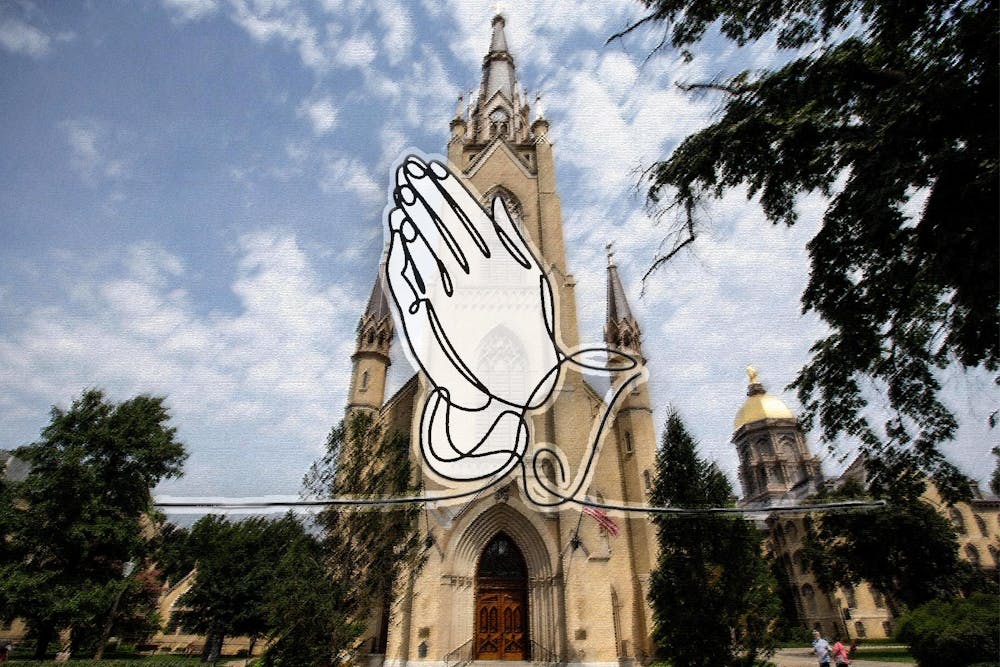
When I first got to Notre Dame, I was taken aback by the sight of crosses in every classroom. I had done all of my K-12 education in the public school systems of New York City and later Miami-Dade County in Florida. Then, for college, I went to Northwestern, a university founded by Methodists but resolutely secular in the present age. The four years I spent working as a teacher, tutor, journalist and legal assistant before starting my Ph.D. were equally divorced from any religious affiliation. So, needless to say, I experienced a bit of cultural shock upon arriving at Notre Dame, even though I was, nominally, a Roman Catholic.
Over the course of my seven-plus years here, however, something has changed. I’ve come under the spell of Our Lady’s University. Northwestern is my alma mater, but Notre Dame has wrung its roots deep inside me. If there’s such a thing as being “converted” into the religion you are already a part of, that’s me. I go to mass weekly, I pray daily and in my spare time, I read Scripture and other materials to help build my faith. No, I am not a theology student. And no, my research as an English Ph.D. student does not deal with matters of faith. My reasons for coming back to Christ are more personal and idiosyncratic.
Trust me when I tell you that this newfound religiosity is unusual among graduate students. Unlike undergraduates, we graduate students are not required to take courses in theology as part of a core curriculum or reside in dorms with live-in priests, chapels and patron saints. Roughly 80% of the undergraduate population identifies as Catholic, and many undergraduates have been going to Catholic school their whole life. Such a pedigree, by contrast, is much rarer among graduate students, unless we are talking about people in theology, sacred music and maybe the law school.
In fact, I’ve met few graduate students who seem to be Catholic, as far as I can tell, anyway. When it comes to student life and Notre Dame’s Catholic identity, undergraduates are the ones who carry the faith. Dare I say it, many of us graduate students remain unaffected by the imagery, language and teachings of Catholicism as we go through the motions of earning our degrees. We are more so students of Notre Dame the neoliberal university than Notre Dame the Catholic institution.
So what gives? Why have I been Christianized like this? Well, for one, I’ve been living and working here in conservative, red-state Indiana longer than anywhere else outside of my hometown of Queens, New York. Over the years, I’ve come to appreciate the rhythms of campus life and the hustle of downtown South Bend, where I’ve lived during my whole time as a Ph.D. student. First, in the sketchy Marmain Apartments. And now, in the swankier Lasalle Apartments, in an eight-floor apartment overlooking the St. Joseph River and the Morris Performing Arts Center.
On weekends, crowds gather in Hunt Plaza as they wait to catch a show at the Morris. Recently, the theater expanded its footprint by opening the Raclin Murphy Encore Center next door. It’s worth a trip downtown, if only to gawk at the ornate spiral staircase inside and the sinewy black statues visible through the building’s floor-length windows. Every once in a while, people congregate in the plaza to protest President Trump, the war in Gaza or some other political issue du jour. During warmer weather, you might see teenage skaters grinding and kickflipping on the steps of the park, or couples decked out in matrimonial finery taking their vows by the fountain, flanked by a coterie of family and friends. In the summer, South Bend’s homeless residents lay claim to one bench or the other or lie out under the marquee sign of the Morris to sleep. Hunt Plaza is more or less South Bend’s town square, and it’s given me a unique vantage point from which to appreciate the city and its people.
From my bedroom window, which faces west, I can see the spires of several South Bend churches, their crosses gleaming in the sunlight. On Main Street, across from the parking lot below, I can see the stone tablet with the 10 Commandments that the city inaugurated in the 1950s. From my living room window, which faces east, I can follow lines of cars streaming through Lasalle avenue and Michigan street during rush hour. If I crane my head and look north through that same window, I’ll spot Touchdown Jesus in the distance, waving at me.
During the summer of 2023, that window showed me a much more dramatic image, one that led me back to faith. On the bridge overlooking the St. Joseph River, I saw police shoot down an armed man running on the bank below. Joshua Ringle, 32, died, slain by gunfire. But not before leading law enforcement on a GTA-type car chase all the way from a marijuana shop in Niles, Mich., roughly 11 miles north of my building. That vision of death and violence drove me to seek God in the months that followed. Ringle became my personal Jesus, the “sacrificial lamb” I hear so much about during homilies. His death rekindled my faith. It made God real in a way nothing else had.
I started going to church again in early 2024. At first, I went to the Basilica of the Sacred Heart on campus. Yet, for all its trappings, it did not seem like the place for me. I needed a house of worship that was more intimate and accessible. Something that didn’t feel like I was going to work on the weekends. So I started attending services at St. Joseph Parish just east of downtown. Like Notre Dame, St. Joe was founded by Fr. Edward Sorin, roughly a decade after he opened the University. Usually, I go to the vigil mass on Saturdays. I like to get there 20 minutes early in order to pray on my own before they turn on the overhead lights. When I sit and look up, I feel like I am in the hull of a wooden ship — a type of Noah’s ark plop in the middle of the city.
For Lent, I gave up going to cafes and drinking espresso drinks. But for all the work I’ve done over the last two years, I sometimes struggle to accept God’s will. At times, I feel lonely as a single man in my early 30s. But I also shy away from friendships and romance. I don’t chase girls anymore, not like I used to in my 20s. I feel torn between my American identity and my ethnic pride. I am an English Ph.D. candidate from New York City who studies assimilation because he is afraid of assimilation. I trust in God’s plan but keeping faith is a cross I often contemplate abandoning.
But I guess that’s the point of Lent, right? To memorialize Jesus’ 40 days in the desert through our own struggles? Often, I’m reminded of a phrase etched on the wall next to the Scholars Lounge in Hesburgh Library’s concourse: “In all things, give thanks.” That’s the key, I think, to keeping everything in balance. So, if you were looking for advice in this column as you go about Lent, that would be it. Keep your faith strong. Even when you don’t want to. I used to scoff when I would hear others — particularly undergraduates — speak about Notre Dame in hushed tones. Somewhere along the line, I, too, started to feel the magic. Now I believe. Let Our Lady’s University — and South Bend — inspire you during this Lenten season. Peace.
Oliver "Oli" Ortega is a Ph.D. candidate in English specializing in contemporary Mexican-American and Latino literatures. Originally from Queens, NY, he has called the Midwest home for 15 years. He lives in downtown South Bend. You can contact Oliver at oortega1@nd.edu.


