Let’s travel back to the roaring ’20s with The Man in the Chair as he pulls us into a world of surprisingly talented tap dancing, in-sync musical numbers and dancing bananas. As someone familiar with the demands of the genre (shout-out to my favorite role Marty from “Grease”), none have been as chaotic while simultaneously comical as PEMCo’s “The Drowsy Chaperone.” And yet, one might wonder what hides between the amusing jokes and its vivacious characters?
With the houselights down, sophomore Jack Jubar, playing The Man in the Chair, appears seated with the audience, walks onstage, and plays us his favorite record: the cast recording of a fictitious 1928 musical. The story comes to life in his own living room.
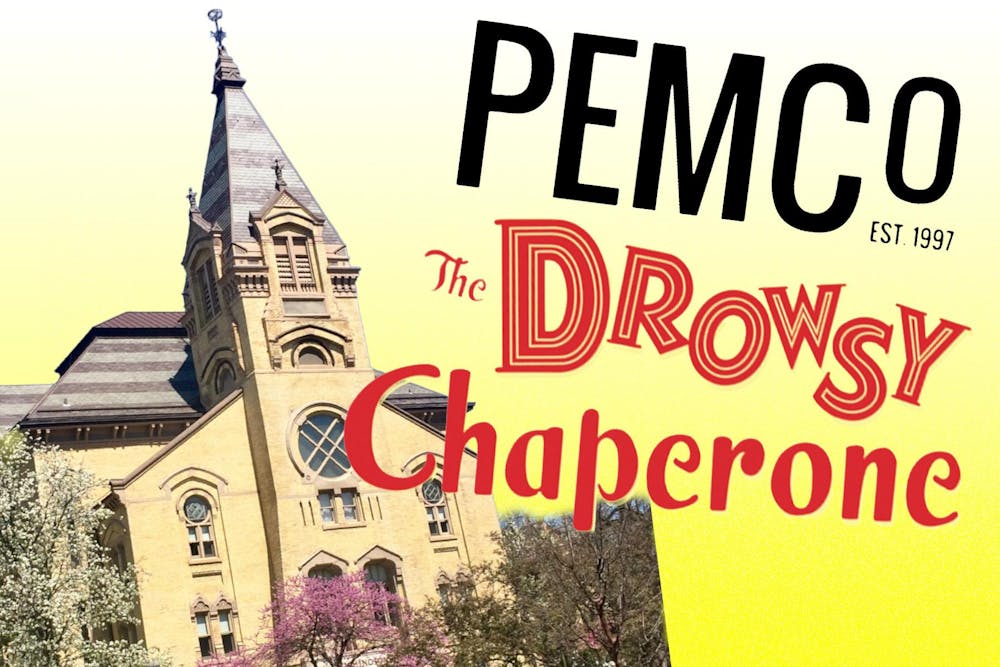
Founded in 1997 by a group of students from Pasquerilla East Hall, PEMCo is the leading producer of musical theater at Notre Dame, presenting two musicals and a revue every year, last fall assembling “Little Shop of Horrors,” directed by senior Carolyn Dell. This spring, the company produced “The Drowsy Chaperone,” directed by sophomore Victoria Khomenko. Through choreographed dances, live orchestra and amazing voices, PEMCo captures the diverse and eccentric characters from the vivid musical.
“The Drowsy Chaperone,” a winner of five Tony Awards, including Best Book and Best Original Score, is a parody of the Golden Age musicals. It debuted in 1998 as a short cabaret-style show in Toronto, Canada, originally created as a wedding gift for Bob Martin and Janet Van de Graaff (the main characters in the story). The show later premiered on Broadway at the Marquis Theatre in 2006, becoming a critically acclaimed hit. Now, it is being performed by our own student body and is running on Washington Hall’s main stage March 26-28.
Alongside our fanatic guide, we dive into the wedding eve of glamorous star Janet Van De Graaff (sophomore Charlotte Schaub) and Robert Martin (sophomore Gabriel McInnis). The event hosted by Mrs. Tottendale — played by Joscie Lefevre — and the butler Underling — played by Bryce Bustamante — becomes a whirlwind of “Wedding Bells” and an “Accident Waiting to Happen.”
The standout performance has to be between the groom Robert and his stressed-out best man George, played by freshman John Ellis, and a final appearance by the butler, Underling. With a dazzling tap routine choreographed by Sarah Wiseman, the male ensemble defies traditional expectations, breaking the misconceived argument that “men can’t dance.” Alongside this surprising dance, the alcoholic diva’s solo, “As We Stumble Along,” sung by freshman Gretchen Nessinger, served as my personal favorite number. The Chaperone, responsible for watching over the bride-to-be, but frequently ignoring her duties, is relatable yet humorous. However, the demand for the Chaperone’s looming presence feels slightly dimmed between big musical numbers, making her standout solo her most memorable moment on stage.
While the ensemble numbers provides the spectacle, the production’s success rests on its comedic archetypes. Aldolpho, excellently performed by junior Cameron Jones, perfectly captures his narcissistic and overly dramatic attempts at seduction. His acting is funny yet very traumatizing, relentlessly committed to the role. If I ever saw an Adolfo in the streets, I would run the other way and I recommend you do the same.
Similarly, the “Pastry Chef” gangsters, freshmen Deborah Nishimwe and Sara Arellano, have on-point accents, refreshing acting and really good jokes, unbothered by the exaggerated performance and amusing costumes. They threaten Broadway producer Mr. Feldzieg, played by sophomore Jason Magistre, who frantically tries to sabotage Janet’s wedding to save the show the gangsters funded, all while assisted by amusing “dumb-blonde” companion Kitty, played by junior Cat Viner. As the gangsters increase the stakes, Magistre’s acting aligns perfectly with the role of desperate producer while Viner’s fondly exasperated character adds humor.
And of course, we can’t forget the bride and groom at the center of it all. McInnis commits fully to Robert’s old-timey charm, excelling in capturing the essence of the decade, though at times tipping from endearing into exaggerated. Schaub’s voice is impressive, highlighted by a surprisingly graceful split, but Janet occasionally lacks the magnetic Broadway star presence the character demands.
However, the production faces a challenge in visual immersion. While most of the performances soar, others are a bit lacking in execution and the sparkling glamour of the twenties, not all are convincing the audience of who they were trying to portray. I wanted more characters to have a bit more seasoning, attempting to become the characters themselves. Some unhistorical clothing pieces, like very short dresses and day-to-day women’s pants, slightly prevent the audience from the full immersion of the decade. Bob Martin’s musical won a Tony for Best Costume Design, and while PEMCo often excels in spectacle, matching the level of authenticity through this commemorated category would have increased the immersion of The Man in the Chair’s nostalgia and historically accurate knowledge of the decade.
Despite these minor oversights in historical cohesion and character development, the production succeeds where it matters most: the show is unapologetically fun. PEMCo’s “The Drowsy Chaperone” is not only a love letter to the beauty of live theater and lighthearted entertainment but also a break from reality into a world full of quirky characters, chaotic scenes and sheer spectacle. For three nights in a row, PEMCo invites us to share The Man in The Chair’s dream, reminding us that an escape from life is sometimes all we need.