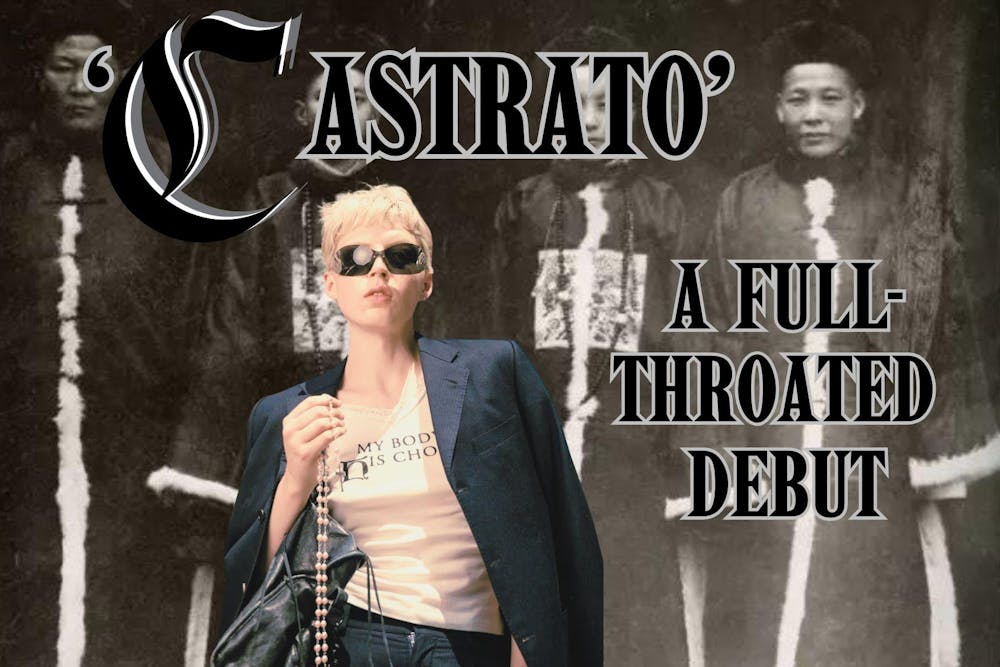
Dave Hurwitz repeatedly reminds us that music criticism should be just that: criticism of music, nothing more and nothing less. It should never devolve into a gossip column about the artist’s life — good advice, but difficult to apply to Miles Yardley’s new album “CASTRATO.” We’ll allow ourselves a few paragraphs of biographical digression before we return to the straight and narrow way.
Yardley is a jack of all trades and master of some, one being classical music. He’s worked as a music teacher, church organist and piano tutor, and trained as a bassoonist, countertenor and composer. His September 2025 single “Mortician” was a hit, at least on my and my roommate’s playlist.
Allegedly, there’s a Catholic countercultural milieu in New York, and allegedly, there are dashing young Thomists with Simone Weil-reading girlfriends mincing around the city, and allegedly, Yardley is associated with this crowd. (For better or worse, this phenomenon has passed over Notre Dame, for our neo-Scholastics aren’t particularly image-conscious, and our women aren’t interested in right-wing book clubs.)
Yardley’s gender trouble has proven news-worthy, with a profile in the New York Post detailing his faith-motivated detransition. Maybe reviews of “CASTRATO” will work this angle — the album doesn’t exactly discourage it. Maybe they’ll call Yardley a sort of Klaus Nomi or Wendy Carlos. All classical-adjacent artists with complicated relationships to gender or sexuality are thus dubbed; if you’re straight and classical adjacent, they just say your music sounds like Joanna Newsom.
“Gone With The Wind”
The album opens with this flute-forward number, which has a kind of Vince Guaraldi Trio sound at first. Then, it morphs into a cantor’s fantasia built on snatches of liturgy and scripture. “Through Him and with Him and in Him,” he sang. “Hosanna in the highest.” He name-dropped Mary. He alluded to Sodom and Gomorrah.
Yardley writes an album like a designer puts together a collection — it’s all about references. It’ll work for some, who will find the lyricism rich, and not for others, who will find the lyricism burdened with meaning and fraught with background.
“Near Occasion”
“Dimes Square” and “Chinatown” — the haunts of the aforesaid milieu — are mentioned, but the mentions are mercifully brief. It grooves, and the words are clever, a neat take on a love song. The piano accompaniment ends the track in a theatrical authentic cadence, a rare and precious thing in anno Domini 2026.
“Let Me Try Again”
This song is impressive, although by no means an earworm. Yardley explores the top and bottom of his range in meandering melismas, singing with the voice of a man who has strong opinions about bel canto vocal technique, with the voice of a man who’s read “The Queen’s Throat.” Every minute or so, Yardley breaks out into a dramatically embellished line, which seems like it’ll be the one to end the song, but, no, it just keeps going.
“Decline And Fall”
In “Decline and Fall,” the album takes a turn into 21st-century classical music, and to great effect. The song opens with a gleeful little motif, much like the one that drives “Near Occasion.” Yardley seems to have a knack for coming up with them. He plays with that tune for a while, layering on other melodic sniglets and “Flower Duet” harmonies.
Then the organ kicks in, and we’re immersed in a womblike soundscape listening to Yardley riff chromatically until what was the intro returns as the outro. “Let Me Try Again” was interminable in a way I didn’t like, but “Decline and Fall” is interminable in a way I did — I didn’t want it to end.
“Music For A While”
This is Yardley doing Nomi: Purcell atop synths can read no other way. Luckily, Yardley is good at doing Nomi. It’s a different aural texture from the rest of the album and, sitting in the middle of the track list, provides a palate cleanser.
“Who Breaks A Butterfly?”
“WHO BREAKS A BUTTERFLY?” is a brief and noisy interlude which, for some reason, every album has to have these days. Addison Rae committed the same sin on “Addison” with “Lost & Found” and “Life’s No Fun Through Clear Waters.” I think the mentality behind these musical knee plays is something like this: “If I include this track, which no one will ever listen to divorced from this album, then it will prove to people that I know an album is a whole which is greater than its parts.” Who cares if an album as a whole is greater than its parts?
“Rimbaud Blues”
Yardley sings a couple of Rimbaud poems mostly in English but, putting that operatic diction training to use, with a smidge of French too. The piano rolls along with a well-executed pseudo-Satie accompaniment. Mary is name-dropped a second time. It’s lovely.
“Ballad of Reading Gaol”
Yardley sets chunks of Wilde’s “The Ballad of Reading Gaol” to a cheeky oom-pah rhythm and melody, with sliding barbershop quartet harmonizations. It’s got the same driving energy as “Near Occasion” and “Decline and Fall.” With the Rimbaud and Wilde numbers back to back, you wonder if two half-gay poets make a whole one.
“Candy Says”
It’s great. You can say it’s great in a Hurwitzian way — i.e., it’s great because it sounds great. Still, hearing the cover, it’s nigh impossible not to consider Yardley’s biography alongside the lyrics, and not be won over by the conviction in his voice.
I confess to almighty God, and to you, my brothers and sisters, that sometimes I listen to a homophobic reggae singer named Abba Alabanza, because the music is so bad and the lyrics so absurd that it makes me laugh. His big hit right now is called “Gay Propaganda,” a sequel to his breakout track “Feminism is a Problem.” Uncharitably, I assumed “CASTRATO” would essentially be a high-brow “Gay Propaganda,” one by someone who’s taken counterpoint classes, one by someone who plays flute, one by someone who’s heard of Meyerbeer. I thought, like an Abba Alabanza song, it’d be ideologically heavy-handed and enjoyable not as a work of art but as a novelty.
Deo gratias, it wasn’t.