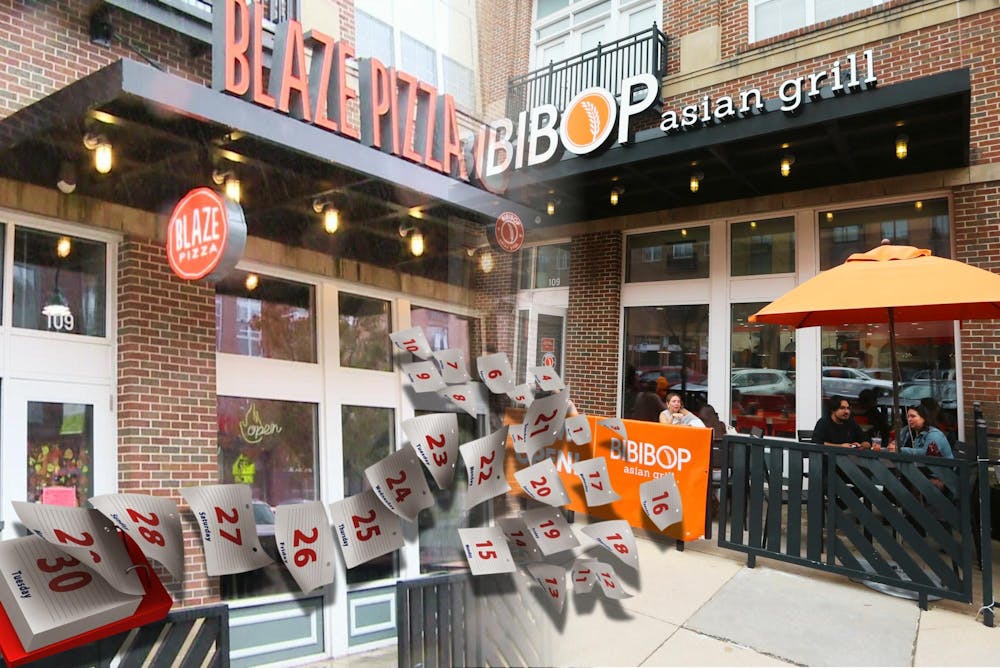
Before I ever set foot on campus, Eddy Street Commons had already made an impression on me. My parents brought me to it during my only campus visit — the Navy game my freshman year of high school. It seemed kind of picturesque: a walkable strip right off campus with restaurants and shops, clean sidewalks and Touchdown Jesus visible in the background. It looked exactly like what a proper college food scene was supposed to be. I remember thinking: this is where I’ll spend a lot of time with friends I hadn’t even met yet. I was right about that. But I hadn’t realized that the Eddy Street I’d come to love was the culmination of years of change.
Talk to people a few years older than me and the picture they paint of the old Eddy Street is consistent: OG Chipotle before post-pandemic price jumps, a Five Guys that wouldn’t bankrupt you, Blaze Pizza and McAlister’s. It was a reliable rotation of fast-casual chains that could get you fed in 20 minutes without making a single compelling decision. It was a private-equity-fueled corridor that had the energy of an airport terminal: functional and efficient, meant to move you through it rather than keep you there. For underclassmen who didn’t yet know the town and were still figuring out which dining hall had the better daily rotations, it was exactly what they needed. It had lots of options for everyone’s tastes, and cheap-ish burritos, along with good post-tailgate food.
What they also describe, for many, is the slow unraveling of that version of Eddy Street. The first signals were easy to miss — a storefront goes dark, construction paper covers the windows, a leasing sign appears in the window. McAlister’s closed. Blaze Pizza followed this fall. The Urban Outfitters corner went to plywood. For a stretch of years, walking down Eddy Street felt like watching a surgery in progress: vital organs removed before viable replacements were even ready for the icebox. It painted a picture of decline. The gaps sat long enough to make people wonder what, if anything, was actually coming.
By the time I arrived in the fall of 2025, the answer was becoming clear. JINYA Ramen Bar had just opened that summer — upscale ramen, sushi, artisanal cocktails — the kind of place that assumes you’ll sit for at least an hour, which was kind of a revolutionary change with all of the fast food places there (besides Brothers and O’Rourke’s). I walked into it during my first week without any sense of the novelty it represented. Barrio arrived that fall as well, with craft cocktails, a customizable Chipotle adjacent menu and a nicer semi-fast-casual vibe. BIBIBOP Asian Grill is taking over the old Blaze space — basically another Chipotle clone. CAVA is coming (a better Chipotle). Osteria Amici is moving into the old Urban Outfitters corner. Basically, I showed up just in time to inherit something that older students are still adjusting to.
The shift, as best I can put it, isn’t just in the names on the storefronts. It’s what these places are asking of you as a customer. The restaurants filling Eddy Street now are betting that Notre Dame students want more than proximity and a rewards app. JINYA wants your evening. Barrio wants your repeat business with customization. They’re pitching experiences rather than transactions, which is either a maturation of the street or a gentrification of it, depending on your attachment to the Blaze Pizza and other fast-casuals that used to be there. Nobody I’ve talked to is actually nostalgic for the “old” Eddy Street as a whole, but watching the pieces falling away and filled in with more sit-down restaurants is bittersweet for most. Then again, the old Eddy Street had a different kind of comfort to it: places for everybody’s preferences, at a much lower cost than sit-down joints.
I only know the current Eddy Street. The one with JINYA on the corner and Barrio filling up on Thursday nights and construction signage promising more changes still to come. It’s my baseline — the version of the street I’ll carry in my head as the real one. But our seniors know a much different version, perhaps even a brighter past than our present.
I showed up for the new version. Someone arriving in 2029 will probably say the same thing about whatever comes next. That’s the thing about a place that keeps evolving for the sake of evolution. It becomes the street of Theseus — with places chipped away and replaced — and it doesn’t wait for you to finish being nostalgic about it before it disappears.