Phil Lord and Christopher Miller are some of my favorite people working in Hollywood. Their long, diverse careers as a creative duo have given us nothing but bangers: the cult classic “Clone High” TV show, the zany “Cloudy With a Chance of Meatballs,” the hysterical “21 Jump Street” and “22 Jump Street” and the brilliant “The Lego Movie.” Unfortunately, their careers hit a speed bump when Disney fired them from directing “Solo: A Star Wars Story” midway through filming in 2017. I can’t imagine how scarring that experience must have been for the two, and they’ve mostly focused on behind-the-scenes production and writing since then. However, the duo finally returned to the director’s chair(s) with “Project Hail Mary,” released this past weekend, and thank God they’re back: The film sees their trademark wit and warmth infused into a delightful sci-fi adventure through the cosmos.
“Project Hail Mary” is an adaptation of the very popular book by Andy Weir, whose other novel, “The Martian,” also received a big-screen translation. The film’s core premise has shades of “Interstellar”: Earth faces an extinction-level event, forcing biologist Ryland Grace to embark on a daring space adventure to save it. But “Project Hail Mary” could not be further tonally from that film. Whereas Christopher Nolan’s space adventure was solemn and grave, “Project Hail Mary” is upbeat and spirited. That’s not to say the stakes aren’t high in the film: The main threat of sun-eating microbes — dubbed astrophage — causing a permanent ice age is scarily plausible due to the film’s clever use of real science. But it never indulges in doom and gloom, and that’s partly due to the infectious performance at the center of the film from Ryan Gosling.
Gosling plays Grace, one of the scientists selected to board the Hail Mary spaceship, investigate a far-off star inexplicably immune to the astrophage and hopefully discover a solution to our sun’s decay. Unfortunately, when he reaches the star and wakes up from his induced coma, he discovers all his crewmates died during the journey, leaving the fate of humanity solely on his shoulders. Lord and Miller expertly handle this setup, embracing both the sadness and the comedic absurdity of a scientist all alone in space and tasked with the impossible. The Hail Mary feels tactile and intimate, and watching Gosling bumble around the ship as he tries to make sense of his crazy circumstance is highly amusing to watch. Gosling finds the perfect balance between self-effacing and intelligent with Grace: He’s competent, but he’s also super goofy and sweet, making him a very easy protagonist to root for. However, the film really takes off once Grace meets an extraterrestrial being who was also sent from his dying home planet to investigate the immune star.
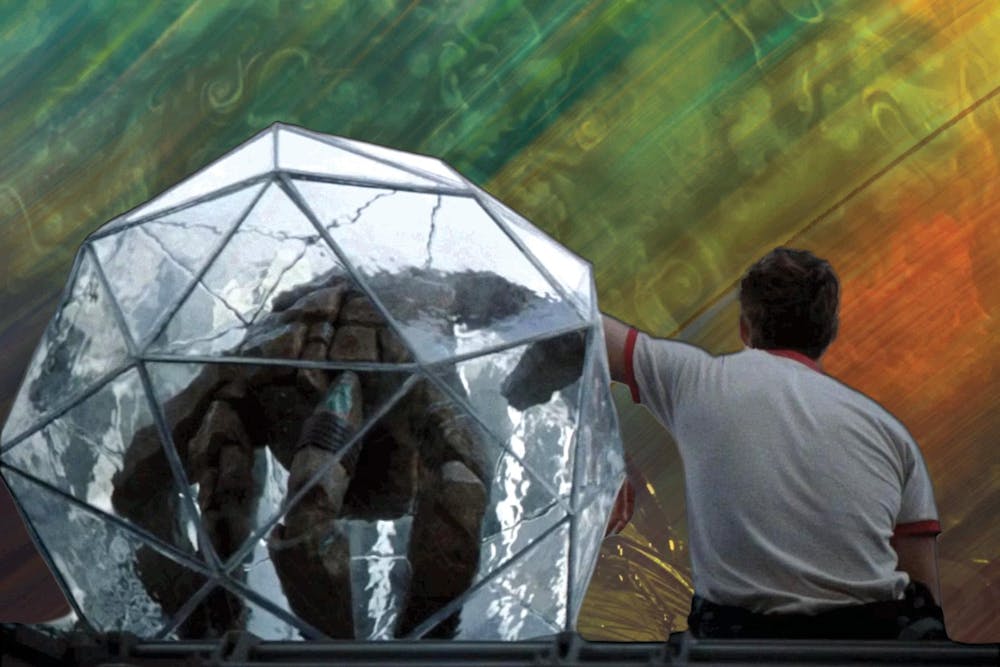
Grace’s discovery of the alien effectively lands as an otherworldly moment. The inspired design of his spaceship and gadgets makes it really feel like an encounter with a completely foreign mode of civilization. Grace eventually finds himself face to face with the alien, a rock-like creature who interfaces through echolocation; Grace ingeniously names him Rocky. Across linguistic and physiological barriers, the two strike up a friendship and work together to solve the astrophage crisis.
This unlikely friendship is the beating heart of the film, transforming it into a buddy comedy reminiscent of the “Jump Street” films. Gosling’s charisma is so powerful that he manages to have chemistry with a literal rock, but Rocky is also very charming in his own right, with his child-like exuberance and amusingly stilted English. He is also brought to life through intricate puppetry rather than CGI, making him feel all the more real. Grace and Rocky have lots of silly moments, but they also share a mutual sadness about their loneliness and the pressure to save their respective species. Their friendship is so effortlessly fun that it almost feels like the movie is cheating, but that’s just the Lord and Miller’s magic! The film is at its best when embracing this sentimental strength. Its attempts at spellbinding visuals of the cosmos and tense action were not as compelling to me, despite the legendary Greig Fraser handling cinematography.
As Grace’s space hijinks unfold, the film flashes back to the lead-up to the Hail Mary space launch. We see how Grace, a middle school science teacher, was recruited by a top government official to help address the astrophage crisis. While this non-linear narrative structure largely exists to explain the shocking twist of how Grace ended up on the ship, there are still many highlights along the way, including Gosling’s rapport with Lionel Boyce and Sandra Hüller’s surprisingly raw karaoke performance of “Sign of the Times.”
As Rocky and Grace concoct a perilous mission to solve the astrophage mystery, we see their friendship pushed to the test. But amid the film’s many heart-tugging moments, it maintains an indefatigable optimism. “Project Hail Mary” offers a very refreshing outlook for a modern film, affirming the goodness of humanity, the ability of human ingenuity to solve any crisis, the cosmos as a source of wonder rather than horror and humanity’s role as steward of all creation. And that’s the true source of the film’s greatness. Lord and Miller can take us on a grand adventure through the cosmos, fraught with danger and difficulty, yet still make it an all-around upbeat and exciting experience.
It’s hard not to fall for “Project Hail Mary,” with its clever science fiction and Gosling turning up the charm to 11. The film has also crushed all expectations at the box office with a remarkable $80.5 million opening weekend in North America. Let’s hope Hollywood treats this as a sign that moviegoers will show up for high-quality films that explore new worlds and trust artists to cook on a large scale.