
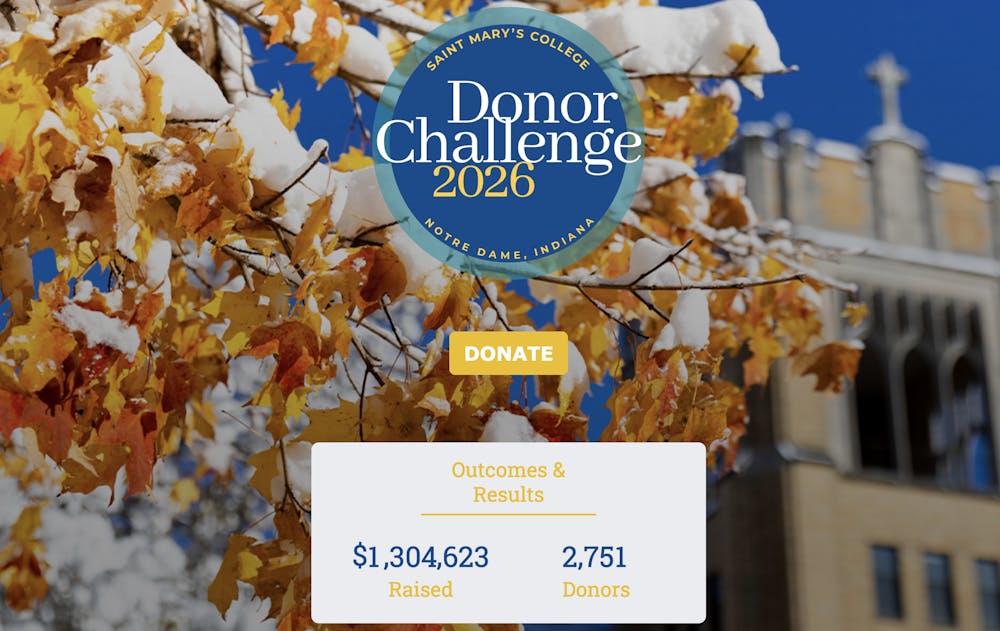
This year’s annual Donor Challenge at Saint Mary’s raised $1.3 million for the Saint Mary’s Fund.
This money is used to support many different aspects of campus life. Donors could allot funds to specific categories of support, such as “Scholarships and Financial Aid,” “Learning and Technology” and “Campus Renewal and Preservation,” among others. Participants in the challenge could also opt to send their money toward the College’s areas of greatest need.
Senior Emma Klockenkemper is one of this year’s class gift campaign co-chairs for the Donor Challenge.
“Donor day is really about gratitude and legacy. It’s about recognizing those who came before us and choosing to pay it forward,” Klockenkemper wrote in a statement to The Observer. “When we participate, we’re not just donating, we’re strengthening traditions, supporting future Belles and showing what this community stands for.”
This year’s Donor Challenge saw increased participation compared with past years, according to director of annual giving and stewardship Danielle Haydell Mason. Over the course of February, Saint Mary’s raised the $1.3 million with the support of 2,751 donors, including students, parents, alumnae and their families as well as faculty and staff. Donors from almost every state contributed.
“While the total dollar amount is always exciting to look at, what stood out most was how many students chose to be part of it. That collective support really reflects the pride students have in Saint Mary’s and their desire to give back, even in small ways,” Klockenkemper wrote.
Klockenkemper and her co-chair, senior Eleanor Henzel, focused on increasing participation among students and garnering excitement for the Donor Challenge at Saint Mary’s. This was done by working with a variety of student organizations on campus and through an increased use of social media, Klockenkemper explained. The pair wanted to share the message that a donation mattered to students and any participation would count.
“One thing we did differently was emphasize storytelling and impact more, helping students understand exactly where their donation goes and why it matters. We really tried to make it feel less like ‘just fundraising’ and more like a collective moment for our community,” Klockenkemper wrote.
This year, the Donor Challenge was extended to last throughout February rather solely on one day. The month culminated in the Donor Challenge Day on Feb. 26, with donation tables set in Noble Family Dining Hall. A live stream from the dining hall featured students and faculty, including Saint Mary’s College President Katie Conboy.
Haydell Mason said this extension allowed donation ambassadors to invite more people to participate and made the process more convenient for participants to donate when it worked for them.
“So people could be busy with work or they could be traveling and it might not always be a day that they can get to a computer or get to a phone and make a gift. So [the change] allows us to give more flexibility to our donors to be able to support the day in this way,” she said.
The Donor Challenge also featured the opportunity to donate money to specific sports teams, such as Belles soccer or basketball, in an event called Clinch the Cup. Haydell Mason said the team with the highest participation would win. Donors could also “adopt a squirrel” with a gift of $25, choosing a name for a campus squirrel and receiving a photo in their inbox.
Participation was ranked in leaderboards for donors toward the challenge. Participation, rather than dollar amounts, was tallied to restate the intention of building community at the core of the Donor Challenge, Klockenkemper said.
“A gift of two dollars counts just as much toward participation as a larger donation, which makes it accessible for everyone. When participation is the focus, it shifts the mindset from ‘How much can I give?’ to ‘How can I show up?‘” she wrote. “That creates a culture where everyone feels included, and it actually motivates more people to give because they know their contribution matters equally. High participation also sends a powerful message to outside donors and alumnae that students are invested in their own community.”


