
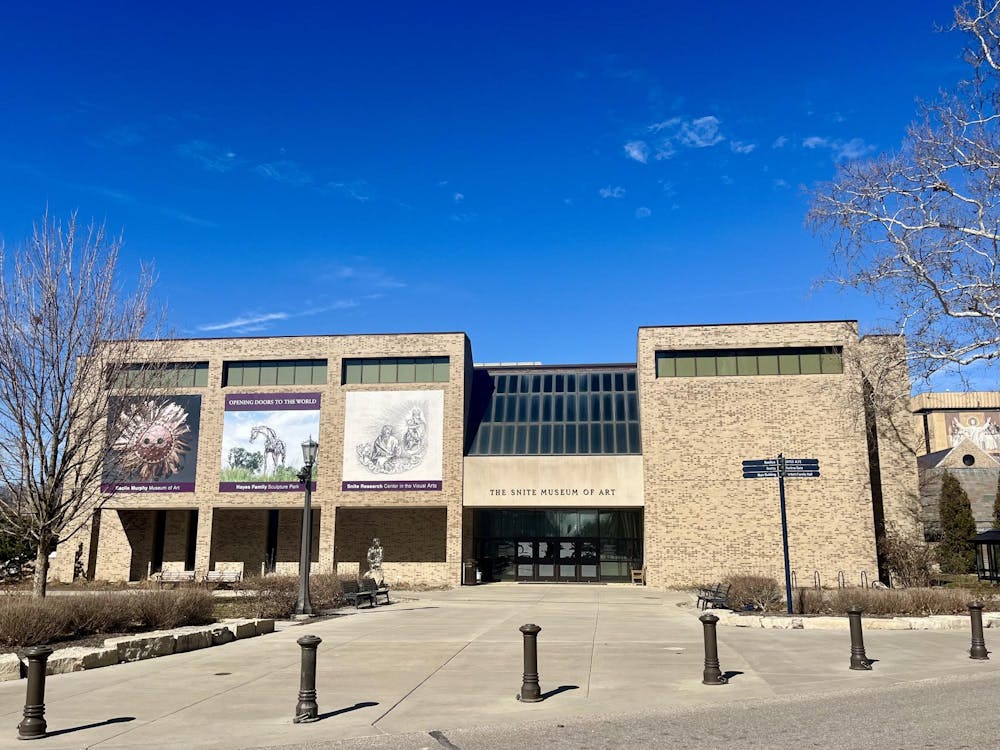
Students at the University of Notre Dame entering O’Shaughnessy Hall might wonder what is occurring in the building next door — formerly the Snite Museum of Art. The building has been closed to the public since spring 2023, when it transitioned to a new role and name as the Snite Research Center in the Visual Arts.
However, the building remains a bustling space for some behind-the-scenes work for the Raclin Murphy Museum of Art. Now, the majority of students who have not yet explored the research center will have the opportunity to see the building next fall, when it will open for public hours and classroom use.
The former Snite Museum of Art opened in November 1980 after four years of construction thanks to a $2 million gift from Fredrick Snite Sr. During the museum’s time, it held the University’s growing art collections and was home to the former Meštrović Sculpture Studio, where renowned Croatian artist-in-residence Ivan Meštrović worked from 1955 to 1962, as well as the existing O’Shaughnessy Art Gallery.
The museum closed to the public in spring 2023 to prepare for the opening of the Raclin Murphy Museum that same fall, transitioning to a new name — the Snite Research Center in the Visual Arts.
Joseph Becherer, director and curator of the Raclin Murphy Museum of Art, said the building was “designed to be very forward-facing.”
“It puts us right at the entrance to campus, so that we can be here for everybody on campus but also everybody who wants to visit campus,” he said.
The Snite Research Center in the Visual Arts supports this forward-facing element behind the scenes as well.
“Right now, more than half of the staff still works there,” Becherer said. “There is about 85% of the permanent collection which is in some level of research or storage, which is there. And our photography studios are there and almost all of our files.”
He explained that though it might seem a bit deserted to students in the meanwhile, there is a lot of work happening on the backend.
“Even if it doesn’t look like there’s a lot of activity, trust me, there’s a lot of activity happening within,” he said.
According to Becherer, around 1000 works of art are on display at Raclin Murphy at any given time. Curators rotate out these artworks for classes as well as the needs of faculty, scholars and curators.
“There’s a lot of things going back-and-forth between the two facilities and even though it's only 40 some yards between the Snite and the Raclin Murphy, we have to take really good care anytime we transport things from point A to point B,” he said.
Snite’s new name emphasizes its new role and purpose as a research center. Research at Snite is done by semester-based teams of student workers, post-docs, curators and visiting scholars. Some of its projects include digitizing the University’s entire collection at its photography studio and broad conservation work.
Junior Juan Becdach frequently attends classes in the adjacent O’Shaughnessy Hall for his philosophy major and is curious to see the Snite’s interior.
“Pretty much since my freshman year, I’ve been wondering about what they house in there, so I’d definitely be inclined to tour it if given the chance,” he said.
Now, students can look forward to using parts of the Snite during its new public hours which will begin on weekdays starting fall 2026. The area will connect the south-facing front doors of Snite to the courtyard of O’Shaughnessy Hall.
In collaboration with the Office of the Registrar, the auditorium located on the lower level of Snite will also be used for academic purposes next fall, acting as a lecture hall with roughly 248 seats.
The upper levels of Snite will remain what Becherer calls “the worker-bee part of the art museum,” housing files, collections and offices, including Becherer’s own office.


