Once every week, Notre Dame students go to prison. They haven’t committed any crime; rather, they are there to learn alongside men incarcerated in the Westville Correctional Facility.
Professor Connie Mick teaches a class called “Poverty & Justice: Inside-Out.” The three-credit-hour class meets once a week, but Notre Dame students — the “outside students” — attend class at the prison 12 times throughout the semester. There they learn alongside incarcerated men — the “inside students.”
In the 2025 rendition of the course, corrections officers were also included in the dialogue.
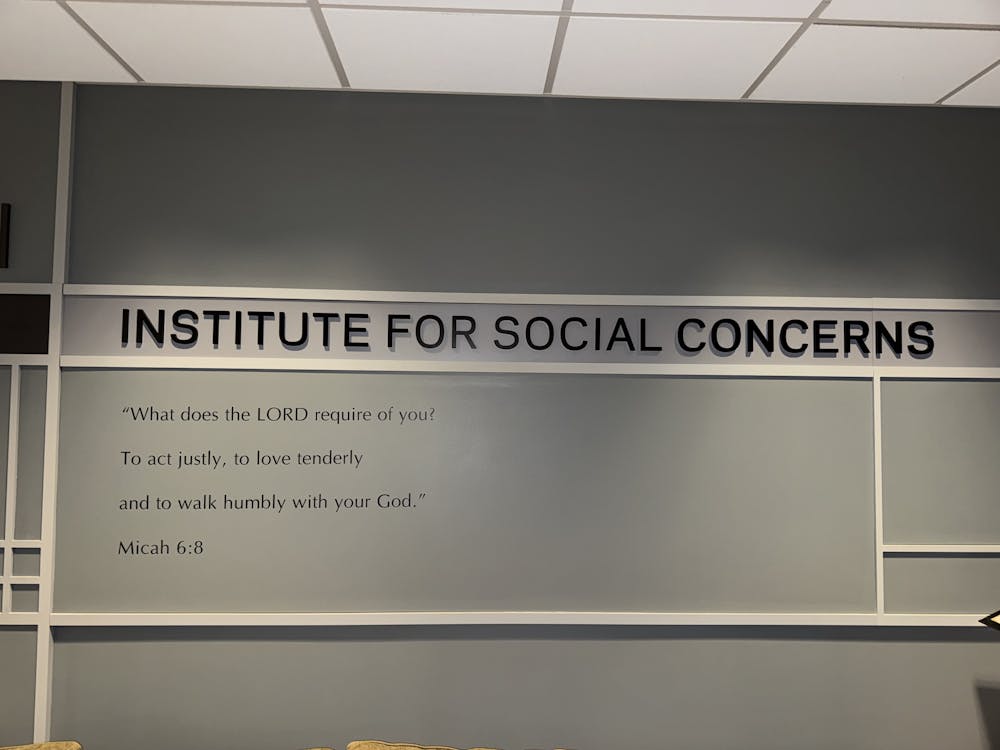
The class was first offered in 2012 by the Center for Social Concerns, now known as the Institute for Social Concerns. Mick, teaching the inside-out class for her third consecutive spring, reported that demand is high for seats both inside and out. Every semester, students apply to be one of 12 participants, with 12 corresponding classmates coming from Westville.
Holding class in prison comes with its fair share of logistical difficulties. Outside students go through standard security protocol before each class, adhering to a long list of rules about permitted clothing and items. No technology is allowed inside of the prison, meaning all papers are handwritten. With Westville a 50-minute drive from campus, students dedicate several hours each Friday to attend class.
Mick wants her students to leave with a clearer understanding of the production of poverty and the perpetuation of poverty in the United States. She also hopes that her students will gain a greater understanding of the connection between poverty and justice. Lastly, she wishes to provide her students with a sense of hope and confidence that they have the ability to effect change.
Each class starts with a meditation to “transition into the experience together,” Mick wrote in a statement to The Observer. Given the security constraints, the class covers fewer texts, meaning students delve deeper into the materials provided. Mick also describes the writing process as “more deliberate,” given everything is written by hand.
While the secure environment can initially make the classroom environment tense, Mick wrote that the level of conversation in class is often “deeper and higher than what happens on campus.”
“Every student in that room is grateful to be there and they show up fully prepared to participate every week,” she wrote. “It’s a privilege for all of us and it shows in the quality of thinking we achieve together.”
Inside and outside students sit in alternate seats to promote shared dialogue, with classes almost entirely discussion-based. Mick wrote that this experience had “an impact on my ability to see the full humanity of people and to appreciate the gifts people develop and share even in difficult places.”
Junior Alayna Lawley chose to apply to the course because of her interest in poverty, inequality and the justice system.
“I think it’s important because it breaks down distance. It’s easy to talk about ‘the prison system’ or ‘incarcerated people’ in broad terms. It’s much harder, and much more meaningful, to sit in a classroom together and wrestle with the same readings,” Lawley wrote in a statement.
She went on to write that getting to know her incarcerated classmates while taking this class changed her views of the prison system.
“Through our conversations, they have opened up about the struggles they face in prison, struggles I had never even considered before. They’ve shared how difficult it is to maintain relationships with family, how limited access to resources affects their mental health, and how small daily restrictions can slowly wear on a person’s sense of identity and dignity,” Lawley wrote.
She said Notre Dame students and faculty should know that this class is not about charity or “saving anyone” but rather mutual learning.
Senior William Pater wrote that the class taught him to treat people as experts in their own lives.
“One moment that has stayed with me: our professor asked whether, if they could go back in time, people would undo the choices that led them here. Many said no — not because they minimized harm, but because they believed they wouldn’t be who they are now without that history,” Pater wrote.
“It was a startling answer, and it made me think about how we talk about ‘mistakes,’ growth, and redemption. It reminded me that people are more than the worst thing they’ve ever done — and that a system claiming to be about justice should make room for transformation, not just punishment,” he wrote.
Editor’s note: A previous version of this story incorrectly stated that corrections officers are participating in the course this year. They are not; they participated in 2025.